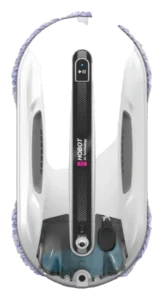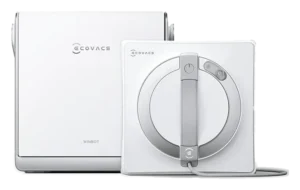
Ecovacs Winbot W2 Pro Omni · Hobot R3
All robot window cleaners. Every measure below is plotted against the full class, so a difference can be read against how much the class itself varies.
- Ecovacs Winbot W2 Pro Omni
- Hobot R3
What each one does on its own.
The Autonomy Ladder is the same five rungs for every robot on the site. A rung describes the conditions a robot handles without you, not how good it is.
Where they actually differ.
The Robovations Score is nine inputs across three pillars, each weighted as shown and each scored so that more is better. A robot can lead on one and trail on another, which is the point of showing them apart. Cost of ownership and data handling are reported on each robot's own page and are never averaged into the score.
Capability
- Ecovacs Winbot W2 Pro Omni78
- Hobot R368
- Ecovacs Winbot W2 Pro Omni78
- Hobot R370
- Ecovacs Winbot W2 Pro Omni46
- Hobot R345
- Ecovacs Winbot W2 Pro Omni70
- Hobot R360
Dependability
- Ecovacs Winbot W2 Pro Omni80
- Hobot R356
- Ecovacs Winbot W2 Pro Omni81
- Hobot R365
- Ecovacs Winbot W2 Pro Omni67
- Hobot R352
Ownership burden
- Ecovacs Winbot W2 Pro Omni38
- Hobot R324
- Ecovacs Winbot W2 Pro Omni89
- Hobot R357
How far apart is a long way?
A number only means something next to the spread it sits in. Each track below is the real range across every classified robot in the class, with the median marked.
- Ecovacs Winbot W2 Pro Omni$700
- Hobot R3$400
- Ecovacs Winbot W2 Pro Omni5,500 Pa
- Hobot R33,000 Pa
- Ecovacs Winbot W2 Pro Omni63 dB
- Hobot R366 dB
- Ecovacs Winbot W2 Pro Omni3.5 lbs
- Hobot R32.1 lbs
- Ecovacs Winbot W2 Pro Omni3 in
- Hobot R33.7 in
Not compared, because fewer than two of these robots carry a published figure: Runtime, Charge time.
What the numbers leave out.
The trade-off
What each design gives up to be good at what it is good at.
Remote control repositioning between windows negates autonomous room-to-room sequencing. The robot maps each window; the operator initiates each zone via app or remote, disqualifying full-autonomy workflows.
Dual rotating pads improve corner coverage but complicate maintenance: two separate pad holders, motor couplings, and rotation mechanisms add weekly inspection points compared to single-pad competitors.
Who each one is wrong for
Stated by the record itself. A robot being wrong for a household is a fact about fit, not a fault.
- Single-story homes where every pane is reachable from the ground
- The battery station, the cordless design and the rope setup exist to reach glass that is awkward to reach. Where a cloth and a step stool cover the whole house, most of what this machine costs goes unused.
- Non-standard or specialty frames (curved, skylights, sunrooms)
- WIN-SLAM 4.0 optimized for planar rectangular window geometry. Curved glass, skylights at angles, and conservatory domed ceilings exceed edge-detection sensor assumptions; manual repositioning for each orientation required.
- Operators unable to position battery station indoors near windows
- The portable station needs an indoor outlet within reach of the window being worked. Homes with limited interior access or deep setbacks will need the station moved from room to room during a session.
- Windows with no mains socket within about 4 meters
- The cord is 4 meters and the robot draws mains power for the whole run, so the reachable set is the windows around one socket. HOBOT's own 2S and S6 Pro ship 5 meter cords.
- Owners who want cordless operation
- The wired design is not optional. The cell the R3 carries is an embedded UPS that keeps it in position on the glass with an alarm for 20 minutes after a power cut; it is a fall-protection measure, not a duty-cycle battery, and the robot does not clean without the cord.
- Frameless or curved tempered glass surfaces
- Vacuum edge detection struggles with reflections and lack of visual boundaries. Optical sensors cause frequent incorrect repositioning; manual path planning becomes tedious.
What stays your job
The upkeep ownership hands back to you, whatever the autonomy level says.
- Before every run: Confirm the safety rope is anchored to a fixed object; check the rope for twists, knots, cuts or fraying at the anchor point.
- After every use: Rinse microfiber pads with fresh water and air dry; inspect the suction intake for lint.
- Monthly: Test edge-sensor calibration on the first window of a session.
- Every 3-6 months: Replace the microfiber pad set (~$25-35 per pair).
- Annually: Deep-clean the battery station contacts with a dry cloth; inspect the dock charging pins for corrosion.
- Weekly: Rinse both pads under tap water; test pad rotation manually to ensure smooth motion; inspect nozzle spray pattern.
- Monthly: Clean vacuum intake and motor filter; check pad-rotation bearings for smooth spin; soak nozzle in distilled vinegar if spray weakens.
- Every 3-4 months: Replace cleaning pads (~$25-30 per pair); inspect power cable for insulation damage or fraying.
- Every 6 months: Lubricate pad-rotation bearings with light machine oil (~$0, 5 min maintenance); test rotation force to detect bearing wear.
- Annually: Replace motor intake filter (~$15); deep-clean nozzle assembly and pad-holder fasteners.
How much each of these is standing on.
Classifications rest on different depths of evidence. A pre-release assessment and a verified one are not the same kind of claim.
| Robot | Evidence status | Sources reviewed | Last assessed |
|---|---|---|---|
| Ecovacs Winbot W2 Pro Omni | Verified | 8 | Aug 2026 |
| Hobot R3 | Pending | 1 | Aug 2026 |
Add a robot
Comparing across classes is allowed — the page will switch to per-class positioning and tell you it has.