Skip to content
Saved
Comparison · 2 robots

Dyson R1 Nurovi Dry · Ecovacs Deebot T50 Pro Omni

All robot vacuums. Every measure below is plotted against the full class, so a difference can be read against how much the class itself varies.

  1. Dyson R1 Nurovi Dry
  2. Ecovacs Deebot T50 Pro Omni
Dyson

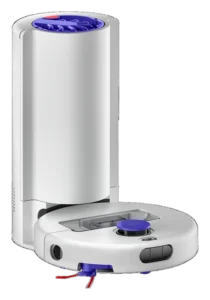
Dyson R1 Nurovi Dry

Autonomy
IIIConditional Autonomy
Score
84/100 Pre-Order Ready
Readiness
Not assessed
Price
$549list

Up to three

01 Classification

What each one does on its own.

The Autonomy Ladder is the same five rungs for every robot on the site. A rung describes the conditions a robot handles without you, not how good it is.

V
Generalized
Any task, any setting
IV
Environmental
Handles new obstacles without help
III
Conditional
Finishes familiar jobs on its own
Dyson R1 Nurovi DryEcovacs Deebot T50 Pro Omni
II
Assisted
Runs preset routines, needs rescue
I
Manual
One action, on command
02 Assessment

Where they actually differ.

The Robovations Score is nine inputs across three pillars, each weighted as shown and each scored so that more is better. A robot can lead on one and trail on another, which is the point of showing them apart. Cost of ownership and data handling are reported on each robot's own page and are never averaged into the score.

Capability

Task completion16% of score
Does it finish the job it is sold to do, unattended
  • Ecovacs Deebot T50 Pro Omni85
18median 72 across 428 scored robots100

Not scored: Dyson R1 Nurovi Dry

Coverage and navigation10% of score
Does it work the whole area, and hold that between runs
  • Ecovacs Deebot T50 Pro Omni88
0median 70 across 416 scored robots100

Not scored: Dyson R1 Nurovi Dry

Edge-case recovery10% of score
Does it recover from the failures its category presents
  • Ecovacs Deebot T50 Pro Omni53
18median 52 across 317 scored robots100

Not scored: Dyson R1 Nurovi Dry

Operating envelope4% of score
How far conditions can vary before performance drops
  • Ecovacs Deebot T50 Pro Omni75
28median 68 across 392 scored robots100

Not scored: Dyson R1 Nurovi Dry

Dependability

Field failure rate16% of score
Documented hardware failures per owner-year
  • Ecovacs Deebot T50 Pro Omni70
6median 70 across 355 scored robots100

Not scored: Dyson R1 Nurovi Dry

Software stability14% of score
Whether updates fix more than they break
  • Ecovacs Deebot T50 Pro Omni65
15median 65 across 339 scored robots100

Not scored: Dyson R1 Nurovi Dry

Support longevity10% of score
Committed parts, service and updates, with dates
  • Ecovacs Deebot T50 Pro Omni63
0median 62 across 424 scored robots100

Not scored: Dyson R1 Nurovi Dry

Ownership burden

Routine maintenance12% of score
Hands-on time it asks for in normal operation
  • Ecovacs Deebot T50 Pro Omni100
22median 67 across 429 scored robots100

Not scored: Dyson R1 Nurovi Dry

Consumables8% of score
Parts that must be bought to keep it working
  • Ecovacs Deebot T50 Pro Omni61
8median 69 across 429 scored robots100

Not scored: Dyson R1 Nurovi Dry

03 Measured against the class

How far apart is a long way?

A number only means something next to the spread it sits in. Each track below is the real range across every classified robot in the class, with the median marked.

Price214 with a published figure
  • Dyson R1 Nurovi Dry$549
  • Ecovacs Deebot T50 Pro Omni$399.99
$160median $799.99$2,599
Suction (mode not stated)207 with a published figure
  • Dyson R1 Nurovi Dry21,000 Pa
  • Ecovacs Deebot T50 Pro Omni15,000 Pa
1,000 Pamedian 10,000 Pa42,000 Pa
Runtime186 with a published figure
  • Dyson R1 Nurovi Dry120 min
  • Ecovacs Deebot T50 Pro Omni215 min
60 minmedian 180 min360 min
Charge time165 with a published figure
  • Dyson R1 Nurovi Dry390 min
  • Ecovacs Deebot T50 Pro Omni222 min
90 minmedian 240 min420 min
Weight181 with a published figure
  • Dyson R1 Nurovi Dry7.5 lbs
  • Ecovacs Deebot T50 Pro Omni8.2 lbs
3.6 lbsmedian 8.5 lbs25 lbs
Height223 with a published figure
  • Dyson R1 Nurovi Dry3.8 in
  • Ecovacs Deebot T50 Pro Omni3.2 in
2.6 inmedian 3.8 in7.8 in

Not compared, because fewer than two of these robots carry a published figure: Noise.

04 Ownership

What the numbers leave out.

The trade-off

What each design gives up to be good at what it is good at.

Dyson R1 Nurovi Dry

At $549 the R1 keeps the R2’s navigation and the same 21,000 Pa suction on the same 352 mm chassis. What the lower price removes is wet cleaning, not sensing: the R2 costs more for mop hardware and a washing dock, and both robots map the same way.

Ecovacs Deebot T50 Pro Omni

The 81 mm body trades onboard capacity for clearance: the robot carries 55 ml of water, so a long mopping run is broken up by returns to the station, which holds 4 L clean and 4 L dirty.

The station’s dry cycle runs two to four hours at 45C after a mopping run, so the dock is still working well after the robot has finished and parked.

Who each one is wrong for

Stated by the record itself. A robot being wrong for a household is a fact about fit, not a fault.

Dyson R1 Nurovi Dry
Anyone needing mopping in the same device
The R1 has no mop hardware at all. Buyers wanting wet cleaning need the R2 Wash+Dry or the R3 Spot+Scrub UV instead.
US buyers wanting to purchase immediately
No confirmed US ship date or retailer listing existed at launch; UK availability began same-day but the US window trails into later September.
Buyers who want independent verification first
No independent reviews, owner reports, or teardowns exist yet; every published figure so far traces back to Dyson's own launch materials.
Buyers comparing on published battery or sound figures
Dyson publishes run time and charge time but no battery capacity, no sound rating, and no onboard bin volume for the R1. Anyone shopping on those numbers has nothing to compare.
Ecovacs Deebot T50 Pro Omni
Homes without a permanent spot for the station
The Omni station carries 4 L of clean water, 4 L of dirty water and a 3 L dust bag, and needs a fixed position against a wall near an outlet. Where that space does not exist, most of what this model is sold on cannot be used.
Homes with high-pile surfaces as primary flooring
Suction is 15,000 Pa and Ecovacs' documentation for the machine centers on hard floors and edge work. Pickup on pile is a function of suction, brush agitation and floor contact, none of which a filter change or a firmware update alters.

What stays your job

The upkeep ownership hands back to you, whatever the autonomy level says.

Dyson R1 Nurovi Dry
  • Every 90 days: Empty the dock’s 2.6 L bin; the dock is bagless and empties the robot after each run.
  • Monthly: Clean the Twin-capture debris separator to maintain suction.
  • Monthly: Wipe down and inspect the extending side sweeper for hair wrap.
  • Every 3-6 months: Clean or replace the robot and dock filters; Dyson has not published an interval.
  • As needed: Clear the anti-tangle brush bar of tangled hair and debris.
  • Annually: Inspect wheels and sensors for dust buildup.
Ecovacs Deebot T50 Pro Omni
  • After every run: No owner task. The station washes the mop in 70C water, dries it with 45C air over a two to four hour cycle, and empties the dust bin into the bag.
  • Weekly: Refill the station’s 4 L clean water tank, empty the 4 L dirty tank, and top up cleaning solution when the app prompts.
  • Monthly: Wipe the station tray and check the main brush, side brush and mop plate for wound hair.
  • When the app reports it full: Replace the station’s 3 L dust bag.
  • Every 3-6 months: Clean or replace the robot’s filter and replace the mop pad as wear develops.
05 Evidence

How much each of these is standing on.

Classifications rest on different depths of evidence. A pre-release assessment and a verified one are not the same kind of claim.

Evidence behind each classification
Robot Evidence status Sources reviewed Last assessed
Dyson R1 Nurovi Dry Pre-Release 10 Sep 2026
Ecovacs Deebot T50 Pro Omni Provisional 3 Aug 2026

Robovations classifies robots; it does not rank them. Nothing on this page is a recommendation, and no manufacturer influences a classification or its placement here.