
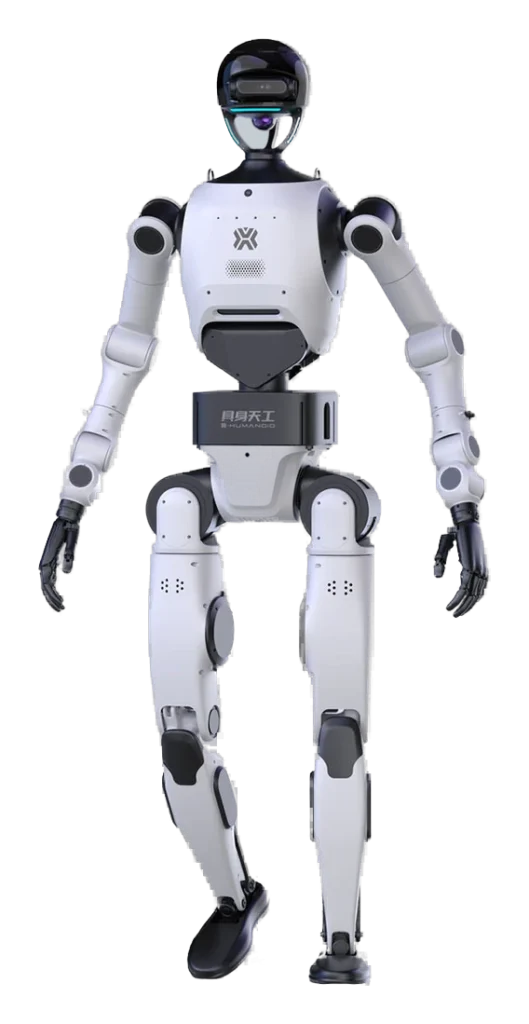
X-Humanoid
X-Humanoid Tiangong 3.0
- Autonomy
- IIIConditional
- Pre-release
- 75/100Promising
- Readiness
- Not assessed
- Price
- Not tracked
X-Humanoid

Boston Dynamics
Up to three
All humanoid robots. Every figure below is placed against the whole class, so a gap can be read against how much the class itself varies.
The conditions each robot was assessed against, side by side. Rows marked in gold are where these machines genuinely differ.
| Condition | Tiangong 3.0 | Boston Dynamics Atlas |
|---|---|---|
| Where it operates | ||
| Home / residential | PoorHome is not a target scenario. X-Humanoid names guided tours and inspection, both commercial. | PoorNot commercially available for home deployment. Research-platform-only access via Boston Dynamics partnership. |
| Office / retailthey differ | GoodThe stated target: a services platform exists for tour-guide and inspection deployments, and the machine was demonstrated navigating a public venue. | DependsCan operate in structured commercial spaces with operator supervision and pre-programmed tasks. Requires partnership agreement and dedicated engineering support. |
| Warehouse / factorythey differ | DependsWhole-body fine manipulation is claimed and the joints carry 400 Nm, but no industrial task has been shown end to end. | GoodDesigned for controlled industrial environments. Deployments in mines, power plants, and manufacturing facilities demonstrate primary use case under operator direction. |
| Primary tasks | ||
| Household chores | PoorNo household task demonstrated, and no consumer route to one. | PoorAtlas does not operate autonomously. Consumer home tasks require continuous operator supervision and custom task programming impractical for residential use. |
| Social / carethey differ | DependsCarries multimodal lip-movement detection and large-model voice interaction, and is pitched at guided tours. The interaction quality is undocumented. | PoorPlatform lacks social autonomy; does not recognize humans, respond to conversational cues, or adapt behavior to social contexts independently. |
| Specialized job | GoodOpen low-level interfaces, an open URDF and an open-sourced VLA training framework make this unusually usable as a research base. | GoodDesigned for specialized inspection, research, and manipulation tasks. Operator-directed execution of complex sequences excels in research and structured industrial contexts. |
| Supervision needs | ||
| Fully autonomousthey differ | DependsAutonomous navigation through crowds was demonstrated without human intervention, but only at the manufacturer's own event. | PoorRequires continuous operator supervision for all locomotion and manipulation. Unattended operation not supported or permitted by Boston Dynamics partnership agreements. |
| With oversight | GoodThe mode every published demonstration has actually run in. | GoodPlatform designed for continuous operator supervision. Sensor feedback aids operator control; human remains in command loop for all task execution. |
| Teleoperated | GoodPartner pilots are the delivery model, and the platform ships with deployment, business and data-collection tooling around it. | GoodTeleoperation with operator-directed task sequences is the intended operating model. Wired or short-range control preferred by Boston Dynamics for safety-critical applications. |
| Timeline | ||
| Ready today | PoorNot purchasable. No price, no ship date. | PoorPre-release research platform. Not available for immediate commercial deployment or consumer purchase. Partnership access only. |
| Near-term (1–2 yrs) | DependsA commercial services platform and named scenarios put this closer than most humanoids here. "Closer" is not a date. | DependsRoadmap and timeline to consumer availability unclear. May remain partnership-only platform indefinitely depending on Boston Dynamics commercial strategy. |
| Research phase | GoodAmong the most open humanoid platforms available: full low-level interfaces, open URDF, open-sourced control and VLA frameworks, optional x86 or Nvidia Thor compute. | GoodIdeal for research institutions and academic labs. Platform designed to support fundamental robotics research with full source access and API documentation. |
A robot being poor for a condition is a fact about fit, not a fault. “Depends” means the record names a limit worth reading, not that the answer is unknown.
None of these has shipped, so they are assessed on track record, engineering plausibility and how the demonstrations match the claims.
Never averaged into it. These describe how much the maker has disclosed, not what the machine does.
| Tiangong 3.0 | Boston Dynamics Atlas | |
|---|---|---|
| ReadinessShip-date specificity, pricing transparency, distribution and regulatory status. Published beside the number; never averaged in. | 35/100 | 35/100 |
| DisclosureHow much of the product is disclosed. Higher means fewer fundamental unknowns remain. Published beside the number; never averaged in. | 38/100 | 55/100 |
A number only means something next to the spread it sits in. Each track is the real range across every classified robot in the class, with the median marked.
Not compared, because fewer than two of these robots carry a published figure: Price, Runtime, Charge time, Noise.
Written on each record, and the only thing here every robot on the site carries.
What each design gives up to be good at what it is good at.
An unusually open platform, with published low-level interfaces, an open URDF and open-sourced control and VLA frameworks, is not the same as an available one: everything needed to develop on this machine is published except a way to obtain it.
Electric actuation enables precise control and extended sequences, but requires careful thermal management and ongoing firmware tuning.
Research-grade flexibility permits custom task definition and algorithm development, but demands expert operators and extended integration timelines.
Stated by the record itself. A robot being wrong for a household is a fact about fit, not a fault.
The upkeep ownership hands back to you, whatever the autonomy level says.
Not recorded for this robot.
Classifications rest on different depths of evidence. A pre-release assessment and a verified one are not the same kind of claim.
| Robot | Evidence status | Sources reviewed | Last assessed |
|---|---|---|---|
| X-Humanoid Tiangong 3.0 | Not Consumer-Ready | 3 | Aug 2026 |
| Boston Dynamics Atlas | Not Consumer-Ready | 9 | Sep 2026 |
Evidence status counts the sources behind a classification, not their kind. A high count can be maker documentation and price coverage, so read it as how much was reviewed rather than as independent testing. How we weigh evidence.
 The full recordX-Humanoid Tiangong 3.0Specifications, evidence, the Fit Check in full, and every tracked change.
 The full recordBoston Dynamics AtlasSpecifications, evidence, the Fit Check in full, and every tracked change.
Robovations classifies robots; it does not rank them. Nothing on this page is a recommendation, and no manufacturer influences a classification or its placement here.
Comparing across classes is allowed — the page will switch to per-class positioning and tell you it has.