

Wybot
Wybot S3
- Autonomy
- IIIConditional
- Score
- 70/100Strong
- Readiness
- Ready Now
- Price
- $2,499.99list
Wybot
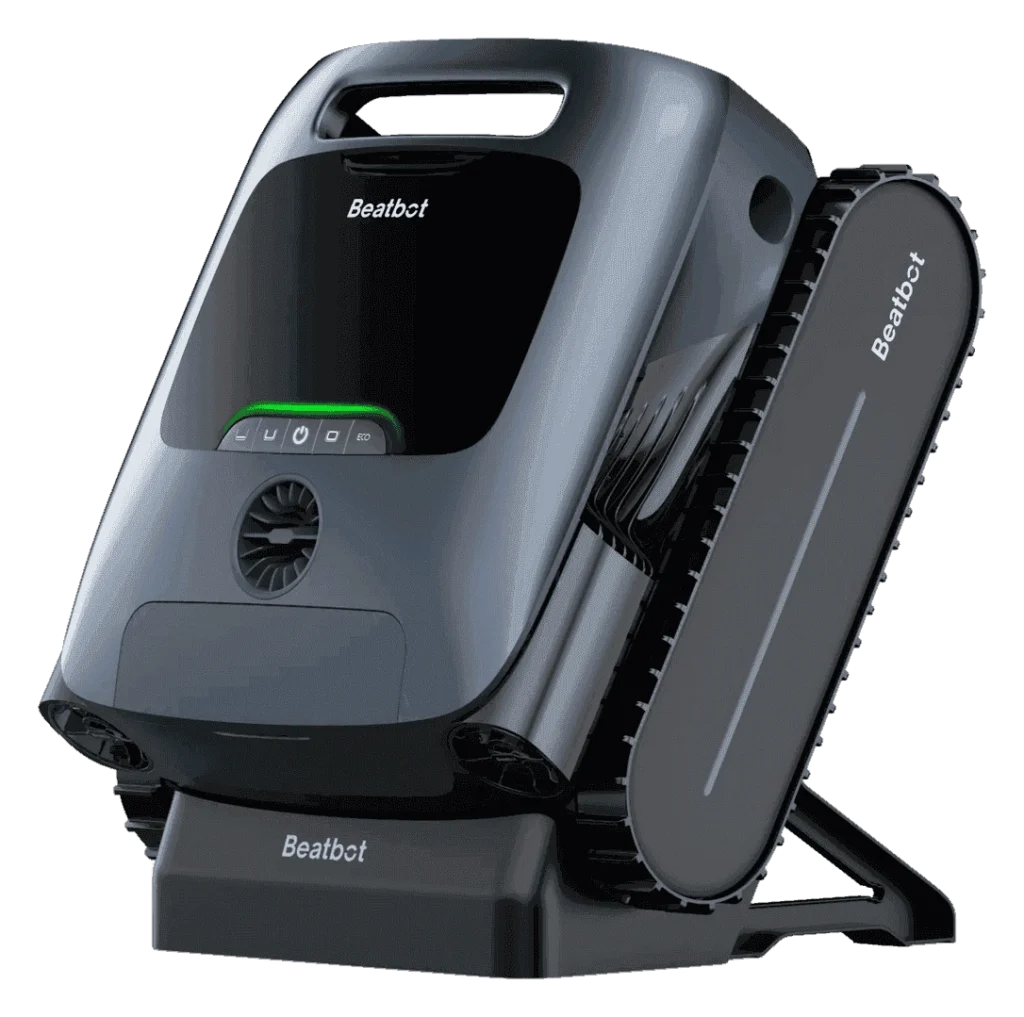
Beatbot
Up to three
All robot pool cleaners. Every figure below is placed against the whole class, so a gap can be read against how much the class itself varies.
The conditions each robot was assessed against, side by side. Rows marked in gold are where these machines genuinely differ.
| Condition | Wybot S3 | Beatbot AquaSense Pro |
|---|---|---|
| Pool type | ||
| In-ground | GoodDesigned for in-ground gunite pools. Dock positioning and waterline reach optimized for standard depth/slope geometry. | GoodDesigned for in-ground installations; smart-mapping calibration optimized for fixed pool geometry. |
| Above-ground | DependsAbove-ground pools under 10,000 gallons risk over-capacity for dock footprint. Shallow models may limit wall coverage; confirm dock fit before purchase. | DependsWorks but optical sensor calibration more sensitive to pool wall material; vinyl above-ground pools require careful mapping setup. |
| Mixed setup | GoodThis robot addresses both pool types. Verify dock placement and cable routing for your setup. | GoodSmart-mapping adapts to both in-ground and above-ground installations when initial calibration accounts for pool material. |
| Pool size | ||
| Small (< 400 sqft) | GoodUnder 5,000 gallons: flagship robot and self-emptying dock exceed small-pool maintenance needs. Overkill for compact pools; mid-range cordless models more economical. | Good90-minute runtime covers small pools under 1500 sqft in single session; ideal use case per owner reports. |
| Medium (400 – 800) | Good5,000–15,000 gallons: ideal range. 90–120 min per charge handles single-pass coverage or multi-session cleaning for heavy debris weeks. | GoodOptimal range for 1500-3000 sqft pools; battery runtime completes full coverage in typical weekly cleaning cycle. |
| Large (> 800)they differ | Good15,000–30,000 gallons: dock automation and cordless freedom shine. Multi-session scheduling manageable; dock self-emptying reduces operator burden. | DependsPools over 3000 sqft require multiple launches per cleaning session; battery depletion mid-cycle limits single-session autonomy. |
| Debris load | ||
| Fine (sand / silt) | GoodSand and fine sediment: dock suction handles routine drainage; filter manageable with dock assist. Confirm filter mesh durability in high-silt environments. | GoodFilter cartridge handles fine particles (sand, pollen) without suction loss in normal maintenance intervals. |
| Leaves / large debristhey differ | GoodLeaf-heavy pools: cordless operation supports frequent short runs without cable hassle. Large debris basket and dock capacity suit seasonal leaf management. | DependsHigh leaf loads reduce battery runtime and increase filter replacement frequency from 2-4 weeks to weekly replacement in autumn. |
| Algae / heavy foulingthey differ | DependsAlgae bloom recovery: robot aids removal, but chemical treatment required first. Dock filter may clog after algae cleanup; manual rinse likely needed. | PoorHeavy algae blooms confuse optical smart-mapping sensors; coverage gaps and sensor recalibration errors documented in owner reports. |
| Coverage you want | ||
| Floor only | GoodFloor coverage only: 3D mapping optimizes floor paths. Waterline and wall features unused; simpler maintenance profile than full-reach model. | GoodSystematic floor coverage is core capability; smart-mapping ensures 100 percent floor contact without missed spots. |
| Floor + walls | GoodFloor and wall cleaning: strong suit. 36-sensor suite maps vertical surfaces; dock placement matters for wall-reach consistency. | GoodWaterline and wall coverage documented in manufacturer specs and owner reports; two-brush design handles vertical surfaces. |
| Floor + walls + waterline | GoodFull waterline reach: designed for this mode. Dock automation minimizes manual waterline supplementation, though mineral buildup may persist in hard-water pools. | GoodFlotation line cleaning included in smart-mapping routine; no separate waterline mode required. |
A robot being poor for a condition is a fact about fit, not a fault. “Depends” means the record names a limit worth reading, not that the answer is unknown.
Nine inputs across three pillars, each weighted as shown and each scored so more is better. A robot can lead on one and trail on another, which is the point of showing them apart.
A number only means something next to the spread it sits in. Each track is the real range across every classified robot in the class, with the median marked.
Not compared, because fewer than two of these robots carry a published figure: Noise.
Written on each record, and the only thing here every robot on the site carries.
What each design gives up to be good at what it is good at.
Cordless, self-docking, and self-emptying comes at flagship price: $2,999 regular, currently discounted to $2,499 on pre-order, places it above mid-range robotic cleaners; the upgrade premium is substantial if dock automation is not the point.
Waterline reach is mapped, not guaranteed: 3D mapping places cleaner at waterline, but scaling and mineral buildup may require supplemental manual brushing on heavy-stain pools.
Published runtime reaches up to 9.5 hours skimming the surface, but floor cleaning is rated to 5 hours: the more demanding mode is the one that sets what a single charge will cover.
Cordless operation removes the cable and its tangling failure mode, but it also removes shore power: coverage per session is bounded by the pack, and the unit is placed in the water by hand at the start of every cycle.
Stated by the record itself. A robot being wrong for a household is a fact about fit, not a fault.
The upkeep ownership hands back to you, whatever the autonomy level says.
Classifications rest on different depths of evidence. A pre-release assessment and a verified one are not the same kind of claim.
| Robot | Evidence status | Sources reviewed | Last assessed |
|---|---|---|---|
| Wybot S3 | Pending | 2 | Aug 2026 |
| Beatbot AquaSense Pro | Discontinued | 4 | Sep 2026 |
Evidence status counts the sources behind a classification, not their kind. A high count can be maker documentation and price coverage, so read it as how much was reviewed rather than as independent testing. How we weigh evidence.
 The full recordWybot S3Specifications, evidence, the Fit Check in full, and every tracked change.
 The full recordBeatbot AquaSense ProSpecifications, evidence, the Fit Check in full, and every tracked change.
Robovations classifies robots; it does not rank them. Nothing on this page is a recommendation, and no manufacturer influences a classification or its placement here.
Comparing across classes is allowed — the page will switch to per-class positioning and tell you it has.