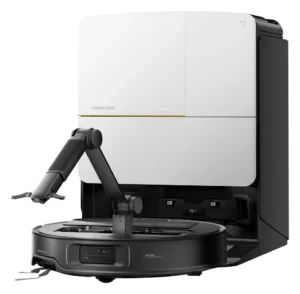
Roborock Saros 10R · Roborock Saros Z70
All robot vacuums. Every measure below is plotted against the full class, so a difference can be read against how much the class itself varies.
- Roborock Saros 10R
- Roborock Saros Z70
What each one does on its own.
The Autonomy Ladder is the same five rungs for every robot on the site. A rung describes the conditions a robot handles without you, not how good it is.
Where they actually differ.
The Robovations Score is nine inputs across three pillars, each weighted as shown and each scored so that more is better. A robot can lead on one and trail on another, which is the point of showing them apart. Cost of ownership and data handling are reported on each robot's own page and are never averaged into the score.
Capability
- Roborock Saros 10R80
- Roborock Saros Z7068
- Roborock Saros 10R75
- Roborock Saros Z7076
- Roborock Saros 10R70
- Roborock Saros Z7048
- Roborock Saros 10R100
- Roborock Saros Z7078
Dependability
- Roborock Saros 10R73
- Roborock Saros Z7073
- Roborock Saros 10R77
- Roborock Saros Z7070
- Roborock Saros 10R73
- Roborock Saros Z7088
Ownership burden
- Roborock Saros 10R100
- Roborock Saros Z7075
- Roborock Saros 10R86
- Roborock Saros Z7071
How far apart is a long way?
A number only means something next to the spread it sits in. Each track below is the real range across every classified robot in the class, with the median marked.
- Roborock Saros 10R$1,599.99
- Roborock Saros Z70$2,599
- Roborock Saros 10R22,000 Pa
- Roborock Saros Z7022,000 Pa
- Roborock Saros 10R180 min
- Roborock Saros Z70180 min
- Roborock Saros 10R150 min
- Roborock Saros Z70150 min
- Roborock Saros 10R55 dB
- Roborock Saros Z7067 dB
- Roborock Saros 10R3.1 in
- Roborock Saros Z703.1 in
Not compared, because fewer than two of these robots carry a published figure: Weight.
What the numbers leave out.
The trade-off
What each design gives up to be good at what it is good at.
You are paying for a Level III robot that does one genuinely new thing: the complete dock cycle (vacuum, 80°C mop wash, forced dry, automatic pad removal) in a single station.
The dock cycle that justifies the price also requires monthly consumable management (detergent, water, pad replacement) that simpler units do not.
The OmniGrip arm adds autonomous item pickup, a real capability, but operates on the robot’s terms: shape and weight constraints mean manual intervention remains necessary for fragile and irregular objects.
The flagship price reflects integrated dock and arm, yet mid-tier Roborock models deliver comparable Level III autonomy for half the cost, making the arm itself a premium component for specific use cases only.
Who each one is wrong for
Stated by the record itself. A robot being wrong for a household is a fact about fit, not a fault.
- Buyers comparing against simpler self-emptying vacuums
- Without mopping requirements, the wash, dry and detergent hardware in the dock adds purchase cost and a consumable stream that a self-emptying-only vacuum does not carry.
- Multi-floor homes expecting the same automation on every level
- The dock is a single-floor installation and maps are stored per floor. Carrying the robot upstairs works, but emptying, washing and drying only happen where the dock is.
- Frequently rearranged apartments
- LiDAR map invalidation on furniture moves requires remapping sessions. Cramped layouts reduce the zone-segmentation value that justifies the premium.
- Those expecting reactive or on-demand spot cleaning
- Scheduled, session-based cleaning is the design model. Reactive spot triggers via app are possible but slower than manual spot cleaning; the dock cycle adds 20–40 minutes per session.
- Minimalist, clutter-free spaces
- The arm's value diminishes without floor scatter. Standard navigation and mopping alone do not justify the $2400+ premium over mid-tier Level III models costing half as much.
- Owners with fragile or oddly-shaped items
- The arm applies fixed gripping force without adaptive sensing. Delicate objects risk damage; manual pre-clearing remains necessary for breakables and irregular shapes.
- Budget-conscious buyers
- Mid-tier Roborock models deliver 90% of navigation autonomy at half the cost. The arm itself accounts for the substantial price premium and complexity burden.
- Very small apartments
- Dock footprint requires 60cm clearance; arm extension adds spatial demand. Compact homes benefit from smaller, less complex models.
- Homes with wall-mounted obstacles or low clearance
- Wall shelves, low-hanging art, or tight corners obscure the arm's reach zone. Pickup attempts fail in confined spaces.
What stays your job
The upkeep ownership hands back to you, whatever the autonomy level says.
- After every use: Review app notification for tank status; empty dock tray if detergent foam overflow occurs.
- Weekly: Clear side brush debris to maintain edge pickup. The DuoDivide dual parallel roller is rated at a 0 percent hair tangling rate, so unwinding hair from the main brush is not the routine task it is on single-roller machines.
- Monthly: Refill the 20 oz detergent reservoir; empty and refill the clean water tank.
- Every 2-3 months: Replace dust bag in dock base (Roborock bags approximately $15 for 3-pack); dock dust storage runs up to 70 days at typical use.
- Every 3-6 months: Replace main brush and side brush set (approximately $20–$30 per set); replace HEPA filter.
- By inspection: Replace mop pads when the fabric is matted or thinning. Roborock publishes no wash-cycle interval for them.
- Annually: Inspect dock pump and seals for mineral buildup; descale hot-water circuit if in high-mineral water area.
- After every use: Empty dock bag if indicator shows capacity near full, typically weekly in normal households.
- Weekly: Visual inspection of arm gripper fingers for debris; compressed air cleanup if hair wrapping detected.
- Monthly: Replace main filter, rinse side brush, check dock connection for dust accumulation.
- Every 3-6 months: Deep clean dock gaskets, test camera clarity with mapping pass, inspect mopping pad for mineral buildup.
- As needed: Manual item extraction if arm encounters stuck or oversized object during cycle.
How much each of these is standing on.
Classifications rest on different depths of evidence. A pre-release assessment and a verified one are not the same kind of claim.
| Robot | Evidence status | Sources reviewed | Last assessed |
|---|---|---|---|
| Roborock Saros 10R | Verified | 8 | Aug 2026 |
| Roborock Saros Z70 | Verified | 9 | Aug 2026 |
Add a robot
Comparing across classes is allowed — the page will switch to per-class positioning and tell you it has.