
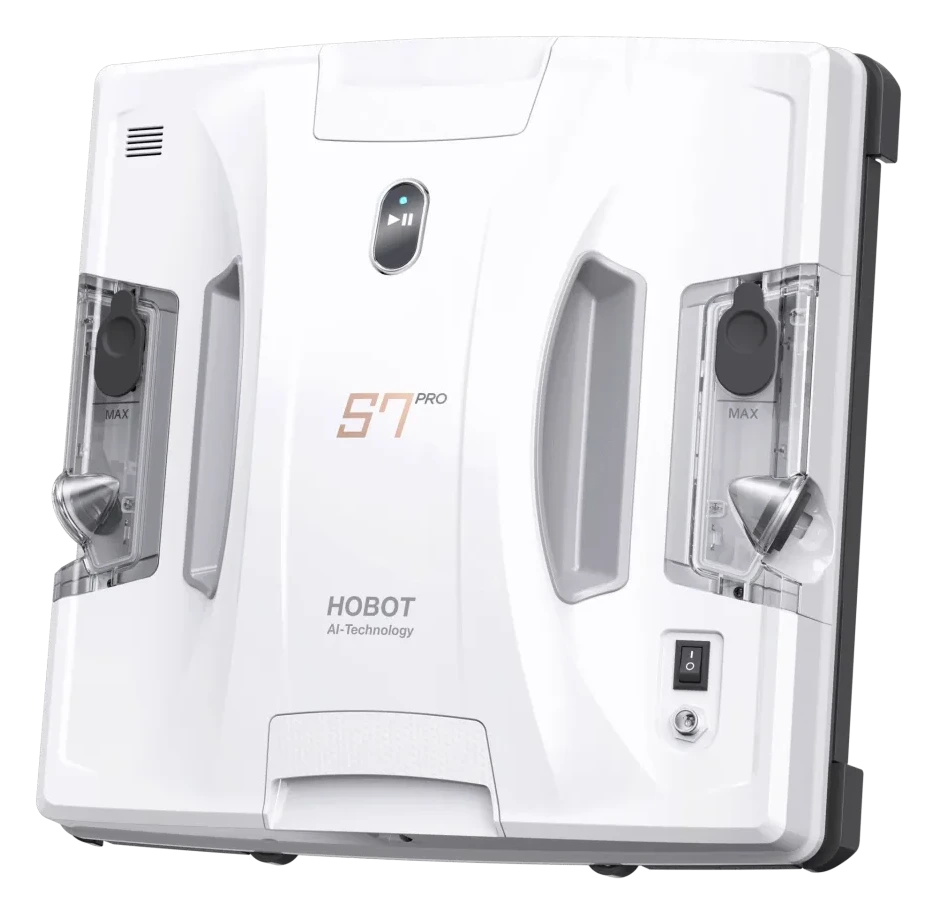
HOBOT
HOBOT S7 Pro
- Autonomy
- IIIConditional
- Score
- 65/100Capable
- Readiness
- Ready Now
- Price
- $460list
HOBOT

Ecovacs
Up to three
All robot window cleaners. Every figure below is placed against the whole class, so a gap can be read against how much the class itself varies.
The conditions each robot was assessed against, side by side. Rows marked in gold are where these machines genuinely differ.
| Condition | HOBOT S7 Pro | Winbot W2S Omni |
|---|---|---|
| Window style | ||
| Standard residential | GoodDesigned for standard horizontal-sliding and framed windows up to 86 inches; edge detection aligns with frame geometry. | GoodSmooth flat standard windows are the documented primary surface; WIN-SLAM covers them systematically in one session. |
| Large panes (8 ft+)they differ | DependsLarger panes work but edge sensor coverage may miss frameless corners; manual repositioning may be needed. | GoodWIN-SLAM path planning and 110-minute cordless runtime cover large flat panes without mid-pane interruption under most conditions. |
| Specialty / textured | PoorSpecialty glass (skylights, curved, skylights) and frameless designs exceed auto-pathing capability and edge-detection scope. | PoorTextured or patterned glass breaks suction adhesion; manufacturer documentation confirms smooth flat glass surfaces only. |
| Frame style | ||
| Frameless / minimalthey differ | PoorEdge detection and auto-pathing depend on frame geometry; frameless windows have no reference edges for navigation. | GoodTruEdge edge detection is documented as compatible with frameless glass, cleaning to within 0.04 in of the edge. |
| Standard mullions | GoodStandard aluminum or vinyl framed windows are the design target; edge sensor performance is predictable and reliable. | GoodStandard framed panes are the reference configuration for the W2S Omni; TruEdge handles aluminum and vinyl frame profiles. |
| Heavy bezels | DependsHeavy frames (steel, wood) are acceptable but may interfere with edge sensor readings near frame edges; test before full sessions. | DependsThick specialty frames reduce accessible pane area at edges; wide-profile frames beyond standard aluminum or vinyl are not documented as tested. |
| Building height | ||
| Single-story | GoodGround-floor and first-story windows suit rope-anchor setup; minimal rope length required and safe operator control. | GoodGround-floor use carries no tether-anchoring complications; full feature set is available without additional rigging. |
| 2 – 3 storiesthey differ | DependsSecond and third stories are feasible with extended rope and secure anchor points; operator must maintain visual contact and rope tension. | GoodLow-rise above-ground use is supported with safety tether anchored to a fixed point; 12-stage anti-drop system provides redundancy. |
| 4+ storiesthey differ | PoorAbove three stories, rope management, anchor reliability, and operator control become impractical; professional equipment required. | DependsHigh-rise use requires a rated safety tether anchor; manufacturer does not certify commercial facade use. Only suitable where a secure anchor point is achievable. |
| Power preference | ||
| Corded OK | GoodCorded tether design is the primary operation mode; 4800Pa suction is consistent throughout the session. | GoodWired mode provides continuous power for uninterrupted high-coverage cleaning with no runtime ceiling. |
| Cordless preferredthey differ | PoorHOBOT S7 Pro is tethered only; no cordless or battery-backup option exists. | GoodCordless mode delivers approximately 110 minutes of runtime, sufficient for most residential window sets in a single session. |
| No preference | GoodIf your setup accepts a tethered robot, the S7 Pro is a solid fit; rope anchor is the only constraint. | GoodW2S Omni supports both modes natively; switch between cordless and wired based on pane location and required session length. |
A robot being poor for a condition is a fact about fit, not a fault. “Depends” means the record names a limit worth reading, not that the answer is unknown.
Nine inputs across three pillars, each weighted as shown and each scored so more is better. A robot can lead on one and trail on another, which is the point of showing them apart.
A number only means something next to the spread it sits in. Each track is the real range across every classified robot in the class, with the median marked.
Not compared, because fewer than two of these robots carry a published figure: Charge time, Noise.
Written on each record, and the only thing here every robot on the site carries.
What each design gives up to be good at what it is good at.
You gain consistent 4800Pa suction but forfeit mobility; the rope tether anchors the robot to one location per setup.
Auto-pathing saves manual repositioning on framed windows, but edge sensors require frequent cleaning to maintain navigation reliability.
Dual power solves the runtime problem: wired mode removes the battery ceiling, but requires a powered outlet within cord reach of every window in the session.
Per-pane repositioning is the constraint this autonomy tier cannot escape. The Level III coverage within a pane is genuine; the manual transfer between panes is equally genuine.
Stated by the record itself. A robot being wrong for a household is a fact about fit, not a fault.
The upkeep ownership hands back to you, whatever the autonomy level says.
Classifications rest on different depths of evidence. A pre-release assessment and a verified one are not the same kind of claim.
| Robot | Evidence status | Sources reviewed | Last assessed |
|---|---|---|---|
| HOBOT S7 Pro | Provisional | 4 | Aug 2026 |
| Ecovacs Winbot W2S Omni | Provisional | 6 | Aug 2026 |
Evidence status counts the sources behind a classification, not their kind. A high count can be maker documentation and price coverage, so read it as how much was reviewed rather than as independent testing. How we weigh evidence.
 The full recordHOBOT S7 ProSpecifications, evidence, the Fit Check in full, and every tracked change.
 The full recordEcovacs Winbot W2S OmniSpecifications, evidence, the Fit Check in full, and every tracked change.
 Written comparisonFrameless and edge-only glass: which window robots actually hold an edge?We have examined this pairing in full, with a stated finding.
Robovations classifies robots; it does not rank them. Nothing on this page is a recommendation, and no manufacturer influences a classification or its placement here.
Comparing across classes is allowed — the page will switch to per-class positioning and tell you it has.