Skip to content
Saved
Comparison · 2 robots

HMND 01 Alpha · NEURA 4NE1 Gen 3

All humanoid robots. Every measure below is plotted against the full class, so a difference can be read against how much the class itself varies.
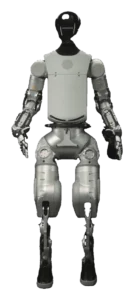
  1. HMND 01 Alpha
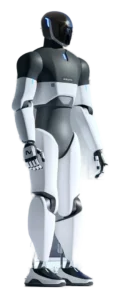
  2. NEURA 4NE1 Gen 3
Humanoid

HMND 01 Alpha

Autonomy
IIIConditional Autonomy
Score
75/100 Promising
Readiness
Not assessed
Price
Not tracked

NEURA Robotics

NEURA 4NE1 Gen 3

Autonomy
IIIConditional Autonomy
Score
75/100 Promising
Readiness
Not assessed
Price
$105,000list

Up to three

01 Classification

What each one does on its own.

The Autonomy Ladder is the same five rungs for every robot on the site. A rung describes the conditions a robot handles without you, not how good it is.

V
Generalized
Any task, any setting
IV
Environmental
Handles new obstacles without help
III
Conditional
Finishes familiar jobs on its own
HMND 01 AlphaNEURA 4NE1 Gen 3
II
Assisted
Runs preset routines, needs rescue
I
Manual
One action, on command
02 Assessment

Where they actually differ.

The Robovations Score is nine inputs across three pillars, each weighted as shown and each scored so that more is better. A robot can lead on one and trail on another, which is the point of showing them apart. Cost of ownership and data handling are reported on each robot's own page and are never averaged into the score.

None of these robots carries a scored assessment yet, so there is nothing to plot here. The classification and evidence below still apply.

03 Measured against the class

How far apart is a long way?

A number only means something next to the spread it sits in. Each track below is the real range across every classified robot in the class, with the median marked.

Runtime33 with a published figure
  • HMND 01 Alpha240 min
  • NEURA 4NE1 Gen 3480 min
60 minmedian 240 min720 min
Weight47 with a published figure
  • HMND 01 Alpha661.4 lbs
  • NEURA 4NE1 Gen 3176.4 lbs
26.5 lbsmedian 142.2 lbs661.4 lbs
Height50 with a published figure
  • HMND 01 Alpha86.6 in
  • NEURA 4NE1 Gen 370.9 in
34.7 inmedian 66.9 in86.6 in

Not compared, because fewer than two of these robots carry a published figure: Price, Suction, Charge time, Noise.

04 Ownership

What the numbers leave out.

The trade-off

What each design gives up to be good at what it is good at.

HMND 01 Alpha

The Siemens trial proved 90%+ pick accuracy over 30 continuous minutes; an 8-hour sustained uptime claim with a 10% failure window in industrial production is a separate question the Alpha phase has not yet answered at scale.

220 cm and 300 kg: the reach advantage that lets it service full-height racking also means it cannot be trialled in facilities with low ceilings or weight-restricted floors without structural assessment.

NEURA 4NE1 Gen 3

Dexterous dual-arm manipulation is powerful, but task-specific training cycles precede each new deployment or scenario variation.

Continuous operation over unattended operation: dual hot-swappable packs let the 4NE1 run across shifts at 6 to 8 hours per pack, and someone has to be present to swap them.

Who each one is wrong for

Stated by the record itself. A robot being wrong for a household is a fact about fit, not a fault.

HMND 01 Alpha
Any consumer or home environment
At 300 kg and 220 cm, the HMND 01 Alpha is a fixed-deployment industrial platform. No consumer purchase path exists and no household application is documented or intended.
Operations requiring stairs or multi-level navigation
The wheeled base operates on flat industrial floors. Stair climbing is not a documented capability of the wheeled variant; bipedal navigation is a separate platform with different specs.
Small businesses without on-site robotics support staff
Alpha-phase deployment requires supervised industrial integration. Humanoid's RaaS model implies on-site support; unsupported standalone operation is not documented for the Alpha.
Facilities needing certified production-ready equipment today
The Alpha is explicitly a pre-Beta, market-feedback phase platform. The Beta model is scheduled for Q3 2026; production-scale deployments depend on that milestone.
Applications requiring outdoor or unstructured terrain
The wheeled omnidirectional base is designed for indoor industrial floors. Outdoor use, gravel, ramps, or wet surfaces are not within the documented operating design domain.
NEURA 4NE1 Gen 3
General-purpose household or service automation
Cost, power consumption, physical footprint, and need for task-specific training make this impractical for consumer home roles or general service deployments.
Unstructured outdoor or dynamic environments
Limited terrain adaptability and reliance on structured indoor geometry prevent reliable autonomous operation in outdoor conditions or unpredictable indoor spaces without human supervision.
Rapid, unsupervised task switching
Task-specific learning pipeline requires engineering cycles between major new task types; not suitable for environments demanding frequent capability changes without human intervention.
High-speed, high-throughput manufacturing
Execution speed is slower than specialized single-task automation; unsuitable for production lines where rapid cycle times and consistent speed are critical.

What stays your job

The upkeep ownership hands back to you, whatever the autonomy level says.

HMND 01 Alpha
  • As needed: Clean 360-degree RGB camera lenses and depth sensor windows; debris on sensors degrades perception in dusty warehouse environments.
  • As needed: Inspect end-effector finger actuators and gripper mechanism for wear after high-cycle picking runs.
  • As needed: Check wheel drive system and omnidirectional platform for debris buildup on rollers.
  • As needed: Update KinetIQ AI framework software; Humanoid has not published a scheduled firmware cadence for the Alpha.
  • Annually: Full joint and actuator inspection for the 29-DOF arm assembly; interval and cost undocumented at Alpha stage.
NEURA 4NE1 Gen 3
  • Daily: Battery pack rotation and charge of the off-duty pack; pre-operation safety verification.
  • Weekly: Joint sensor calibration check and force-feedback threshold validation.
  • Monthly: Gripper pad inspection, cable routing check, and inspection of the capacitive skin surface for damage or contamination that would degrade proximity sensing.
  • Every 3-6 months: Actuator compliance verification and spring tension measurement.
  • Every 6-12 months: Full joint recalibration and firmware update validation per manufacturer service bulletins.
05 Evidence

How much each of these is standing on.

Classifications rest on different depths of evidence. A pre-release assessment and a verified one are not the same kind of claim.

Evidence behind each classification
Robot Evidence status Sources reviewed Last assessed
HMND 01 Alpha Pre-Release 11 Aug 2026
NEURA 4NE1 Gen 3 Pre-Release 4 Sep 2026

Robovations classifies robots; it does not rank them. Nothing on this page is a recommendation, and no manufacturer influences a classification or its placement here.