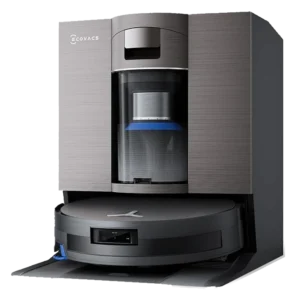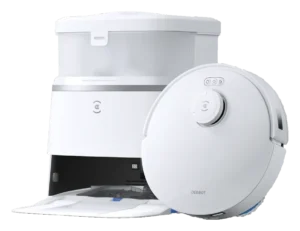
Ecovacs Deebot T30 Pro Omni · Ecovacs Deebot X11 OmniCyclone
All robot vacuums. Every measure below is plotted against the full class, so a difference can be read against how much the class itself varies.
- Ecovacs Deebot T30 Pro Omni
- Ecovacs Deebot X11 OmniCyclone
What each one does on its own.
The Autonomy Ladder is the same five rungs for every robot on the site. A rung describes the conditions a robot handles without you, not how good it is.
Where they actually differ.
The Robovations Score is nine inputs across three pillars, each weighted as shown and each scored so that more is better. A robot can lead on one and trail on another, which is the point of showing them apart. Cost of ownership and data handling are reported on each robot's own page and are never averaged into the score.
Capability
- Ecovacs Deebot T30 Pro Omni72
- Ecovacs Deebot X11 OmniCyclone55
- Ecovacs Deebot T30 Pro Omni75
- Ecovacs Deebot X11 OmniCyclone62
- Ecovacs Deebot T30 Pro Omni40
- Ecovacs Deebot X11 OmniCyclone48
- Ecovacs Deebot T30 Pro Omni75
- Ecovacs Deebot X11 OmniCyclone84
Dependability
- Ecovacs Deebot T30 Pro Omni80
- Ecovacs Deebot X11 OmniCyclone70
- Ecovacs Deebot T30 Pro Omni82
- Ecovacs Deebot X11 OmniCyclone65
- Ecovacs Deebot T30 Pro Omni73
- Ecovacs Deebot X11 OmniCyclone58
Ownership burden
- Ecovacs Deebot T30 Pro Omni94
- Ecovacs Deebot X11 OmniCyclone97
- Ecovacs Deebot T30 Pro Omni57
- Ecovacs Deebot X11 OmniCyclone97
How far apart is a long way?
A number only means something next to the spread it sits in. Each track below is the real range across every classified robot in the class, with the median marked.
- Ecovacs Deebot T30 Pro Omni$999
- Ecovacs Deebot X11 OmniCyclone$1,099.99
- Ecovacs Deebot T30 Pro Omni11,000 Pa
- Ecovacs Deebot X11 OmniCyclone19,500 Pa
- Ecovacs Deebot T30 Pro Omni290 min
- Ecovacs Deebot X11 OmniCyclone207 min
- Ecovacs Deebot T30 Pro Omni186 min
- Ecovacs Deebot X11 OmniCyclone180 min
- Ecovacs Deebot T30 Pro Omni65 dB
- Ecovacs Deebot X11 OmniCyclone61.8 dB
- Ecovacs Deebot T30 Pro Omni9 lbs
- Ecovacs Deebot X11 OmniCyclone11.7 lbs
- Ecovacs Deebot T30 Pro Omni4.1 in
- Ecovacs Deebot X11 OmniCyclone3.8 in
What the numbers leave out.
The trade-off
What each design gives up to be good at what it is good at.
The dock eliminates manual mop rinsing, but introduces a 20-30 minute wash-and-dry cycle that conflicts with quiet household hours.
Ecovacs publishes up to 290 minutes in silent mode on hard floor, but that is a best case; raising suction toward the 11,000 Pa maximum shortens a charge substantially, and no runtime at that setting is published.
The automated dock adds convenience but brings its own upkeep, mop pads, dust bags and tank refills, that a budget vacuum does not carry.
Advanced room mapping and multi-space autonomy extend cycle times and battery drain compared to single-room-focused designs.
The bagless cyclone station removes the bag consumable entirely, at the cost of a bin that has to be emptied by hand and a filter that has to be washed.
Integrated mopping adds a wet subsystem: station tanks to fill and empty, mineral buildup to watch in hard-water homes, and a roller and scraper to keep clear alongside vacuum maintenance.
Who each one is wrong for
Stated by the record itself. A robot being wrong for a household is a fact about fit, not a fault.
- Buyers who will not accept a networked camera in the home
- The robot carries a camera and depends on the Ecovacs cloud, and no fully local mode is documented. Ecovacs has a documented security incident history across the Deebot line, including a 2024 DEF CON demonstration of Bluetooth takeover and a subsequent CISA advisory covering Deebot vacuums and base stations.
- Homes requiring silent daytime operation
- Dock wash cycles run 20-30 minutes at 60-70 dB after mop sessions. Owner reports note scheduling conflicts in work-from-home environments.
- Buyers requiring offline or local-only operation
- All advanced features depend on Ecovacs cloud servers. No documented local-only scheduling or mapping mode. Cloud connectivity is required for routine operation.
- Single-floor homes exceeding 3,000 sq ft
- Ecovacs publishes up to 290 minutes in silent mode on hard floor, which is a best case; higher suction modes draw that down, so very large floors take a mid-session recharge and a longer total elapsed time.
- Homes with high-pile, shag, or luxury carpeting
- Suction drops 30-40% on deep pile per owner reports. Multiple passes or manual vacuuming necessary. Consider higher-Pa models for carpet-primary homes.
- Privacy-first households
- The X11 carries the AIVI 3D camera stack for obstacle avoidance and AGENT YIKO, an on-board voice assistant, so both a camera and a microphone are live during operation, alongside floor maps and schedules synced to Ecovacs servers. No local-only mode is documented for this model.
- Pet owners with heavy shedding
- Main-brush entanglement requires weekly clearing in high-shedding homes, and hair is the usual cause of a stalled run. Households report maintenance frequency as the main friction.
- Renters or frequent movers
- Complex multi-room mapping becomes liability in temporary housing. Layout changes trigger re-mapping cycles. Simpler gyro-only vacuums adapt faster to new spaces.
- Budget-conscious buyers without docking priority
- List price is $1,499.99, but street price runs well under it; Ecovacs' own US store has listed the machine at $749. Ongoing consumables are the filter and the brushes. The station is bagless and the mop roller is washed rather than replaced on a schedule.
- 5 GHz-only Wi-Fi networks
- Dock pairing and app remote commands require 2.4 GHz availability. Does not support 5 GHz exclusive networks. Dual-band router essential.
What stays your job
The upkeep ownership hands back to you, whatever the autonomy level says.
- Weekly: Empty dustbin and mop water tank; refill clean water tank ($0).
- Monthly: Swap mop pads; clean dock water filter ($15-25 per pair pads).
- Monthly: Rinse vacuum dustbin filter; replace when clogged ($0).
- Every 3-6 months: Replace vacuum motor filter and side brush ($20-40 total per Ecovacs pricing).
- Every 3-6 months: Clean LiDAR window and camera lenses; inspect cliff sensors for dust accumulation ($0).
- Annually: Inspect dock brush and replace if bristles are flattened; clean dock jets ($0 unless replacement brush ordered).
- After every use: Nothing required. The station empties the robot into its bagless cyclone bin, then washes the mop roller at 167 F and hot-air dries it.
- Weekly: Clear tangled hair from the main brush and side brush. Empty the station’s cyclone bin as it fills.
- Monthly: Wash the filter, clean the station sensors and charging contacts, and rinse the dirty-water tank.
- Every 3-6 months: Inspect the station water tanks for mineral buildup, and check the mop roller and its scraper arm for wear or embedded debris.
- Annually: Wipe the cliff and docking sensors, check battery health via the app, and apply firmware updates as they are released.
- As needed: Replace the main brush, side brush and filter as they wear, and adjust navigation settings for atypical layouts.
How much each of these is standing on.
Classifications rest on different depths of evidence. A pre-release assessment and a verified one are not the same kind of claim.
| Robot | Evidence status | Sources reviewed | Last assessed |
|---|---|---|---|
| Ecovacs Deebot T30 Pro Omni | Provisional | 7 | Aug 2026 |
| Ecovacs Deebot X11 OmniCyclone | Provisional | 4 | Sep 2026 |
Add a robot
Comparing across classes is allowed — the page will switch to per-class positioning and tell you it has.