Skip to content
Saved
Comparison · 2 robots

Boston Dynamics Stretch · Husqvarna CEORA

All specialty robots. Every measure below is plotted against the full class, so a difference can be read against how much the class itself varies.
  1. Boston Dynamics Stretch
  2. Husqvarna CEORA
Boston Dynamics

Boston Dynamics Stretch

Autonomy
IIIConditional Autonomy
Score
Not scored
Readiness
Not assessed
Price
Not tracked

Up to three

01 Classification

What each one does on its own.

The Autonomy Ladder is the same five rungs for every robot on the site. A rung describes the conditions a robot handles without you, not how good it is.

V
Generalized
Any task, any setting
IV
Environmental
Handles new obstacles without help
Husqvarna CEORA
III
Conditional
Finishes familiar jobs on its own
Boston Dynamics Stretch
II
Assisted
Runs preset routines, needs rescue
I
Manual
One action, on command
02 Assessment

Where they actually differ.

The Robovations Score is nine inputs across three pillars, each weighted as shown and each scored so that more is better. A robot can lead on one and trail on another, which is the point of showing them apart. Cost of ownership and data handling are reported on each robot's own page and are never averaged into the score.

None of these robots carries a scored assessment yet, so there is nothing to plot here. The classification and evidence below still apply.

03 Measured against the class

How far apart is a long way?

A number only means something next to the spread it sits in. Each track below is the real range across every classified robot in the class, with the median marked.

Runtime28 with a published figure
  • Boston Dynamics Stretch960 min
  • Husqvarna CEORA200 min
30 minmedian 255 min960 min
Weight33 with a published figure
  • Boston Dynamics Stretch2,646 lbs
  • Husqvarna CEORA160 lbs
0.1 lbsmedian 26.5 lbs2,646 lbs
Height30 with a published figure
  • Boston Dynamics Stretch82 in
  • Husqvarna CEORA17.3 in
0.9 inmedian 22.8 in82 in

Not compared, because fewer than two of these robots carry a published figure: Price, Suction, Charge time, Noise.

04 Ownership

What the numbers leave out.

The trade-off

What each design gives up to be good at what it is good at.

Boston Dynamics Stretch

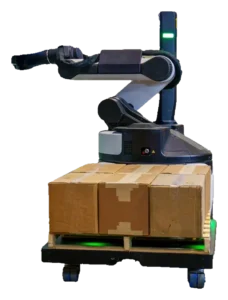
Unloading runs without operator input once started, but every trailer begins with a manual positioning step: an operator opens the door, drives Stretch inside, and presses Go.

Tolerance of mixed and messy loads is the advertised capability, yet the machine is built around one environment, the dock and the floor-loaded trailer or container. It is not a general-purpose warehouse robot.

Husqvarna CEORA

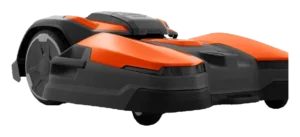
Autonomous operation across large areas reduces labor costs, offset by substantial upfront capital and dealer installation unsuitable for sporadic maintenance.

Centimeter-level accuracy enables professional line patterns, offset by dependency on terrain mapping and boundary redefinition when landscape topology changes.

Weather-resistant design supports year-round operation, offset by recurring blade replacement across three cutting discs on commercial duty cycles.

Who each one is wrong for

Stated by the record itself. A robot being wrong for a household is a fact about fit, not a fault.

Boston Dynamics Stretch
Small to medium-sized logistics operations
Stretch is sized for facilities unloading floor-loaded trailers and containers at volume, and Boston Dynamics publishes no pricing. Where inbound case volume does not sustain a dedicated machine, the purchase and integration effort is hard to justify.
Consumers and small business owners
Stretch is an industrial machine of about 2,650 lb sold to commercial customers. There is no consumer retail channel, published pricing, or consumer support path.
Operations expecting a machine with no human in the loop
An operator opens the trailer door, drives Stretch inside, and starts the job. Unloading then runs without operator input, but that positioning step recurs for every trailer.
Operations requiring outdoor or unstructured environments
Stretch is built for loading docks, trailers, and shipping containers. Outdoor spaces, extreme temperatures, and variable terrain are not documented use cases.
Husqvarna CEORA
Residential consumers with small lawns
Commercial pricing and dealer installation place CEORA outside consumer budgets. Compact residential properties lack cost justification for commercial-grade equipment.
Properties without reliable satellite reception
EPOS positioning depends on a clear sky view at the machine and at the correction source. Dense canopy, tall surrounding structures, or a site where Husqvarna Cloud correction is unavailable and an RS5 reference station cannot be mounted with mains power require alternative equipment.
Terrain with complex obstacles
Narrow passages, dense landscaping, and varied topography exceed EPOS boundary definition capabilities. Properties with non-uniform layout require manual intervention.
Organizations requiring cloud-optional operation
Job scheduling and remote monitoring run through Husqvarna Fleet Services. Sites with network isolation or strict data-privacy policies cannot operate CEORA autonomously.

What stays your job

The upkeep ownership hands back to you, whatever the autonomy level says.

Boston Dynamics Stretch
  • As needed: Scheduled maintenance runs under the Stretch Care service plan, not operator hands; Boston Dynamics publishes no owner-performed intervals, including for the vacuum gripper’s suction cups.
  • As needed: Repairs are dispatched, not shipped: Stretch Care sends a regionally located field service engineer rather than parts for owner installation.
  • As needed: Apply product enhancements and software updates as Boston Dynamics releases them; both are included in the Stretch Care agreement.
  • As needed: Boston Dynamics runs health checks on customer equipment under Stretch Care’s Proactive Prevention component.
  • As needed: Recharge between shifts; the manufacturer documents battery life spanning single or multiple shifts but publishes no operator charging procedure.
Husqvarna CEORA
  • After every use: Blade inspection and grass clearing, no cost.
  • Weekly: Charging-dock contact cleaning and a check for damaged or missing blades across the three discs.
  • As wear or damage appears: Replace the pivoting blades as a set across all three discs, together with their fasteners. Husqvarna’s Automower blade guidance is to replace blades rather than sharpen them, because sharpening weakens the blade coating and can lead to breakage.
  • Annually: Dealer service including electrical connector inspection and software update.
  • Longer term: Battery capacity assessment as the 49 Ah lithium-ion pack ages.
05 Evidence

How much each of these is standing on.

Classifications rest on different depths of evidence. A pre-release assessment and a verified one are not the same kind of claim.

Evidence behind each classification
Robot Evidence status Sources reviewed Last assessed
Boston Dynamics Stretch Not Consumer-Ready 8 Sep 2026
Husqvarna CEORA Verified 11 Sep 2026

Robovations classifies robots; it does not rank them. Nothing on this page is a recommendation, and no manufacturer influences a classification or its placement here.