What does ‘autonomous’ mean on a robot mower spec sheet?
A wire-free robot mower draws its boundary from satellites instead of a buried cable, and the maker's page calls that autonomous. But the satellite fix only holds where the mower and its base station keep a clear view of the sky; trees, walls and even a metal shed can loosen it. That is what decides whether the invisible line holds across a real yard.
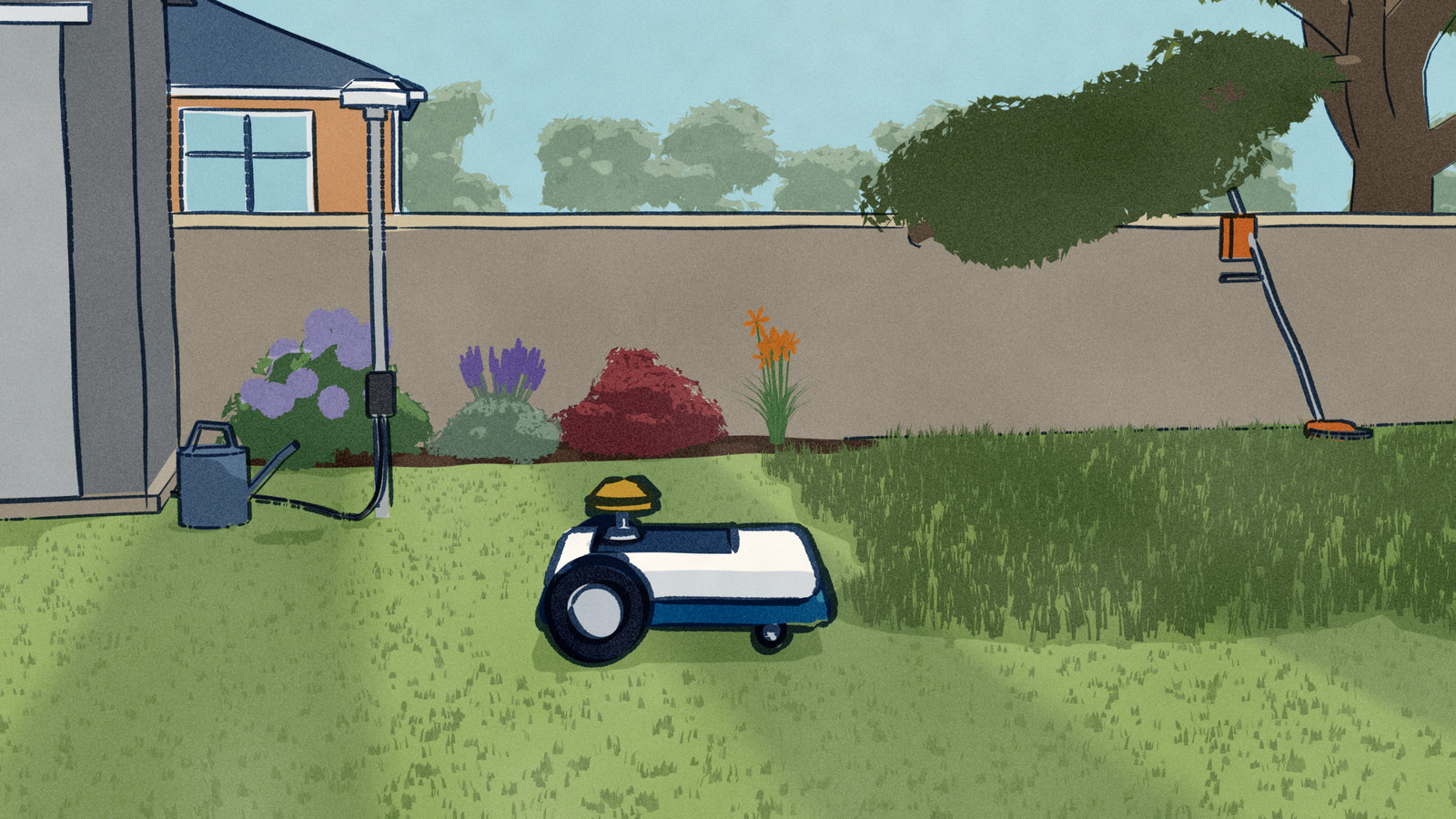
A robot mower’s product page can make a short promise. One sells a “Perimeter Wire Free Robot Lawn Mower” that mows by “Precise Satellite Positioning with Centimeter-Level Accuracy.” The machines it replaced needed a cable pinned around the lawn’s edge to mark where the grass stopped. Removing that cable is the feature on the box.
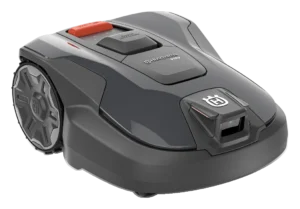
Satellite positioning draws the fence instead. The mower and a small base station both read signals from navigation satellites overhead, and a correction brings the position down to roughly two centimeters, close enough to follow a line nobody buried. Husqvarna says its satellite-based technology lets the mower work within virtual boundaries, with no physical wire to break.
That removal is real, and it is not free. An independent review of one wire-free model still had to assemble and install a physical antenna, because the network correction signal was not available in that area. Two firmware updates during setup added about twenty minutes before the first mow.
So “autonomous” here means something specific. The mower keeps itself inside a boundary that holds only while the satellite reading is good. On a clear, open lawn, that is most of the time. But what happens where the sky is not clear?
That is the one thing a spec sheet does not tell you. A satellite fix needs an open line to each satellite it uses: leaves and branches scatter those signals, so under a tree the reading loosens from about two centimeters to something too vague to mow a boundary on.
Where the fix holds, and where it loosens
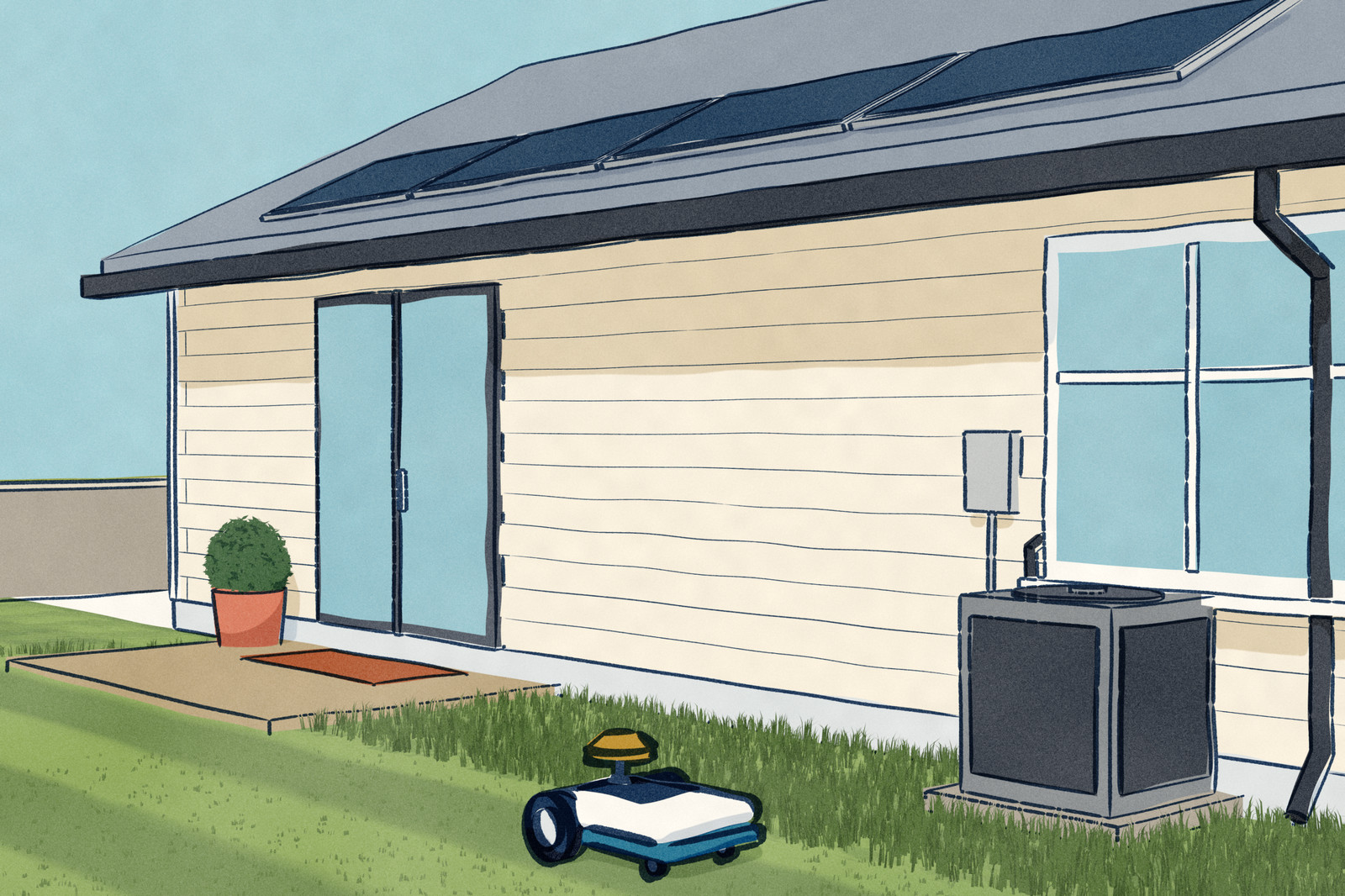
Both ends of the system have to see the sky. The base station and the mower each read the satellites directly, so anything that covers the upper sky weakens the position. An independent review gave the setup instruction in one line: give the antenna “a broad, unobstructed view of the sky, away from buildings and trees.”
Reference station must have clear 135-degree view of sky in all upper directions.
That is the condition the one word on the box leaves out. An independent guide to signal problems lists the usual blockers: “Leaves and branches absorb and scatter satellite signals,” and a wall, roofline, fence, or the side of the house “cuts off part of the satellite view.” One mature tree over a corner of your lawn can be enough.
The blockers are not only shade. The same guide lists reflections, where “Signals bounce off metal roofs, gutters, solar panels, glass, HVAC units and parked cars,” arriving at the antenna twice and confusing the position. A tidy suburban yard with a metal shed and a solar array can trouble the fix more than an open field does.
When the fix drops, the machine does not improvise. Some mowers coast through a short gap on inertial sensors, but even then a mower “can’t navigate a large shaded zone on dead reckoning alone.” So it slows, stops, or stays off that patch of grass.
The owner then repositions the antenna, re-maps the lawn, or redraws the boundary around the shaded corner and finishes that strip another way. The slope has a number too. One wire-free mower is rated to an 80 percent grade, about 38 degrees, and past that the wheels give up the hill.
For a yard with too much shade to escape, the fix is to change the navigation method rather than the settings: a mower that adds cameras or a laser scanner can read the ground through gaps that break a satellite-only fix. That is a different machine, and a different price, chosen because of the trees.
Why this counts as conditional autonomy
This is what the Autonomy Ladder is built to name. It does not ask whether a machine is autonomous as a yes or a no. It asks whether the machine finishes its task on its own, and inside what conditions.
Figure
The Autonomy Ladder
- Level IIIConditional Autonomy
Level III, Conditional Autonomy, is the rung for a machine that completes the job end to end within a domain it does not set or hold by itself. A wire-free mower on an open lawn fits it cleanly. A person defines that domain by placing the antenna and drawing the map, and keeps it by minding the sky.
That bounded kind of autonomy is the common case here. Of the 625 consumer robots classified on this site, 376 sit at Level III, more than the other four rungs together. The single word a mower is sold under is almost always this rung: a machine that runs itself inside conditions a person arranges.
Part of what makes the word slippery is that “wire-free” names an absence. The old cable was a thing the lawn had, and its removal gets sold as independence. What replaced it is a dependence instead: on satellites, on a correction signal, on a sky clear enough to read them. The boundary did not vanish. It moved from the ground to the sky.
A spec sheet is good at the capabilities and clear about some limits. The slope rating is a real, checkable ceiling; the cut width, the battery runtime and the charge time are all there to compare. What it cannot give you is the shape of that domain, because it is a property of the particular yard: its trees, its walls, the corner the satellites cannot see.
So the mower finishes the lawn on its own, and a person decides where its view of the sky will hold. The buyer who reads only the spec sheet sees the capability. The owner lives with the conditions: the one oak over the back fence that has to be trimmed, or worked around by hand, before the line out there will hold.