
- Changes
- 6
- Tracking since
- Nov 2023
- Latest
- Sep 29, 2026
- Net movement
- Classification stable
- 2026
-
Yarbo names the Y40 Snow Blower as the S1's successor
Yarbo's catalog now names the Y40 Snow Blower as the S1's successor, added two days after the newer model's listing went live.
Full assessment4 claims · 3 technical notes · 2 sources
Where it standsAutonomy LadderIIIIIIIVVLevel IIIConditional AutonomyHuman ReadinessReady NowNew to MarketWaitKnown IssuesRobovations Score04055708560CapableWhat happenedA named successor usually signals where a manufacturer's attention is shifting; it does not confirm that the older model is being withdrawn.
WatchingFor whether Yarbo sets an end-of-sale date or confirms continued software and security support for S1 units in the field.
Bottom lineThe successor designation is a documented catalog fact, not evidence of a sales, support or capability change to the S1 itself.
ImpactOn autonomy
- Autonomy classification carries over unchanged; this entry records no behavior change.
- No new sensor, mapping or recovery capability is documented for the existing S1 hardware.
On readiness
- Continued retail availability of the S1 is not confirmed or denied by this listing.
- Software and security support continuity for fielded S1 units remains undocumented after this change.
Claim check4 maker claims checked against the record. Open one to read the finding.
A named successor is often presented as a straightforward upgrade path for existing customers.
Documented findingNeither record states whether the S1 remains for sale or is being withdrawn.Successor announcements commonly imply continued support for the outgoing model during a transition period.
Documented findingNo separate statement addresses firmware or security updates for S1 units already in the field.A snow-specific successor could suggest the newer model resolves snow-handling limits reported on its predecessor.
Documented findingNo documentation available to this entry confirms the Y40 Snow Blower's control software addresses the GPS drift and snow-handling issues owners reported on the S1.A succession listing can read as a signal that the predecessor is being phased out.
Documented findingThe catalog record only establishes a lineage link; it carries no discontinuation date or sales-status change.Evidence2 sources · 1 linked
21Nov 2023Sep 2026filed 29 Sep 2026- 1Yarbo Official Site (Y40 Snow Blower product page)29 Sep 2026
- 2Yarbo Official Site (S1 product page)1 Nov 2023named, not linked
Technical notes3 sectionsWhat Changed
Yarbo’s catalog record for the S1 now carries a succeeded_by link pointing to the Y40 Snow Blower, a record published September 29, 2026, two days before this entry. The field establishes a lineage connection between the two listings; it does not itself state a discontinuation date, a trade-in program, or an end-of-sale timeline for the S1.
Open Questions For Existing Owners
The S1’s documented history includes a hardcoded root-password vulnerability and owner reports of GPS drift and snow-handling limits during its first winter in the field. Naming a snow-specific successor raises, but does not answer, whether Yarbo intends to keep patching S1 units already sold or whether support attention is shifting to the newer model. Nothing in the successor listing addresses either point directly.
What To Watch
A defined end-of-sale date, a stated support window for existing S1 units, or any manufacturer statement connecting the Y40 Snow Blower’s control software to the S1’s reported snow-handling limits would resolve these questions. None of those exist in available documentation as of this entry.
-
Researchers find hardcoded universal root password on every Yarbo S1
Kaspersky published research 2 Jul 2026 documenting a root account password hardcoded identically into every Yarbo yard robot, requiring only a device serial number for remote access.
Full assessment2 claims · 3 technical notes · 2 sources
Where it standsAutonomy LadderIIIIIIIVVLevel IIIConditional AutonomyHuman ReadinessReady NowNew to MarketWaitKnown IssuesRobovations Score04055708560CapableWhat happenedThe password resets to its factory default after firmware updates, so an owner who changes it loses that protection at the next update. Documented capabilities included pulling GPS coordinates, email addresses and Wi-Fi passwords, accessing cameras, and re-arming the mower after an emergency stop.
WatchingWhether Yarbo's announced fixes remove the universal credential rather than only add controls around it.
Bottom lineThe password was not leaked or guessed; it was built into the firmware identically across the fleet, and updates restored it even after an owner changed it.
ImpactOn autonomy
- No autonomy or navigation capability changed by this disclosure
- The flaw is in remote-access authentication, not onboard task execution
On readiness
- Every unit sharing one hardcoded credential is a fleet-wide exposure, not a per-device flaw
- Yarbo announced plans to remove universal passwords and add stronger access controls after publication
Claim check2 maker claims checked against the record. Open one to read the finding.
Yarbo markets remote monitoring and camera features as owner conveniences
Documented findingKaspersky's researcher documented those same channels as the exposed surface: camera access, GPS coordinates, email addresses and Wi-Fi passwords were all reachable through the universal root credentialYarbo stated it would fix the issues after publication
Documented findingReporting describes the announced remediation as removing universal passwords and adding access controls; independent verification that the firmware update process itself no longer resets credentials was not found in the coverage reviewedEvidence2 sources · all linked
- 1Kaspersky official blog2 Jul 2026
- 2Fox News2 Jul 2026
Technical notes3 sectionsThe Flaw
Security researcher Andreas Makris, writing on Kaspersky’s official blog (2 Jul 2026), documented a root account on Yarbo yard robots protected by a password hardcoded identically into every device’s firmware. Remote access to any unit required only its serial number and that shared password. Critically, the password reset to its factory default after firmware updates, so an owner who changed it lost that protection at the next update cycle.
Documented Impact
With root access, the research demonstrated retrieval of GPS coordinates, owner email addresses and Wi-Fi passwords, access to onboard cameras, and the ability to re-arm the mower’s blades after a physical emergency stop had been triggered. News reports said the flaw could expose an estimated 6,000 owners.
Vendor Response
Yarbo reportedly lacked a dedicated vulnerability-reporting channel when researchers first attempted contact. Following publication, the company announced it would remove universal passwords across devices, implement stronger access controls, and add transparency to its remote diagnostics system.
-
US advisory discloses critical Yarbo mobile app credential flaw, fix already issued
A US government cybersecurity advisory disclosed that Yarbo's Android and iOS apps embedded identical, hard-coded MQTT broker credentials across every user and device (CVSS 9.8), letting an attacker who extracted them read the entire fleet's live telemetry and send commands to any robot by serial number.
Full assessment4 claims · 3 technical notes · 2 sources
Where it standsAutonomy LadderIIIIIIIVVLevel IIIConditional AutonomyHuman ReadinessReady NowNew to MarketWaitKnown IssuesRobovations Score04055708560CapableWhat happenedYarbo's 3.17.4 app update fixes it; watch for whether the advisory or Yarbo later confirms the flaw was exploited before that fix shipped.
Bottom lineThe advisory documents a critical, fleet-wide credential exposure with a fix already available; it does not document a confirmed attack that used it.
ImpactOn autonomy
- No change to onboard autonomous navigation, obstacle handling, or Level III capabilities documented here.
- The vulnerability sits in the mobile app's cloud connection, not onboard robot software.
On readiness
- A fleet-wide credential flaw is a documented point against this connected ecosystem's security record.
- Yarbo's fix requires owners to update to app version 3.17.4 or later.
Claim check4 maker claims checked against the record. Open one to read the finding.
A US government cybersecurity advisory documents that the Yarbo apps shipped identical, hard-coded MQTT broker credentials extractable from the app package.
Documented findingConfirmed in the advisory: an attacker who extracts the credentials gets unrestricted read access to real-time telemetry across Yarbo's fleet.The same broker credentials work against the cloud connection for any device on the network.
Documented findingConfirmed: an attacker can send arbitrary operational commands to an individual robot using only its serial number.A related flaw, CVE-2026-7368, was disclosed in the same advisory.
Documented findingDocumented as missing authorization, CVSS 8.1 to 8.6; the advisory does not say whether it was used against a real device.The flaw carries a CVSS v3 score of 9.8, rated Critical.
Documented findingNot documented: the advisory is a vulnerability disclosure, and it reports no confirmed case of the flaw being exploited against a real robot or account.Evidence2 sources · all linked
- 1CISA
- 2ToolsLib Blog22 Jun 2026
Technical notes3 sectionsThe vulnerability
A US government cybersecurity advisory (ICSA-26-162-01) documents CVE-2026-10557 (CVSS v3 9.8, Critical) in the Yarbo Android and iOS mobile apps: the apps embed MQTT broker credentials that are hard-coded and identical across every user account and every connected robot. Anyone who extracts the credentials from the app package gains unrestricted read access to real-time telemetry for Yarbo’s connected fleet, and can publish commands to the broker that any individual robot accepts by matching its own serial number. The exposure applies across Yarbo’s product line, including the S1, because every connected robot shares the same mobile app and cloud stack rather than model-specific credentials.
The related finding
The same advisory lists CVE-2026-7368, a missing-authorization flaw rated CVSS 8.1 to 8.6, disclosed alongside the credential issue.
The fix
Yarbo’s remedy is an app update: version 3.17.4 or later replaces the shared broker credentials. The flaw sits in the mobile app’s cloud connection rather than the robot’s onboard firmware, so it affected the whole connected fleet through the shared app and cloud stack rather than one model’s hardware.
- 2025
-
First winter season owner reports document Yarbo S1 GPS drift and snow limits
Owner community reports from the Yarbo S1's first winter season identified GPS boundary drift under dense tree canopy and motor overload in wet snow above approximately 8-10 inches as the two most frequently cited operational issues.
Full assessment4 claims · 4 technical notes · 2 sources
Where it standsAutonomy LadderIIIIIIIVVLevel IIIConditional AutonomyHuman ReadinessReady NowNew to MarketWaitKnown IssuesRobovations Score04055708560CapableWhat happenedNeither issue constitutes a safety recall; both represent documented edge cases for the platform's GPS-dependent navigation approach.
WatchingFor manufacturer firmware or documentation response addressing the canopy interference pattern.
Bottom lineFirst-season owner data confirmed the GPS canopy limitation and wet-snow boundary as the platform's primary operational constraints; neither rises to a defect level but both narrow the fit profile for wooded or heavy-snowfall properties.
ImpactOn autonomy
- GPS zone boundary accuracy confirmed degraded under dense canopy by multiple independent owner reports
- Motor overload in wet snow above rated depth documented as automatic shutdown event requiring manual restart
- Dynamic obstacle blindspot (pets, repositioned furniture) confirmed as known architectural limitation by owner community
- No navigation improvements or firmware mitigations documented in response to canopy drift pattern
On readiness
- Canopy-heavy properties identified as category of buyers with elevated operational risk
- Wet-snow performance limits clarified via real-world reports beyond manufacturer rated specifications
- An owner forum thread became the primary community resource for setup and troubleshooting guidance
- Setup complexity for GPS zone mapping rated manageable by owners on open residential lots
Claim check4 maker claims checked against the record. Open one to read the finding.
GPS navigation works across all residential properties
Documented findingOwner reports confirm accuracy degrades under dense tree canopy; multiple reports of boundary departure in heavily shaded zones (owner forum, winter 2024-2025)Snow plowing handles all winter conditions
Documented findingMotor overload and automatic shutdown documented above approximately 8-10 inches of wet or heavy snow; performance degrades below 20°F due to battery effects (owner reports)Set it and forget it seasonal operation
Documented findingFirst-season owners report that GPS zone tuning, canopy workarounds, and attachment reseating errors required multiple owner interventions beyond initial setup (owner forum reports)Universal obstacle avoidance during operation
Documented findingNo real-time dynamic obstacle detection; unit operates on static mapped boundaries only; pets and repositioned objects not detected during scheduled runs (manufacturer documentation confirmed by owner reports)Evidence2 sources · 1 linked
- 1Reddit r/Yarbo
- 2Yarbo Support Centernamed, not linked
Technical notes4 sectionsGPS Boundary Drift Pattern
Owner forum reports from winter 2024-2025 described boundary departure events concentrated in zones with significant overhead tree canopy. The S1 uses GPS with optional RTK base station; standard GPS without RTK shows documented accuracy reduction near structures and under canopy. Affected owners reported the unit crossing programmed boundary edges by variable distances during tree-shaded portions of scheduled runs.
Snow Performance Edge Cases
Motor strain reports in wet or compacted snow concentrated above approximately 8-10 inches, consistent with manufacturer’s stated rating. Automatic motor cutoff and app error notification confirmed as the unit’s protective response. Cold-temperature battery behavior documented with reduced runtime below approximately 20°F, with some owners reporting the battery management system refusing to initiate scheduled runs in sub-freezing storage conditions.
Attachment Seating Fault
A secondary issue reported across owner threads involved attachment connection faults where the module did not seat fully, triggering an error code that halted the scheduled run. Resolution documented as reseating the attachment before restarting the scheduled operation.
Community Documentation
An owner forum became the primary aggregation point for first-season owner experience. A forum thread seeking community feedback (posted approximately mid-2023 during early access period) accumulated operational reports from general-release owners through winter 2024-2025.
- 2024
-
Yarbo S1 modular yard robot platform demoed at CES 2024
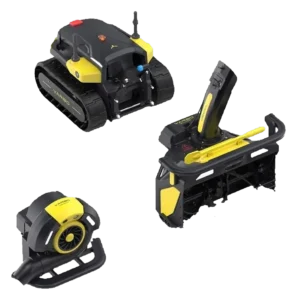
Yarbo showcased the S1 modular platform at CES 2024, demonstrating all three seasonal attachments (snow blower, mower, leaf blower) operating on a single GPS-navigating base unit.
Full assessment4 claims · 4 technical notes · 2 sources
Where it standsAutonomy LadderIIIIIIIVVLevel IIIConditional AutonomyHuman ReadinessReady NowNew to MarketWaitKnown IssuesRobovations Score04055708560CapableWhat happenedThe demo confirmed the multi-module architecture as a real hardware system rather than a speculative roadmap item.
WatchingFor attachment availability timeline and pricing to confirm whether all three modules ship at launch or stagger.
Bottom lineThe CES 2024 demo established the multi-module hardware as real and operational, but the manual attachment transition requirement was documented as a functional limitation during press coverage.
ImpactOn autonomy
- GPS-defined zone navigation demonstrated across all three attachment modes
- Multi-module compatibility on single base unit confirmed via live hardware show floor demo
- App-based scheduling interface shown operating without perimeter wire boundary setup
On readiness
- Full three-attachment system shown publicly for first time, reducing hardware uncertainty
- CES floor demo enabled hands-on press evaluation ahead of commercial release
- Multiple tech publications covered the platform, broadening documented evidence base
Claim check4 maker claims checked against the record. Open one to read the finding.
One robot replaces all seasonal yard equipment
Documented findingThree attachments cover snow, mowing, and leaf clearing, but each swap is manual; no autonomous mode switching (CES 2024 demo coverage)GPS precision eliminates buried wire entirely
Documented findingGPS boundary mapping confirmed; RTK base station shown as optional upgrade for tighter accuracy near structures (manufacturer demo materials)Fully autonomous year-round yard management
Documented findingAutonomous operation confirmed within each mode; transitions between modes require owner-performed attachment swap of approximately 10-15 minutes (press demo reports)Handles all snow conditions autonomously
Documented findingDemo conditions were controlled; wet-snow depth limits and cold-temperature battery behavior not addressed in floor demonstration (CES 2024 press coverage)Evidence2 sources · 1 linked
129 Jan 202410 Jan 2024filed 9 Jan 2024- 1CNET9 Jan 2024
- 2TechRadar10 Jan 2024named, not linked
Technical notes4 sectionsPlatform Architecture
The S1 base unit demonstrated at CES 2024 uses GPS with optional RTK base station for boundary navigation. The modular attachment system connects via a standardized mechanical coupling on the base unit front. Three modules shown: snow blower, rotary mower deck, and leaf blower.
Navigation System
GPS-defined virtual zones replace perimeter wire used by competing robotic mowers. App-based zone mapping confirmed during demo. RTK upgrade path shown for centimeter-level precision in tight or obstructed lots.
Battery and Runtime
Base unit houses the primary battery pack. Manufacturer indicated approximately 240-minute runtime per charge for mowing operations at the CES event; snow plow runtime varies with snow load conditions.
Attachment Interface
All three module types connect to the same front coupling on the S1 base. Attachment swap demonstrated on the show floor with an approximately 10-15 minute process per press reports, confirming manual intervention requirement for every mode change.
- 2023
-
Yarbo S1 reaches commercial retail availability in North America
Yarbo S1 launched into general commercial availability at $3,999 MSRP, making GPS-guided modular yard robotics available to residential buyers without a crowdfunding or waitlist requirement.
Full assessment4 claims · 4 technical notes · 2 sources
Where it standsAutonomy LadderIIIIIIIVVLevel IIIConditional AutonomyHuman ReadinessReady NowNew to MarketWaitKnown IssuesRobovations Score04055708560CapableWhat happenedThe release established the start of the broad consumer reliability data window.
WatchingFor owner reports on GPS boundary performance and snow plow behavior across a first full winter season.
Bottom lineThe retail launch established real commercial availability; the multi-module value proposition requires using two or more seasonal functions to justify the entry price over purpose-built alternatives.
ImpactOn autonomy
- Level IV GPS boundary navigation confirmed available to general consumers without early-access restrictions
- Full three-module attachment library available at launch per manufacturer release documentation
- App-based scheduling and zone management confirmed through retail distribution channels
On readiness
- Product available for direct purchase without pre-order requirement for first time
- Retail channel expansion increased access beyond direct manufacturer sales
- Launch price of $3,999 established entry cost for modular GPS yard robotics category
Claim check4 maker claims checked against the record. Open one to read the finding.
Replaces all seasonal outdoor power equipment
Documented findingThree attachment modes cover primary seasonal tasks; each requires manual swap; not a drop-in replacement for all scenarios (manufacturer launch documentation)No installation required beyond app zone mapping
Documented findingGPS zone mapping requires initial setup session; RTK base station optional but recommended for precision near structures; charging station placement also requires setup (manufacturer quick-start guide)Works on any residential property
Documented findingGPS performance varies with tree canopy density; manufacturer documentation notes reduced accuracy in obstructed yards; owner community reports on canopy interference began appearing post-launch (owner forums)Handles all winter conditions
Documented findingManufacturer documentation rates the plow for approximately 6-10 inches of dry snow per pass; wet-snow performance and cold-temperature battery limitations disclosed in support documentation (Yarbo Support Center)Evidence2 sources · 1 linked
21Nov 2023Jun 2024filed 1 Nov 2023- 1CNET18 Jun 2024
- 2Yarbo Press Release15 Jun 2024named, not linked
Technical notes4 sections
Launch Configuration
The S1 launched commercially in mid-2024 at $3,999 MSRP. The base unit ships with one selected attachment; additional modules available as separate purchases. All three attachment types (snow blower, mower deck, leaf blower) confirmed available at launch.
Navigation at Release
GPS-defined virtual zone navigation via companion app. Optional RTK base station upgrade improves positioning to centimeter-level accuracy. No perimeter wire required for standard operation. App supports day-of-week and time-of-day scheduling per zone.
Hardware Specifications at Launch
Base unit weight approximately 55 lbs per manufacturer specs. Battery pack rated approximately 240 minutes runtime for mowing per charge. Charging station requires weather-protected placement per installation documentation. Wi-Fi and Bluetooth connectivity for app communication.
Support Infrastructure
Manufacturer launched support documentation covering user manual, quick-start guide, snow preparation guidance, and troubleshooting guides via Yarbo Support Center portal at product availability.