Skip to content
Saved
Weave Isaac 1
Robot Tracker

Weave Isaac 1

Weave Robotics · Multi-Task Robots
Level IIPromising Progress
  1. 2026
  2. Weave Isaac 1 Capped at Level II by Teleoperator Fallback Dependency

    Weave documentation discloses that Isaac 1 transfers control to a remote human teleoperator when it cannot complete a task autonomously.

    Full assessment
    AutonomyL3 → L2
    ReadinessPromising progress strengthened
    ScoreScores unchanged

    Under Robovations methodology, any robot whose operating model includes teleoperator fallback is capped at Level II (Assisted Autonomy); Level III requires end-to-end task completion without human takeover. Classification will advance only when Weave documents removal of the teleoperator dependency from the operating loop.

    Impact on autonomy

    • Teleoperator fallback confirmed in Weave documentation; caps classification at Level II
    • Level III (Conditional Autonomy) requires zero teleop dependency within operating design domain
    • Marketing claims of autonomy are not reconcilable with documented fallback architecture
    • Reclassification to Level III contingent on documented removal of human takeover pathway

    Impact on readiness

    • Teleop dependency introduces variable latency and staffing cost for operators
    • Deployments requiring unattended operation are not supported under current architecture
    • Readiness status revised to reflect human-in-the-loop requirement for task completion

    Claim check4 claims reviewed

    Isaac 1 operates autonomously across task environments
    Weave documentation confirms a remote human teleoperator assumes control when Isaac 1 cannot complete a task; autonomous operation is conditional, not general
    Platform described as an autonomous robot for commercial deployment
    Teleoperator fallback is a structural part of the operating model, not an edge-case override; this places the system at Level II (Assisted Autonomy) under Robovations methodology
    Autonomy framing implies end-to-end task completion without human intervention
    Level III (Conditional Autonomy) requires end-to-end completion within the operating design domain; Isaac 1 does not meet this threshold while teleop fallback remains active
    Commercial readiness implied by deployment marketing
    Deployments requiring unattended, fully autonomous operation are not supported under the documented architecture; a staffed teleoperator pool is a prerequisite

    Bottom lineIsaac 1 is a Level II system: capable of autonomous task initiation but dependent on human teleoperators to close the loop when autonomy fails.

    Technical notes3 sections
    Autonomy Classification Basis

    Robovations classifies Isaac 1 at Level II (Assisted Autonomy) based on Weave’s own documentation, which describes a remote human teleoperator as the fallback when the robot cannot complete a task independently. Under the Robovations Canonical Autonomy Ladder, Level III (Conditional Autonomy) requires end-to-end task execution within the operating design domain without any teleoperator handoff. The presence of a structured teleop fallback is a hard cap, not a deduction.

    Teleoperator Architecture

    Weave documentation indicates the teleoperator fallback is a designed system feature, not an emergency override. This means human labor is a runtime dependency for any deployment where edge cases are expected. The frequency of teleop invocations, the latency of handoff, and the staffing ratio required per robot are not disclosed in available documentation and represent key unknowns for prospective operators.

    Path to Reclassification

    Isaac 1 can be reclassified to Level III if Weave publishes documentation demonstrating removal of the teleoperator from the task-completion loop within the robot’s operating design domain. Incremental reductions in teleop frequency do not satisfy the threshold; the requirement is structural removal, not statistical rarity.

    IIIIIAutonomy level
  3. Isaac 1 Adds Mobile Base, Autonomous Room-to-Room Laundry Collection

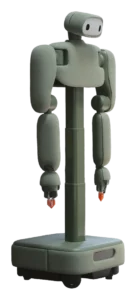
    Isaac 1 introduces a motorized wheeled base and autonomous navigation, replacing the desk-mounted Isaac 0 that could only process laundry at a fixed table.

    Full assessment
    AutonomyLII → LIII
    ReadinessWait → Ready Now
    Score+major advance

    The mobile platform allows Isaac 1 to traverse rooms, collect clothes, and empty hampers without repositioning by the user. Key items to verify: real-world navigation reliability across varied floor plans and whether hamper-emptying succeeds across different container geometries.

    Impact on autonomy

    • Mobile base enables autonomous room-to-room traversal without user repositioning
    • Autonomous navigation added where Isaac 0 had no locomotion capability whatsoever
    • Clothes pickup and hamper emptying now executed across multiple spatial contexts
    • Task domain expands from single fixed-table folding to whole-room laundry tidying

    Impact on readiness

    • Isaac 1 commercially released July 2026, replacing stationary Isaac 0 generation
    • Mobile operation removes the fixed-table setup requirement of the prior model
    • Autonomous navigation reduces per-task user intervention compared to Isaac 0 baseline

    Claim check4 claims reviewed

    Isaac 1 moves room to room autonomously to collect laundry
    Manufacturer describes motorized wheeled base with autonomous navigation; independent third-party verification of multi-room reliability across varied floor plans is not yet documented
    Isaac 1 empties hampers autonomously
    Manufacturer describes hamper-emptying as a supported task; performance across different hamper geometries and fill levels has not been confirmed by owner reports or third-party benchmarks as of July 2026
    Isaac 1 represents a generational step beyond Isaac 0
    The architectural shift from a fixed desk-mounted unit to a self-propelled mobile platform is documented; Isaac 0 had no locomotion, making this a structural rather than iterative change
    Isaac 1 tidies rooms end to end
    Manufacturer describes clothes pickup and tidying across rooms; the scope of object types handled beyond laundry items is not yet specified in available documentation

    Bottom lineThe mobile base is a documented architectural change from Isaac 0; real-world navigation and hamper-emptying reliability across diverse home environments remains to be confirmed by owner reports and third-party testing.

    Technical notes4 sections
    Platform Architecture Change

    Isaac 0 operated as a desk-mounted stationary unit, performing laundry folding exclusively at a fixed table. Isaac 1 introduces a motorized wheeled base that provides self-propelled locomotion, enabling the robot to depart from a home position and traverse to other rooms without user assistance.

    Navigation Capability

    Manufacturer describes autonomous navigation as a core Isaac 1 feature. Specific sensor architecture (camera-based, LiDAR, or hybrid) has not been confirmed in available documentation. Navigation method and mapping approach remain unverified by third-party sources as of July 2026.

    Task Domain Expansion

    Isaac 0 task domain: laundry folding at a single fixed table. Isaac 1 task domain per manufacturer description: room-to-room clothes pickup, hamper emptying, and general laundry tidying. The expansion from a single-location manipulation task to a multi-room retrieval-and-collection workflow represents the primary capability delta between generations.

    Generation Designation

    The Isaac 0 to Isaac 1 transition is designated as a generational shift by the manufacturer, not a firmware or software update to existing hardware. Isaac 1 is a distinct physical platform.

    WaitReady NowReadiness
  4. Weave Isaac 1 Pre-Orders Open at $7,999 or $449 Monthly

    Weave opened Isaac 1 pre-orders in July 2026, establishing two purchase paths: a $7,999 one-time price and a $449 per month subscription, both secured with a fully refundable $250 deposit.

    Full assessment
    AutonomyL2 held
    ReadinessWait → Promising Progress
    Score+5 overall

    California deliveries are targeted for Fall 2026, with national US availability extending through 2027. Key items to verify: whether subscription pricing includes maintenance and software updates, and whether Fall 2026 delivery targets hold as the first hardware reaches customers.

    Impact on autonomy

    • Pre-order opening does not document new autonomous capability changes.
    • Autonomy classification remains subject to first-delivery hardware verification.
    • Subscription model implies ongoing software updates, but scope is unconfirmed by manufacturer.

    Impact on readiness

    • Pre-order with refundable deposit lowers financial risk for early reservation holders.
    • California-first rollout limits geographic availability through Fall 2026.
    • Broader US availability not expected until sometime in 2027 per manufacturer disclosure.
    • Dual pricing paths (purchase vs. subscription) expand access to different buyer profiles.

    Claim check5 claims reviewed

    Isaac 1 available now via pre-order
    Manufacturer discloses a $250 refundable deposit secures a reservation; hardware has not shipped as of July 2026.
    Fall 2026 delivery timeline
    Manufacturer states first deliveries target California in Fall 2026; no third-party confirmation of production readiness exists at this entry date.
    $449/month subscription as an accessible path to ownership
    Subscription terms, including what is covered (maintenance, software, replacement parts), have not been publicly documented beyond the monthly price figure.
    Nationwide availability
    Manufacturer discloses US rollout extends through 2027; California is the sole confirmed initial delivery region.
    Fully refundable deposit reduces buyer risk
    Manufacturer states the $250 deposit is fully refundable; refund process and timeline are not yet publicly documented.

    Bottom linePre-order pricing is confirmed by manufacturer disclosure, but delivery timelines, subscription terms, and production scale remain unverified by third parties.

    Technical notes4 sections
    Pricing Structure

    Manufacturer discloses two purchase paths: a $7,999 one-time purchase price and a $449 per month subscription. Both require a $250 fully refundable deposit to reserve a unit. No documentation has been published on whether the subscription includes consumables, maintenance visits, or software update guarantees.

    Delivery Regions and Timeline

    First deliveries are targeted for California in Fall 2026. Manufacturer states broader US rollout will continue through 2027. No specific delivery windows for states outside California have been disclosed. International availability has not been announced.

    Deposit and Reservation Terms

    The $250 deposit is described by the manufacturer as fully refundable. No cancellation window, refund processing timeline, or reservation queue details have been published as of this entry date.

    Hardware and Autonomy Status

    No hardware specification changes accompany this commercial release entry. Autonomy classification for the Isaac 1 is held pending first-delivery unit verification. Subscription pricing structure suggests ongoing software delivery, but the update cadence and scope are not documented in manufacturer materials available at this entry date.

    WaitPromising ProgressReadiness
    +5Overall score