
- Changes
- 2
- Tracking since
- Feb 2026
- Latest
- Feb 12, 2026
- Net movement
- Classification stable
- 2026
-
Early Weave Isaac 0 reviews detail heavy reliance on remote teleoperation
Reviews published in February 2026, days after Isaac 0's Bay Area launch, detailed the robot's reliance on remote teleoperators for garments it cannot fold unassisted, including pants, undergarments, and pillowcases.
Full assessment3 claims · 3 technical notes · 2 sources
Where it standsAutonomy LadderIIIIIIIVVLevel IIAssisted AutonomyHuman ReadinessReady NowNew to MarketWaitKnown IssuesNot ratedPre-Consumer Assessment03050717656PlausibleWhat happenedThe disclosure tempers the standalone-autonomy framing of the launch announcement.
WatchingWhether Weave publishes a specific unassisted-completion rate as the fleet accumulates more field hours.
Bottom lineIsaac 0 launched with genuine autonomous folding for simple garments, but independent reviews found it still leans on remote human teleoperators for a documented share of loads.
ImpactOn autonomy
- Remote specialists intervene with 5 to 10 second corrections when folds fail autonomously.
- Pants, undergarments, and pillowcases require human assistance more often than t-shirts and towels.
- Weave's autonomy engine improves through weekly updates informed by field corrections.
On readiness
- Bay Area buyers should expect occasional remote-operator involvement, not full self-sufficiency.
- Teleoperators view camera and diagnostic feeds only, with no audio access reported.
- Service remained limited to the Bay Area pilot footprint at review time.
Claim check3 maker claims checked against the record. Open one to read the finding.
Weave's launch announcement described Isaac 0 as an autonomous laundry-folding robot for the home.
Documented findingCompany statements to reviewers describe a blend of autonomy and teleoperation, with remote specialists completing 5 to 10 second corrections on difficult folds.Isaac 0 is presented as ready to fold a household's laundry independently.
Documented findingReviewers reported the robot autonomously completes simple items like t-shirts and towels but hands off pants, undergarments, and pillowcases to remote operators.The company frames Isaac 0 as a finished consumer product available today.
Documented findingCoverage characterized the Bay Area rollout as an early-release pilot that doubles as training data collection for Weave's AI systems.Evidence2 sources · all linked
1212 Feb 202613 Feb 2026filed 12 Feb 2026- 1TechBuzz.ai12 Feb 2026
- 2eWeek13 Feb 2026
Technical notes3 sectionsTeleoperation Architecture
Reviews published in February 2026 described Isaac 0’s operating model as a blend of autonomous folding and remote teleoperation. When the robot’s onboard AI cannot complete a garment, a remote specialist views camera feeds from the robot’s head and wrist cameras, without audio, and issues corrections lasting roughly 5 to 10 seconds before returning control to the robot.
Garment Handling
Coverage described t-shirts, shorts, and long-sleeve tops as the categories Isaac 0 completes most consistently without assistance. Pants, undergarments, and pillowcases were reported to require teleoperator involvement more frequently. The robot does not attempt large blankets or bed sheets. A standard load takes 30 to 90 minutes.
Company Framing
Weave described the Bay Area rollout as an early-release deployment that also functions as a data-collection pilot for its autonomy systems, with a stated goal of reducing the share of folds requiring teleoperator correction as the fleet accumulates field hours.
-
Weave Robotics launches Isaac 0 stationary laundry robot for Bay Area homes
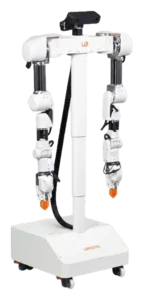
Weave Robotics publicly announced Isaac 0 on February 11, 2026 and opened Bay Area preorders at $7,999 upfront or $450 per month, marking the first consumer home robot specifically designed and sold for laundry folding.
Full assessment5 claims · 4 technical notes · 3 sources
Where it standsAutonomy LadderIIIIIIIVVLevel IIAssisted AutonomyHuman ReadinessReady NowNew to MarketWaitKnown IssuesNot ratedPre-Consumer Assessment03050717656PlausibleWhat happenedThe announcement drew on months of commercial deployments at Tumble Laundry and Seabreeze Cleaners in San Francisco as confidence evidence. Garment coverage expansion beyond t-shirts, hoodies, and towels, plus geographic rollout beyond the Bay Area, remain the primary milestones to track.
Bottom lineIsaac 0 is a real, shipping product with documented commercial pilot evidence, but the consumer home context introduces variables (mixed loads, workspace constraints, camera privacy) that the commercial pilot data does not fully address.
ImpactOn autonomy
- Stationary torso with dual 6-DOF arms handles common garments autonomously in 30-90 minutes
- Teleop specialists intervene in 5-10 second corrections for items the AI cannot resolve
- Weekly AI model updates delivered over Wi-Fi push continuous garment recognition improvement
- Level II classification confirmed: teleop fallback prevents end-to-end autonomous task completion
On readiness
- Bay Area-only shipping at launch limits availability to a narrow geographic cohort
- Two purchase paths available: $7,999 upfront with two-year warranty, or $450 monthly subscription
- Requires 6×5 ft dedicated workspace and stable internet, narrowing eligible households
- Early adopters gain preferred pricing credit toward forthcoming wheeled Isaac platform
Claim check5 maker claims checked against the record. Open one to read the finding.
Works with any laundry load right after install
Documented findingManufacturer documentation confirms Isaac 0 cannot handle large blankets or turn garments right-side out; pants and undergarments require remote specialist corrections in the current software versionA home robot for everyone
Documented findingShipping restricted to SF Bay Area residents only at launch; $7,999 purchase price or $450 monthly subscription narrows the accessible market substantiallyLearns from every correction and improves continuously
Documented findingWeekly AI model updates are documented; the rate of garment-coverage expansion has not been published by Weave Robotics, so improvement trajectory is unverifiedConfidence built from months of real-world deployment
Documented findingCommercial pilots at Tumble Laundry and Seabreeze Cleaners in San Francisco are documented by SF Standard and CBS News SF; these were institutional laundry environments, not home settings, which the company itself acknowledges as a more demanding contextA specialist sees only what is needed during corrections
Documented findingHead and wrist camera feeds stream to remote Weave specialists during teleop interventions; no opt-out from this monitoring model is documentedEvidence3 sources · all linked
31211 Feb 202621 Feb 2026filed 11 Feb 2026- 1Interesting Engineering16 Feb 2026
- 2New Atlas21 Feb 2026
- 3Humanoids Daily11 Feb 2026
Technical notes4 sections
Hardware Architecture
Isaac 0 is a stationary torso unit with dual arms providing six degrees of freedom each and a four-DOF neck. The telescoping torso allows reach to table level. Two-finger gripper design handles textile manipulation. The unit draws up to 600W from a standard 120V wall outlet with no onboard battery.
Sensing and Connectivity
RGB cameras on the head and wrist units provide visual input for onboard AI inference and remote specialist oversight during teleop corrections. Ethernet or dual-band Wi-Fi connectivity is required for both autonomous AI inference and teleoperation pipeline. No LiDAR or depth sensor is documented in manufacturer specifications.
Operating Model
The hybrid autonomy model routes garments through onboard AI for recognized items (t-shirts, hoodies, towels, shorts at launch) and escalates to a remote Weave specialist for 5-10 second corrections on items outside the current recognition envelope. Correction data feeds the weekly AI model update cycle. Garments confirmed outside the current scope: large blankets, inside-out garments.
Workspace Requirements
Manufacturer specifies a 48×30-inch folding table and a 6×5 ft clear zone. Installation is documented as a single-afternoon process requiring only a standard wall outlet connection.