
- Changes
- 3
- Tracking since
- Jun 2025
- Latest
- Oct 5, 2025
- Net movement
- Classification stable
- 2025
-
NVIDIA GR00T N1 integration on Calvin-40 confirmed via Jetson platform
Wandercraft released technical disclosures confirming the NVIDIA Isaac GR00T N1 humanoid foundation model runs on Jetson hardware inside Calvin-40.
Full assessment4 claims · 4 technical notes · 2 sources
Where it standsAutonomy LadderIIIIIIIVVLevel IIAssisted AutonomyHuman ReadinessReady NowNew to MarketWaitKnown IssuesNot ratedPre-Consumer Assessment03050717656PlausibleWhat happenedThe information clarifies the platform's AI architecture, including Visual Language Model integration for task reasoning. Fine-tuning methodology for specific assembly operations and real-world task-completion benchmarks remain undisclosed.
Bottom lineNVIDIA stack confirmation is meaningful architectural disclosure; task performance in Renault environments remains undocumented.
ImpactOn autonomy
- GR00T N1 foundation model provides pre-trained locomotion and manipulation priors for bipedal form
- Visual Language Models enable object recognition and instruction-following in factory environments
- Jetson onboard compute processes sensor fusion from day/night cameras and foot force sensors
- Task-reasoning capability scope on Calvin-40 specifically has not been benchmarked against published GR00T N1 evaluations
On readiness
- NVIDIA partnership lends compute-stack credibility to the platform's autonomy claims
- Onboard processing reduces dependency on cloud inference for factory-floor operation
- No software update cadence, version history, or maintenance protocol for GR00T N1 deployment disclosed
- Absence of published benchmarks limits independent assessment of reasoning capability
Claim check4 maker claims checked against the record. Open one to read the finding.
GR00T N1 enables autonomous navigation and task reasoning in factories
Documented findingGR00T N1 integration confirmed by NVIDIA and Wandercraft. Task-specific performance on Calvin-40 in factory conditions has not been published separately from NVIDIA's general GR00T N1 documentation.Jetson platform provides sufficient onboard compute for real-time operation
Documented findingNVIDIA Jetson is designed for edge AI workloads in robotics. Suitability for Calvin-40's specific sensor fusion and reasoning pipeline is confirmed by manufacturer; independent latency or throughput benchmarks are not available.Visual Language Models support complex instruction-following in assembly contexts
Documented findingVLM integration is part of the GR00T N1 architecture. How instructions are specified and what vocabulary of assembly tasks is supported on Calvin-40 has not been documented.Headless design simplifies the perception stack without capability loss
Documented findingRemoving the head eliminates head-mounted sensors and reduces system complexity. Whether this trades any perception coverage in overhead or behind-the-robot zones has not been addressed in available disclosures.Evidence2 sources · 1 linked
12Sep 2025Oct 2025filed 5 Oct 2025- 1NVIDIA Developer Blog28 Sep 2025named, not linked
- 2The Robot Report6 Oct 2025
Technical notes4 sectionsFoundation Model
Calvin-40 runs NVIDIA Isaac GR00T N1, a humanoid robot foundation model providing pre-trained locomotion, balance, and manipulation priors. GR00T N1 is designed for deployment on NVIDIA Jetson hardware and supports fine-tuning for task-specific workflows.
Compute Platform
NVIDIA Jetson serves as onboard compute. The specific Jetson module variant deployed in Calvin-40 has not been disclosed. Jetson handles sensor fusion, inference, and motor control in an onboard configuration that does not require external cloud compute for real-time operation.
Perception Inputs
Day and night cameras provide visual input for navigation and object recognition. Force sensors embedded in the feet supply balance and ground-contact feedback. The headless design eliminates a dedicated head-sensor array; all perception operates from body-mounted hardware.
Visual Language Model Integration
VLM capability is part of the GR00T N1 architecture and is confirmed present in Calvin-40. This supports natural-language task instruction and scene understanding. Which specific VLM component is used and how task vocabularies are defined for Renault assembly contexts has not been released.
-
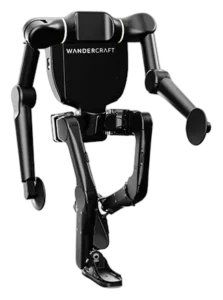
Wandercraft unveils Calvin-40 industrial humanoid built in 40 weeks
Wandercraft announced the Calvin-40 humanoid at a June 2025 event, citing a 40-day development cycle and exoskeleton-heritage actuation applied to a bipedal platform.
Full assessment4 claims · 4 technical notes · 2 sources
Where it standsAutonomy LadderIIIIIIIVVLevel IIAssisted AutonomyHuman ReadinessReady NowNew to MarketWaitKnown IssuesNot ratedPre-Consumer Assessment03050717656PlausibleWhat happenedThe headless, handless form factor and NVIDIA Isaac GR00T N1 foundation model were confirmed as the core architecture. Independent task documentation and published safety validation have not followed the announcement.
Bottom lineThe announcement establishes platform architecture and partnership context; task capability and safety validation remain undisclosed.
ImpactOn autonomy
- NVIDIA Isaac GR00T N1 and Jetson platform confirmed as primary compute stack
- Force sensors in feet and day/night cameras enable balance and visual navigation
- Headless, no-hands design scopes autonomy to locomotion and object transport, not manipulation
- No published evidence of multi-task or unscripted autonomous operation at announcement
On readiness
- Platform remains research-partnership-only; no consumer or open-market path announced
- Renault co-development context signals factory-pilot intent, not general deployment
- 40-week build timeline raises engineering-maturity questions unaddressed at launch
- No pricing, availability, or third-party validation disclosed at announcement
Claim check4 maker claims checked against the record. Open one to read the finding.
Built in 40 days, demonstrating rapid development capability
Documented finding40-day timeline confirmed by manufacturer; engineering-maturity implications undisclosed. Speed of build does not establish field reliability.Exoskeleton heritage transfers to bipedal autonomy
Documented findingWandercraft's prior exoskeleton work is in wearable human augmentation. Transfer to autonomous bipedal robotics is asserted, not documented with performance data.NVIDIA GR00T N1 enables autonomous navigation and task reasoning
Documented findingGR00T N1 integration confirmed. Manufacturer does not specify which tasks or environments have been validated on the Calvin-40 platform specifically.Designed for automotive manufacturing environments
Documented findingRenault partnership context supports this framing. No public disclosure of which assembly operations were tested or what success metrics apply.Evidence2 sources · 1 linked
2115 Jun 202516 Jun 2025filed 15 Jun 2025- 1The Robot Report16 Jun 2025
- 2Wandercraft Press Release15 Jun 2025named, not linked
Technical notes4 sectionsPlatform Architecture
Calvin-40 is a bipedal humanoid robot built on a 40-day development cycle. The designation Calvin-40 references the build duration as a program identifier. Wandercraft’s prior engineering base is wearable exoskeleton actuation for human rehabilitation and augmentation.
Compute and Navigation Stack
Primary compute is the NVIDIA Jetson platform running the Isaac GR00T N1 humanoid foundation model. Visual Language Models support task reasoning. Force sensors in feet provide balance feedback. Day/night cameras cover environmental perception. The headless, no-hands design eliminates head-mounted sensors and end-effector manipulation hardware.
Form Factor Implications
Absence of hands constrains task scope to locomotion, object transport via body contact, and pre-defined physical interactions. This is a deliberate design choice for assembly-line integration rather than an omission. No arm or gripper specifications are disclosed because none are present in the base configuration.
Open Items at Announcement
Task-level performance data, operating design domain boundaries, safety validation documentation, and joint-durability specifications were not released at the June 2025 announcement event.
-
Renault Group partnership positions Calvin-40 for automotive factory pilots
Wandercraft and Renault Group disclosed a co-development partnership positioning Calvin-40 for automotive factory integration.
Full assessment4 claims · 4 technical notes · 2 sources
Where it standsAutonomy LadderIIIIIIIVVLevel IIAssisted AutonomyHuman ReadinessReady NowNew to MarketWaitKnown IssuesNot ratedPre-Consumer Assessment03050717656PlausibleWhat happenedThe collaboration is the primary commercial signal for the platform. Neither party has released pilot scope, task performance data, or a timeline for broader industrial availability.
Bottom lineThe Renault partnership is a meaningful commercial signal, but trial outcomes and expansion plans remain undisclosed.
ImpactOn autonomy
- Automotive assembly-floor environment defines the operating design domain for initial pilots
- Factory integration implies structured, repeatable task cycles rather than generalized autonomy
- Bipedal form factor selected specifically to navigate human-designed workspaces without modification
- No documentation of multi-step autonomous task sequences within the Renault environment released
On readiness
- Partnership with a Tier-1 automotive manufacturer validates industrial deployment intent
- Pilot scope remains confidential; no third-party reporting on trial outcomes available
- No open-market or multi-customer deployment path disclosed alongside the partnership
- Consumer availability remains outside the stated scope of the Renault co-development program
Claim check4 maker claims checked against the record. Open one to read the finding.
Renault partnership validates Calvin-40 for industrial deployment
Documented findingPartnership existence confirmed by both parties. Pilot trial outcomes, task scope, and success criteria have not been publicly reported.Bipedal form factor uniquely suited to automotive manufacturing
Documented findingManufacturer rationale is that human-designed factory floors do not require environmental modification. No comparative performance data versus wheeled or fixed-arm alternatives has been published.Co-development accelerates path to broader industrial availability
Documented findingRenault partnership is described as co-development, not a procurement contract. Expansion beyond the Renault environment has not been announced.Exoskeleton actuation heritage reduces integration risk
Documented findingWandercraft's exoskeleton work provides actuation engineering background. Transfer of reliability characteristics to repetitive industrial cycles is not documented.Evidence2 sources · 1 linked
12Jun 2025Aug 2025filed 6 Jun 2025- 1Reuters20 Aug 2025named, not linked
- 2IEEE Spectrum22 Aug 2025
Technical notes4 sections
Partnership Structure
The Wandercraft-Renault co-development agreement was disclosed as part of the Calvin-40 platform announcement in mid-2025. Renault Group’s involvement positions the robot for automotive manufacturing environments specifically, with Wandercraft responsible for platform development and Renault contributing factory-integration context.
Deployment Environment
Automotive assembly floors present structured, repeatable workflows with defined task stations. The bipedal form factor is cited by Wandercraft as appropriate for navigating aisles, stairs, and workstations designed for human operators. No environmental modification requirements for Renault facilities have been disclosed.
Commercial Status
The partnership is classified as co-development rather than a volume supply agreement. No per-unit pricing, minimum order quantity, or timeline for pilot-to-production transition has been announced. Access outside the Renault relationship is not currently available.
Open Items
Renault has not published trial results, task completion rates, or safety incident data. Partnership confidentiality appears to restrict third-party access to pilot outcomes at this stage.