
- Changes
- 3
- Tracking since
- Nov 2022
- Latest
- Oct 22, 2024
- Net movement
- Classification stable
- 2024
-
Starship reports seven million deliveries completed; Level II classification held
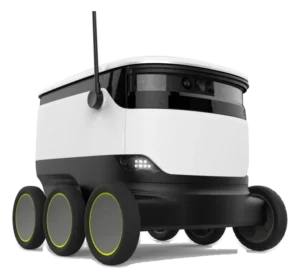
Starship Technologies announced that its cumulative delivery count surpassed seven million, extending the fleet's documented operational record.
Full assessment4 claims · 4 technical notes · 2 sources
Where it standsAutonomy LadderIIIIIIIVVLevel IIAssisted AutonomyHuman ReadinessReady NowNew to MarketWaitKnown IssuesNot ratedPre-Consumer Assessment↑ moved by this entry03050717690Pre-Order ReadyWhat happenedThe milestone follows the four-million mark reported in mid-2023 and reflects continued fleet growth across campus and corporate-zone deployments. Remote-operator fallback remains integral to the delivery model; the Level II classification is unchanged.
WatchingFor any Starship disclosure on operator-intervention frequency, which would provide the first publicly available signal on whether the fallback dependency is narrowing over time.
Bottom lineSeven million deliveries is the strongest operational-credibility data point in sidewalk delivery robotics; the autonomy qualifier and regulatory context are essential for accurate classification.
ImpactOn autonomy
- Seven million deliveries does not alter onboard navigation or sensor architecture
- Remote-operator fallback model documented as unchanged in Starship fleet communications
- Level II classification confirmed; milestone is a volume record, not an autonomy advancement
On readiness
- Cumulative delivery scale strengthens the institutional reliability argument for campus partners
- Fleet-only deployment model continues with no consumer availability announced
- Operational envelope restricted to pre-mapped campus and corporate-zone service areas
Claim check4 maker claims checked against the record. Open one to read the finding.
Seven million deliveries demonstrates full autonomy at scale
Documented findingDeliveries completed under Starship's hybrid autonomous-plus-teleop model; remote operators handle scenarios the onboard system cannot resolve independentlyFastest-growing autonomous delivery fleet globally
Documented findingStarship holds a documented delivery milestone record for sidewalk delivery robots; comparative fleet growth rate against competitor platforms is not independently auditedProven safety record across millions of deliveries
Documented findingStarship cites the delivery count as a safety proxy; incident rate per delivery, near-miss data, and pedestrian-interaction event frequency are not published in available Starship materialsReady for urban street deployment beyond campuses
Documented findingStarship's operational deployment as of this milestone remains in campus and corporate-park service zones; general public urban sidewalk deployment is subject to regulatory permitting not in place at scaleEvidence2 sources · 1 linked
1221 Oct 202424 Oct 2024filed 22 Oct 2024- 1Starship Technologies Press Release21 Oct 2024named, not linked
- 2IEEE Spectrum24 Oct 2024
Technical notes4 sectionsMilestone and Classification Note
Starship’s seven-million-delivery announcement was covered in technology and logistics press in late 2024. The company cited the milestone as evidence of fleet reliability and operational maturity. No hardware revision, software architecture change, or operator-model restructuring was announced alongside the milestone.
Autonomy Architecture Status
Starship’s published technical descriptions continue to characterize the platform as using AI-based obstacle detection with remote-operator fallback for complex scenarios. LiDAR and camera sensor arrays, onboard mapping, and cellular-plus-Wi-Fi connectivity for operator access are consistent with earlier deployment descriptions. No autonomous-only operational mode without remote-operator availability has been announced.
Fleet Scale Context
From four million deliveries in mid-2023 to seven million in late 2024, the fleet added roughly three million deliveries in approximately 15 months. This rate reflects either expanded campus count, increased per-campus utilization, or both; Starship has not disaggregated the milestone by deployment site in available public communications.
Classification Implication
Volume milestones provide operational credibility evidence but do not modify the autonomy ladder classification. The Level II cap derives from architectural design (teleop fallback), not from operational history length or delivery count. A classification change to Level III would require documented end-to-end task completion without operator availability as a fallback.
-
Starship expands US campus deployment footprint with additional university partnerships
Starship Technologies announced partnerships with additional US university campuses in early 2024, expanding its domestic deployment footprint through its established campus-operator model.
Full assessment4 claims · 4 technical notes · 2 sources
Where it standsAutonomy LadderIIIIIIIVVLevel IIAssisted AutonomyHuman ReadinessReady NowNew to MarketWaitKnown IssuesNot ratedPre-Consumer Assessment03050717690Pre-Order ReadyWhat happenedEach new campus follows Starship's standard deployment pattern: service-zone mapping, charging-station installation, and staff onboarding. The expansion adds operational environments but does not modify the platform's autonomy architecture or Level II classification.
WatchingFor reporting on whether new campuses include any operational model variations, such as reduced remote-operator staffing ratios.
Bottom lineCredible commercial expansion within an established model; no capability advancement and no change to the teleop-fallback architecture that determines the Level II classification.
ImpactOn autonomy
- No change to onboard navigation or sensor architecture with campus expansion
- New service zones add environmental diversity to fleet operational dataset
- Remote-operator fallback model deployed identically across all new campuses
On readiness
- Additional campus deployments extend institutional reference base for procurement decisions
- Consumer retail availability remains unavailable; campus-only fleet model continues
- Deployment timelines at new campuses follow Starship's documented multi-week onboarding process
Claim check4 maker claims checked against the record. Open one to read the finding.
Effortless campus integration with immediate service launch
Documented findingCampus deployments require service-zone mapping, charging-infrastructure installation, and staff onboarding; Starship deployment communications describe a multi-week setup processAutonomous operation on any campus environment
Documented findingStarship operates within pre-mapped service zones on each campus; routes outside designated zones are not served; irregular terrain or unmapped areas require operational exclusionScales seamlessly to new locations
Documented findingEach new campus requires dedicated infrastructure investment and mapping; Starship has not published a self-serve or accelerated onboarding pathway for new partnersProven technology ready for any institution
Documented findingStarship's deployments are concentrated on US and European universities with predictable sidewalk networks; applicability to campuses with complex terrain, weather extremes, or dense pedestrian zones is not independently validatedEvidence2 sources · 1 linked
126 Mar 202412 Mar 2024filed 8 Mar 2024- 1Starship Technologies Announcement6 Mar 2024
- 2EdTech and Campus Technology News12 Mar 2024named, not linked
Technical notes4 sectionsExpansion Model
Starship’s campus deployment model requires physical infrastructure preparation at each new site: charging docks, mapped service corridors, and operator-support integration. Each campus is treated as a discrete service zone; robots do not navigate between campuses or operate outside their pre-mapped area.
Platform Unchanged
Robot hardware and software architecture at the 2024 expansion wave matched the configuration used in earlier deployments. LiDAR and camera-based navigation with AI obstacle detection, remote-operator fallback via cellular and Wi-Fi connectivity, and payload-tray design all carried forward without documented revision.
Operational Scope at Expansion
Campus delivery services cover food, beverages, and convenience items sourced from on-campus dining and retail partners enrolled in the Starship operator program. Service hours are set per campus based on operational demand; overnight and weather-suspension policies vary by site per Starship campus communications.
No Consumer Pathway
The 2024 expansion reinforced the B2B campus-operator model. No retail product, consumer subscription, or individual-user pathway was announced in conjunction with the expansion. Starship’s public-facing positioning during this period remained institutional.
- 2022
-
Starship Technologies reports four million deliveries completed across fleet
Starship Technologies announced that its delivery robot fleet surpassed four million cumulative deliveries, the highest publicly confirmed delivery-count milestone at the time for an autonomous sidewalk delivery platform.
Full assessment4 claims · 4 technical notes · 2 sources
Where it standsAutonomy LadderIIIIIIIVVLevel IIAssisted AutonomyHuman ReadinessReady NowNew to MarketWaitKnown IssuesNot ratedPre-Consumer Assessment↑ moved by this entry03050717690Pre-Order ReadyWhat happenedThe milestone is significant as operational evidence of fleet reliability at scale, though it does not alter the platform's Level II classification, which reflects the teleop-fallback architecture rather than delivery volume.
WatchingFor subsequent Starship milestone announcements and any published data on per-delivery operator-intervention rates.
Bottom lineFour million deliveries is a meaningful operational credential; the autonomy qualification that remote operators remain part of the system is essential context for the milestone.
ImpactOn autonomy
- Delivery count milestone does not modify onboard autonomy architecture
- Remote-operator fallback remains the mechanism capping classification at Level II
- Large delivery dataset may inform future navigation model improvements per Starship technical communications
On readiness
- Four million deliveries provides substantial fleet reliability signal for institutional partners
- No consumer retail availability announced; fleet-only model continues
- Campus and corporate-park operational envelope unchanged
Claim check4 maker claims checked against the record. Open one to read the finding.
Fully autonomous delivery at scale
Documented findingStarship's own documentation describes remote-operator fallback for complex scenarios; four million deliveries were completed under this hybrid model, not under full autonomyFour million deliveries proves safety and reliability
Documented findingDelivery count is a volume metric; per-delivery incident rate, operator-intervention frequency, and safety event data are not published in available Starship materialsMarket-ready for broad deployment beyond campuses
Documented findingStarship operates in designated campus and corporate zones; general public sidewalk deployment at scale is not documented in this milestone announcementMilestone demonstrates autonomous navigation superiority
Documented findingMilestone reflects operational persistence across managed environments with remote-operator support; autonomous navigation capability is well-documented but the fallback model is integral to the delivery countEvidence2 sources · 1 linked
12Nov 2022Jul 2023filed 1 Nov 2022- 1Starship Technologies Press Release17 Jul 2023named, not linked
- 2TechCrunch19 Jul 2023
Technical notes4 sections
Milestone Context
Starship Technologies began campus deployments in 2018-2019 at US and European university campuses. The four-million-delivery figure, cited in Starship’s own communications and covered by technology press in mid-2023, represents accumulated deliveries across all active deployment zones including university campuses, corporate parks, and selected residential neighborhoods in managed zones.
Fleet Architecture at Milestone
Each Starship robot operates with LiDAR, camera arrays, and AI-based obstacle detection. Remote operators monitor fleet units and assume manual teleoperation control when robots encounter scenarios outside their autonomous-operation envelope. This architecture was unchanged at the milestone announcement.
Operational Scope
Deployments at milestone date spanned more than 20 US college campuses and multiple European locations. Delivery categories include food, groceries, and campus convenience items within mapped service zones.
Data Transparency
Starship published the cumulative delivery count; operational metrics such as mean-time-between-operator-interventions, per-delivery incident rates, and fleet-wide uptime figures were not disclosed in conjunction with the milestone announcement.