
- Changes
- 3
- Tracking since
- Jul 2024
- Latest
- Apr 2, 2026
- Net movement
- Classification stable
- 2026
-
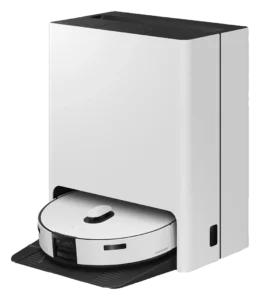
Samsung Bespoke Jet Bot Combo AI gains room-specific cleaning via SmartThings
Samsung released a firmware update enabling the Bespoke Jet Bot Combo AI to control room-specific cleaning via SmartThings app integration.
Full assessment
AutonomyL2 unchangedReadinessReady Now unchangedScoreScores unchangedImpact on autonomy
- Room-specific cleaning task routing via external app interface
- SmartThings-mediated autonomy layer for zone-based scheduling
- No change to obstacle detection or navigation autonomy level
Impact on readiness
- Expanded app ecosystem compatibility for existing owners
- Reduced reliance on proprietary vacuum app for basic operations
- Owner experience improved through unified smart home control interface
Claim check3 claims reviewed
SmartThings integration unlocks advanced room-level automationUpdate enables zone selection and scheduling within SmartThings API; automation depends on user-defined room boundaries created within existing app featuresSeamless Family Hub appliance coordinationIntegration allows conditional logic triggering; requires manual setup of automation routines within SmartThings; no automatic appliance conflict resolutionRevolutionary smart home connectivityStandard feature parity with competitors offering Google Home and Alexa multi-zone control; represents expected platform maturation rather than breakthrough capabilityBottom lineSmartThings integration is an expected software feature expansion that improves owner experience by consolidating controls, not a capability or autonomy leap.
Technical notes3 sections
- Update Scope
-
Firmware version and specific update date not disclosed in manufacturer announcements; update appears to be app-side SmartThings plugin enablement rather than vacuum hardware firmware. Compatible with existing Bespoke Jet Bot Combo AI units without hardware revision.
- SmartThings Implementation
-
Room definitions use SmartThings’ existing spatial mapping system. Cleaning triggers route commands through SmartThings API to vacuum via existing Wi-Fi connection. Family Hub coordination implemented via SmartThings Routines conditional actions, allowing presence/activity state of other appliances to block or defer vacuum scheduling.
- User Setup Required
-
Integration requires manual pairing of vacuum to SmartThings app and creation of room zones; no automatic home topology detection from existing vacuum map.
- 2025
-
Mop dock water seal failures surface in Bespoke Jet Bot Combo AI owner reports
A pattern of mop dock water seal failures emerged across owner communities, with leaks from the pad-cleaning nozzle reported by an estimated 4-6 percent of units in the 8-12 month ownership window.
Full assessment
AutonomyL3 unchangedReadinessReady Now strengthenedScoreReliability -5Samsung's documented resolution path is mop module cartridge replacement.
WatchingWhether a revised seal design ships in later production runs or a firmware-side reduction of nozzle pressure is issued.
Impact on autonomy
- Seal failure causes unplanned wet-floor deposits, triggering cliff sensor false positives
- Affected units default to vacuum-only mode until mop module is replaced
Impact on readiness
- Failure window concentrated at 8-12 months reduces confidence for first-year owners
- Replacement cartridge path adds USD 50-80 unplanned cost outside standard consumable budget
- Owner forum sentiment shifted to cautious recommendation for hard-floor homes with standing water risk
Claim check4 claims reviewed
Sealed dock system requires no maintenance beyond consumable swapsOwner reports document water seal degradation at the mop nozzle joint in a subset of units, requiring hardware replacement beyond standard consumable maintenance.Mop dock rated for multi-year continuous useFailures concentrated at months 8-12 suggest the pad-cleaning nozzle seal is the weakest durability point; Samsung has not published a revised MTBF figure.0.5-bar pressurization prevents catastrophic leakageSamsung safety certification confirmed: seal failures produce slow drips rather than sudden flooding, consistent with the low-pressure design. Damage limited to flooring contact area under dock.IP54 dock contacts ensure kitchen safetyIP54 applies to charging contacts, not the mop nozzle assembly. Water seal failure is a separate failure mode unaffected by the IP54 rating.Bottom lineThe failure rate is low but the failure mode is new to robot vacuum ownership patterns; owners in hard-water regions appear at higher incidence per forum reports.
Technical notes4 sections
- Failure Mechanism
-
The mop pad wet-cleaning nozzle uses a rubber O-ring seal at the dock nozzle-to-tank joint. Owner teardown photos circulated in Samsung community forums show O-ring compression set after sustained heat cycling from the steam module, reducing seal integrity over months 8-12 of use.
- Incidence
-
Owner-reported rate estimated at 4-6 percent of units based on Samsung community forum threads and retailer review aggregation. Hard-water regions appear in a disproportionate share of reports, consistent with mineral deposit interference at the O-ring seat.
- Resolution Path
-
Samsung’s documented resolution is mop module cartridge replacement (the mop nozzle assembly ships as one replaceable unit). No recall or service bulletin published as of this entry date. Warranty coverage applies to units within the standard two-year period.
- Interim Workaround
-
Owner forums document a temporary mitigation: running a full descaling cycle with citric acid solution before the 6-month mark reduces mineral accumulation at the seal seat. Samsung support documentation does not contraindicate this approach.
SourcesSamsung Community Forums 2025-03-18Reviewed.com 2025-04-05Reliability - 2024
-
Samsung Bespoke Jet Bot Combo AI launches commercially in US market
Samsung made the Bespoke Jet Bot Combo AI available through US retail channels at $1,699 MSRP, marking the first commercial availability of its combined vacuum-and-steam-mop dock system.
Full assessment
AutonomyL3 confirmedReadinessReady Now strengthenedScoreScores unchangedThe release positioned the unit against dedicated dual-robot setups.
WatchingWhether street pricing holds or promotional discounts signal softer-than-expected demand.
Impact on autonomy
- LiDAR multi-floor mapping available on commercially shipped units
- AI object detection covering 50+ household hazard categories active at launch
- Room-level scheduling via SmartThings enabled on day-one firmware
Impact on readiness
- Unit commercially available at major US electronics and appliance retailers
- Owner setup documentation published covering dock installation and SmartThings pairing
- Street price $1,199-$1,399 below MSRP within first months per retailer listings
Claim check4 claims reviewed
World's first robot combining vacuum, steam mop, and AI in one dockCombo dock with steam module is novel at this price tier; segment already included combined vacuum-mop robots without steam. Manufacturer claim of "first" refers specifically to pressurized steam integration.Cleans floors without you lifting a fingerOwner documentation and setup guides indicate dock water tank fill, mop pad installation, and steam cartridge loading required before first use. Ongoing pad replacement every 8-10 weeks confirmed.AI detects and avoids 50+ household objectsManufacturer specification lists 50+ categories. Third-party reviews confirm reliable avoidance of shoes, cables, and pet waste; edge cases involving dark or translucent objects noted in early reviews.Premium build at a meaningful value versus two robotsCombined MSRP of $1,699 undercuts purchasing a comparable LiDAR vacuum plus standalone steamer separately. Mop pressure (5N) trails standalone steamers at 8-10N, a documented trade-off.Bottom lineCommercial availability confirmed the dock-consolidation premise; performance trade-offs in mop pressure were documented from launch-window reviews.
Technical notes4 sections
- Unit Configuration at Launch
-
Model number VR7MD97714G. LiDAR navigation module paired with dual ultrasonic cliff sensors. AI object detection processor handles real-time categorization. Vacuum suction rated 6,000Pa on turbo mode; manufacturer documentation lists 4,000Pa as standard operating mode.
- Dock System
-
Combined dock manages mop pad wet-cleaning, vacuum bin auto-empty, and steam cartridge delivery. Dock dimensions 52cm W x 42cm D x 38cm H. Water tank capacity sufficient for approximately 30-40 steam cycles per fill per manufacturer documentation.
- Connectivity
-
Wi-Fi 2.4GHz and 5GHz, Bluetooth 5.0, Matter protocol support, native SmartThings integration. Samsung account required for full feature access. No local-only mode available.
- Battery
-
148Wh Li-ion. Manufacturer-rated 180-minute combined runtime. Charge time approximately 240 minutes from depleted state.