
- Changes
- 2
- Tracking since
- Sep 2024
- Latest
- May 21, 2025
- Net movement
- Classification stable
- 2025
-
Pudu D7 enters commercial pilot phase in logistics and hospitality environments
Industry reporting in mid-2025 noted Pudu D7 units entering commercial pilot programs across warehouse logistics and hospitality environments, providing the first third-party documentation of the platform operating beyond announcement-stage.
Full assessment4 claims · 4 technical notes · 2 sources
Where it standsAutonomy LadderIIIIIIIVVLevel IIAssisted AutonomyHuman ReadinessReady NowNew to MarketWaitKnown IssuesNot ratedPre-Consumer Assessment03050717689Pre-Order ReadyWhat happenedCoverage described pick-and-place and object-staging tasks as the primary use cases, consistent with the dual-arm design intent disclosed at launch.
WatchingWhether pilot customers disclose performance data or expand to multi-site contracted deployment within the following 12 months.
Bottom lineEntry into commercial pilots advances the D7 past announcement stage; documented performance metrics from those pilots remain the key evidence gap.
ImpactOn autonomy
- Pick-and-place and object-staging tasks documented as operational use cases in pilot environments
- Dual-arm coordination confirmed in structured commercial workflows under operator supervision
- Operator intervention required for task variants outside pre-programmed sequences; consistent with Level II classification
On readiness
- Commercial pilot access marks progression from announcement to operational validation stage
- Industrial and hospitality pilot customers accessing platform; no consumer purchase path or retail pricing disclosed
- Pilot scope limited to supervised structured environments; broad commercial availability not yet announced
Claim check4 maker claims checked against the record. Open one to read the finding.
D7 dual arms deliver genuine manipulation capability in commercial settings
Documented findingPilot coverage describes pick-and-place and staging tasks completed under supervision; fine-manipulation benchmarks and failure-rate data not published in available reportingWheeled base enables flexible deployment across diverse commercial spaces
Documented findingPilot deployments described in warehouse and hospitality settings; multi-floor transitions requiring physical relocation between levels documented as a constraint in manufacturer materialsD7 operates reliably across shift-length duty cycles
Documented findingCommercial pilot deployments suggest operational stability; specific duty-cycle reliability data (uptime percentage, mean time between interventions) not published in press coverage reviewedPudu's service robot track record transfers to D7 deployment outcomes
Documented findingManufacturer references BellaBot fleet heritage for navigation and mobility reliability; dual-arm manipulation represents new capability with its own validation requirements separate from prior fleet performanceEvidence2 sources · 1 linked
1219 May 202527 May 2025filed 21 May 2025- 1Robotics Business Review19 May 2025named, not linked
- 2The Robot Report27 May 2025
Technical notes4 sectionsPilot Deployment Contexts
Mid-2025 press coverage described Pudu D7 pilot deployments in two primary contexts: warehouse logistics (pick-and-place, bin staging, order assembly support) and supervised hospitality environments (equipment handling, object transport between service areas). Both contexts operate with on-site staff managing task handoffs and exception handling.
Arm Coordination in Operational Tasks
Pilot coverage indicated the D7’s dual-arm system operating in a coordinated mode for two-handed object handling tasks, consistent with the 7-DOF-per-arm architecture disclosed at announcement. Single-arm tasks (lighter pick operations, tool handoffs) also documented in coverage.
Navigation in Pilot Environments
The omnidirectional wheeled base provided autonomous routing on single-level flat surfaces in pilot facilities. Coverage noted operator-assisted relocation for multi-floor transitions in hospitality settings, consistent with the design constraints disclosed in manufacturer materials.
Operational Model
Pilot deployments operated under a supervised model: pre-programmed task sequences handle routine workflows, teleoperation available for edge-case intervention. This matches the Level II operational model documented in Pudu’s product materials and is consistent with the D7’s autonomy_level classification.
- 2024
-
Pudu D7 semi-humanoid robot with dual 7-DOF arms announced September 2024
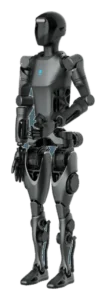
Pudu Robotics announced the D7 on September 19, 2024, unveiling a wheeled semi-humanoid platform combining the company's mobile base heritage with dual 7-DOF arms and a 30-DOF bionic upper body.
Full assessment4 claims · 4 technical notes · 2 sources
Where it standsAutonomy LadderIIIIIIIVVLevel IIAssisted AutonomyHuman ReadinessReady NowNew to MarketWaitKnown IssuesNot ratedPre-Consumer Assessment03050717689Pre-Order ReadyWhat happenedThe announcement positioned the D7 as a purpose-built manipulation platform distinct from Pudu's existing hospitality and delivery robot lines.
WatchingWhether disclosed arm dexterity translates into documented commercial task performance beyond the initial announcement.
Bottom lineThe September 2024 announcement established a credible hardware architecture; dexterity benchmarks and commercial task scope remain to be documented through pilot deployments.
ImpactOn autonomy
- Dual 7-DOF arm architecture introduces manipulation capability not present in prior Pudu wheeled platforms
- 30-DOF bionic upper body disclosed as the manipulation substrate; arm workspace dimensions not specified at announcement
- Wheeled omnidirectional base provides mobile manipulation foundation at up to 2 m/s
On readiness
- Announcement stage only; no commercial availability date or pricing disclosed
- Design targets industrial pilot and commercial supervised deployment contexts
- No consumer purchasing path announced; requires facility integration and operator oversight
Claim check4 maker claims checked against the record. Open one to read the finding.
Semi-humanoid platform capable of human-like task performance
Documented findingDual 7-DOF arms disclosed with 30-DOF bionic upper body; specific task categories and dexterity benchmarks not published at announcementD7 extends Pudu's service robot capabilities into manipulation
Documented findingAnnouncement positions D7 as a manipulation-focused platform; how tasks translate from existing Pudu fleet workflows to dual-arm operations not detailed at launchWheeled base delivers flexible deployment across environments
Documented findingOmnidirectional base provides flat-surface mobility; manufacturer materials note limitations on multi-floor and stair-based navigation consistent with wheeled-platform constraintsD7 combines mobility and manipulation for broad commercial use
Documented findingAnnouncement covers architecture; deployment environments and commercial customer categories referenced as pilot targets, not confirmed use cases, at September 2024 disclosureEvidence2 sources · all linked
1219 Sep 202423 Sep 2024filed 19 Sep 2024- 1Pudu Robotics Press Release19 Sep 2024
- 2The Robot Report23 Sep 2024
Technical notes4 sections
Platform Architecture
The Pudu D7 uses a wheeled omnidirectional base providing mobility up to 2 m/s, combined with a semi-humanoid upper body. The dual-arm system uses 7-DOF configuration per arm, with the full upper body reporting 30 degrees of freedom across the bionic arm and torso structure.
Form Factor Distinction
The D7’s wheeled lower body differentiates it from bipedal humanoid platforms. The manufacturer disclosed dimensions of approximately 700 mm width, 1,200 mm height, and 600 mm depth, with a reported weight in the 130 kg range based on published specifications. The wheeled stance provides a wider, more stable footprint than bipedal alternatives at the cost of stair and ramp traversal capability.
Autonomy Infrastructure
At announcement, the D7 was described as operating with autonomous navigation in structured spaces and supervised fallback to teleoperation for edge cases. Pre-programmed task sequences handle repeat workflows; novel handoff tasks require operator-guided operation or taught demonstrations.
Product Lineage
Pudu Robotics disclosed the D7 as a distinct product from its BellaBot service robot and delivery robot lines. The D7 shares navigation heritage but introduces an entirely new manipulation architecture not present in existing Pudu products.