
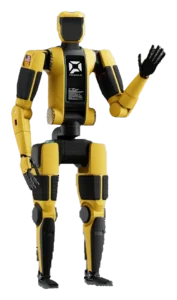
- Changes
- 4
- Tracking since
- Jun 2024
- Latest
- Aug 24, 2026
- Net movement
- Classification stable
- 2026
-
Persona AI Names Shipyard Welding Its First Commercial Deployment Target
IEEE Spectrum's Aug 17, 2026 profile reports Persona AI has deliberately chosen shipyard welding, not general-purpose demonstrations, as its first commercial target, citing repetitive, millimeter-scale work suited to a legged humanoid in open-air shipyards.
Full assessment4 claims · 3 technical notes · 2 sources
Where it standsAutonomy LadderIIIIIIIVVLevel IIAssisted AutonomyHuman ReadinessReady NowNew to MarketWaitKnown IssuesNot ratedPre-Consumer Assessment03050717658PlausibleWhat happenedThe company targets built prototypes by end of 2026 and welding readiness in 2027.
WatchingFor a disclosed prototype and whether the SSE and POSCO pilots yield autonomous task evidence.
Bottom lineThis is a disclosed commercial strategy update, not a capability advance or classification change.
ImpactOn autonomy
- Strategic focus on welding targets repetitive, millimeter-scale tasks, not new autonomy
- No end-to-end autonomous welding task has been publicly demonstrated to date
- Prototype hardware targeted by end of 2026, welding readiness projected for 2027
On readiness
- Commercial strategy announcement does not change Persona AI Gen 1's pre-release readiness
- SSE Steel Fabrication and POSCO pilots remain supervised, data-collection efforts only
- No shipyard welding RaaS contract or commercial deployment has been announced
Claim check4 maker claims checked against the record. Open one to read the finding.
Persona AI has strategically targeted shipyard welding as its ideal first commercial deployment
Documented findingIEEE Spectrum reports the choice reflects millimeter-scale, repetitive work suited to a legged humanoid, but no autonomous welding deployment has occurredPrototypes are on track for completion by end of 2026
Documented findingThis is a company-stated target reported by IEEE Spectrum, not a shipped or independently verified milestoneShipyard welding readiness is expected in 2027
Documented findingCurrent pilots (SSE Steel Fabrication, POSCO) remain supervised data-collection efforts; no autonomous task completion has been publishedOpen-air shipyards suit a legged humanoid better than other form factors
Documented findingThis is Persona AI's stated rationale; no independent deployment data compares form factors in this settingEvidence2 sources · 1 linked
- 1IEEE Spectrum17 Aug 2026
- 2The Robot Reportnamed, not linked
Technical notes3 sectionsStrategic Focus
IEEE Spectrum’s Aug 17, 2026 profile details Persona AI’s decision to prioritize shipyard welding as its first commercial deployment target rather than pursuing general-purpose humanoid demonstrations. The Houston-based company, co-founded by Nicolaus Radford (former lead of NASA’s Valkyrie humanoid program, founder of Nauticus Robotics) and Jerry Pratt (former IHMC and Figure AI CTO), frames welding as a task suited to a legged humanoid: millimeter-scale and repetitive work that humans find fatiguing, and historically one of the first tasks sold to industrial robots.
Shipyard Environment
Open-air shipyards span hundreds of meters, require stepping over spars, and demand work performed at ground level, overhead, and through portholes, conditions the company argues favor a legged form factor over wheeled or fixed-arm alternatives.
Timeline and Context
Persona AI targets built prototypes by end of 2026, with shipyard welding readiness targeted for 2027. This strategic-focus reporting builds on, but does not repeat, the company’s May 2025 MOU with HD Hyundai/HD Korea Shipbuilding and Offshore Engineering. Current pilots, SSE Steel Fabrication (Louisiana, Jan 2026) and a POSCO on-site proof of concept (from Feb 2026), remain supervised and data-collection focused.
-
Louisiana Partners with Persona AI on Humanoid Pilot at SSE Steel Fabrication
On January 22, 2026, the State of Louisiana and Persona AI announced an MOU to pilot humanoid robotics at SSE Steel Fabrication in St.
Full assessment5 claims · 3 technical notes · 1 source
Where it standsAutonomy LadderIIIIIIIVVLevel IIAssisted AutonomyHuman ReadinessReady NowNew to MarketWaitKnown IssuesNot ratedPre-Consumer Assessment03050717658PlausibleWhat happenedBernard Parish, the first formal U.S. state partnership supporting humanoid deployment in an active industrial facility. The pilot focuses on collecting human motion and task data to train Gen 1 control systems for welding and fabrication roles.
WatchingWhether this data-collection phase transitions to autonomous robot operation within SSE's live production environment.
Bottom lineThe SSE Steel pilot is the first live-facility commitment in Persona AI's program; robot operational deployment depends on data-collection outcomes yet to be reported.
ImpactOn autonomy
- Live industrial motion-capture data from SSE Steel will inform Gen 1 perception and movement models
- Humanoid robots to navigate uneven terrain and use existing tools alongside skilled workers
- Task scope includes metal welding, floor-plan recognition, and dynamic environment adaptation
- No autonomous operation confirmed at pilot launch; data collection precedes deployment phase
On readiness
- First active industrial pilot site announced, progressing beyond agreement-only stage
- State economic development agency (LA.IO) involvement adds governmental validation
- SSE Steel pilot positions Louisiana as a test site for commercial humanoid deployment
- Pilot scope limited to data collection; timeline to live robot tasking not yet disclosed
Claim check5 maker claims checked against the record. Open one to read the finding.
First formal state partnership supporting humanoid robotics development in a live industrial setting
Documented findingGlobeNewswire press release characterizes it this way; no contradicting prior state partnership documented at time of announcementHumanoids will handle "dull, dirty, dangerous, and declining" work
Documented findingGlobeNewswire and LED (Louisiana Economic Development) release language; consistent with stated welding-risk rationale but no operational data yetRobots will "recognize factory floor plans, weld sheets of metal, and collect data through motion capture
Documented findingStated capabilities from Interesting Engineering coverage of the announcement; these are target tasks, not demonstrated capabilities at pilot launchSkilled workers will transition into "supervision and quality assurance" roles
Documented findingStated workforce framing in press release; no SSE Steel workforce agreement or job-transition plan documented at announcementLouisiana positioned as "national leader in embodied AI for advanced manufacturing
Documented findingLouisiana Economic Development (LA.IO) framing; based on single pilot agreement at time of announcementEvidence1 source · all linked
- 1GlobeNewswire22 Jan 2026
Technical notes3 sectionsPilot Site
SSE Steel Fabrication’s facility in St. Bernard Parish, Louisiana. SSE Steel operates a large-scale fabrication environment with active production, providing conditions that conventional fixed automation cannot address. The facility was selected as the industrial proving ground for Persona AI’s Gen 1 platform ahead of its scheduled release.
Data Collection Scope
The pilot’s primary function at announcement is collecting real-world human movement and task data within an operating steel manufacturing environment. This data is intended to inform how Gen 1 humanoid systems perceive, move through, and work alongside skilled tradespeople in complex, dynamic settings. Motion-capture integration within a live production environment distinguishes this from laboratory collection.
Governance Structure
Louisiana Innovation (LA.IO), a division of Louisiana Economic Development, facilitated the MOU. The state’s involvement is framed as part of a broader initiative to position Louisiana as a center for embodied AI and next-generation manufacturing workforce technology. Additional pilot program details were listed as forthcoming at announcement.
- 2025
-
Persona AI and HD Hyundai Sign Humanoid Welding MOU for Shipyards
On May 7, 2025, HD Korea Shipbuilding and Offshore Engineering, HD Hyundai Robotics, Persona AI, and Vazil Company signed an MOU to develop humanoid robots capable of high-precision welding in shipyard environments.
Full assessment5 claims · 3 technical notes · 2 sources
Where it standsAutonomy LadderIIIIIIIVVLevel IIAssisted AutonomyHuman ReadinessReady NowNew to MarketWaitKnown IssuesNot ratedPre-Consumer Assessment03050717658PlausibleWhat happenedThe agreement designates Persona AI as hardware and AI-control lead, with field testing targeting 2027.
WatchingWhether the prototype delivery milestone at end of 2026 holds as the four-party program moves into active development.
Bottom lineThe four-party MOU structures a credible development path; hardware validation remains ahead.
ImpactOn autonomy
- Welding task mandate requires end-to-end high-precision tool manipulation in live environments
- HD Hyundai Robotics to supply welding-path AI training data for autonomy development
- Field engineering data from HD KSOE shipyards will inform environment perception training
- No autonomous welding capability demonstrated at agreement signing
On readiness
- First named industrial customer relationship established via formal MOU structure
- Deployment timeline set: prototype end 2026, field testing and commercialization 2027
- Vazil Company integration adds welding-tool and testing-environment infrastructure
- Agreement scope limited to development phase; commercial revenue not yet contracted
Claim check5 maker claims checked against the record. Open one to read the finding.
Humanoid robots performing "complex welding tasks" in shipyards
Documented findingMOU stage only; prototype completion targeted for end of 2026 per PR Newswire release; no welding capability demonstrated at signingHD Hyundai described as "global leader in shipbuilding
Documented findingHD Hyundai is among the largest shipbuilders by tonnage; characterization consistent with public industry dataPartnership to address "chronic skilled labour shortage" in welding
Documented findingShipbuilding workforce shortages are documented across industry reporting; the MOU's ability to deliver welding automation depends on prototype deliveryPersona AI leads "humanoid hardware and AI-based control and learning algorithms
Documented findingConfirmed role assignment in PR Newswire release; no hardware specification or control architecture disclosed at signingInitial delivery expected "within 18 months" of funding close
Documented findingPR Newswire funding release (May 14, 2025) cites 18-month delivery window; the MOU (May 7, 2025) separately targets end-2026 prototype, giving approximately two calendar periods to reconcileEvidence2 sources · all linked
127 May 202517 May 2025filed 7 May 2025- 1PR Newswire7 May 2025
- 2The Robot Report17 May 2025
Technical notes3 sectionsAgreement Structure
The May 7, 2025 MOU signed in Houston, Texas, involves four parties with distinct roles. Persona AI develops Gen 1 humanoid hardware and AI control systems. Vazil Company builds welding tooling and constructs the industrial testing environment. HD KSOE (HD Korea Shipbuilding and Offshore Engineering) provides live shipyard deployment context and field engineering data. HD Hyundai Robotics supplies welding-path AI training data and handles performance validation.
Target Capability
The program targets humanoid robots capable of high-precision welding in unstructured shipyard settings. Welding represents one of shipbuilding’s most labor-constrained roles, combining ergonomic risk with skilled-trades shortage across major shipbuilding nations.
Milestones Disclosed
Prototype completion: end of 2026. Field testing and commercial deployment: 2027. No intermediate hardware or software milestones disclosed in the MOU announcement. The agreement is a development-phase commitment; commercial contract structure not disclosed.
- 2024
-
Persona AI Exits Anti-Stealth with Industrial Humanoid Program
Persona AI launched in June 2024 in what CEO Nic Radford called 'anti-stealth mode,' founded by Radford and CTO Jerry Pratt (former Figure AI CTO and 20-year IHMC walking-robot researcher).
Full assessment4 claims · 3 technical notes · 2 sources
Where it standsAutonomy LadderIIIIIIIVVLevel IIAssisted AutonomyHuman ReadinessReady NowNew to MarketWaitKnown IssuesNot ratedPre-Consumer Assessment03050717658PlausibleWhat happenedThe company disclosed plans to build a humanoid targeting shipyard and heavy-fabrication tasks, with an 18-24 month timeline to first customer delivery.
WatchingWhether initial hardware reveals confirm the stated design direction and customer-targeting schedule.
Bottom lineThe founding team credentials are documented; hardware capability is not yet verifiable at this stage.
ImpactOn autonomy
- Founding team brings 20+ years of bipedal locomotion research from IHMC
- Target task set defined as physically demanding industrial welding and fabrication
- Surrogate test robots disclosed as interim hardware while Gen 1 design progresses
- No autonomy capability demonstrated at launch; classification pending hardware reveal
On readiness
- Company in pre-revenue phase with no deployed hardware at founding
- First customer delivery projected 18-24 months from company launch
- Founder disclosures set expectation of multi-use-case targeting per customer site
- Team build-out across Houston and Pensacola signals distributed R&D approach
Claim check4 maker claims checked against the record. Open one to read the finding.
Industrial-grade precision with human-like dexterity
Documented findingStated design goal at founding; no hardware yet disclosed to verify dexterity claimsTargeting 2-3 use cases per customer site
Documented findingFounder interview with IEEE Spectrum confirms the multi-use-case framing, but no customer contracts named at launch12-month build timeline to first prototype
Documented findingRadford confirmed to IEEE Spectrum; consistent with prior experience on NASA Valkyrie, though no milestone checkpoints disclosedTremendous" industry response to LinkedIn posts
Documented findingRadford's own characterization; no independent demand signal documented at foundingEvidence2 sources · all linked
2128 Jun 202430 Jun 2024filed 30 Jun 2024- 1IEEE Spectrum30 Jun 2024
- 2InnovationMap Houston28 Jun 2024
Technical notes3 sections
Founding Configuration
Persona AI launched with three co-founders: Nic Radford (CEO, former NASA Valkyrie principal investigator and Nauticus Robotics founder), Jerry Pratt (CTO, 20 years at IHMC on bipedal locomotion, former Figure AI CTO), and Jide Akinyode (COO, former Nauticus Robotics). The company disclosed it would use surrogate robots during the design phase while developing Gen 1 hardware in parallel.
Target Application
The founding program targets shipbuilding and heavy-fabrication environments. Radford cited welding and physically demanding tasks in unstructured industrial settings as the primary use cases. The design brief explicitly addresses environments built for humans rather than conventional fixed automation.
Build Timeline
At founding, Radford stated 18 to 24 months to first customer delivery of a Gen 1 unit. Geographic footprint: Houston, Texas (primary) and Pensacola, Florida. Founding team size target: 10-20 members.