
- Changes
- 3
- Tracking since
- Aug 2024
- Latest
- Feb 27, 2026
- Net movement
- Classification stable
- 2026
-
Barcelona begins installing PAL Robotics ARI units in telecare users' homes
Barcelona City Council began installing PAL Robotics ARI units in the homes of Telecare Service users on February 27, 2026, moving the EU-funded pilot from procurement into active deployment.
Full assessment3 claims · 3 technical notes · 2 sources
Where it standsAutonomy LadderIIIIIIIVVLevel IIAssisted AutonomyHuman ReadinessReady NowNew to MarketWaitKnown IssuesNot ratedPre-Consumer Assessment03050717675PromisingWhat happenedOf the 600 robots, 500 are going to telecare recipients and eligible facilities, with 100 assigned to Catalan government-managed services. Whether the pilot extends past its initial term remains unconfirmed.
ImpactOn autonomy
- Fall and household incident detection now active across hundreds of monitored homes
- Video call and medication reminder functions moved from pilot plan to live household use
On readiness
- Installation phase confirms the telecare program moved beyond the 2025 procurement announcement
- ARI remains a municipally procured platform; no general consumer purchase path was announced
Claim check3 maker claims checked against the record. Open one to read the finding.
Coverage described the rollout as robots now caring for Barcelona's elderly citywide
Documented findingOfficial announcements describe installation beginning for the initial 600-unit pilot allocation, not a citywide rolloutSome reports characterized ARI as an autonomous home care robot
Documented findingBarcelona City Council materials describe ARI as a complement to human Telecare Service staff, not a replacementPress coverage suggested broad availability once installation began
Documented findingThe council's own materials describe a phased rollout to the 600 pre-approved units, not open enrollmentEvidence2 sources · all linked
12Feb 2026Mar 2026filed 27 Feb 2026- 1Barcelona City Council (Info Barcelona)27 Feb 2026
- 2El Debate4 Mar 2026
Technical notes3 sectionsInstallation Start
Barcelona City Council announced on February 27, 2026 that installation of PAL Robotics ARI social robots had begun for users of the city’s Telecare Service, roughly a year after the 600-unit pilot was approved in March 2025. The council described the phase as the practical rollout of the previously announced program.
Unit Allocation
Of the 600 ARI robots, 500 are being installed in the homes of Telecare Service users and in eligible residential facilities, while 100 are assigned to services and facilities managed by the Generalitat de Catalunya.
Documented Functions
The council’s materials describe ARI as a free complement to the existing Telecare Service, supporting detection of falls or domestic incidents, video calls with family members, and medication and appointment reminders. Program materials do not describe the robots performing physical caregiving tasks or operating independent of the underlying Telecare Service staff.
- 2025
-
Barcelona approves purchase of 600 PAL Robotics ARI units for elderly telecare
Barcelona City Council approved the purchase of 600 PAL Robotics ARI units for a pilot advanced telecare program, with about 400 robots placed in private homes and 200 in residential centers managed by the Catalan social rights ministry.
Full assessment3 claims · 3 technical notes · 2 sources
Where it standsAutonomy LadderIIIIIIIVVLevel IIAssisted AutonomyHuman ReadinessReady NowNew to MarketWaitKnown IssuesNot ratedPre-Consumer Assessment03050717675PromisingWhat happenedThe 3.8 million euro contract is financed through EU Next Generation funds. Whether the pilot converts into the planned installation phase remains to be confirmed.
ImpactOn autonomy
- Fall and household incident detection identified as the pilot's core sensing function
- Video calling and medication reminder functions scoped for household deployment
On readiness
- Municipal-scale procurement extends ARI beyond PAL Robotics' research pilot programs
- ARI remains a government-procured platform; no direct consumer purchase path exists
Claim check3 maker claims checked against the record. Open one to read the finding.
Coverage described the ARI rollout as a technology upgrade to elderly telecare services
Documented findingBarcelona City Council documents confirm a pilot phase covering an initial 600 units, not a permanent citywide rolloutSome coverage framed the robots as replacing prior telecare check-ins
Documented findingOfficial announcements describe ARI as a free complement to the existing Telecare Service, not a replacementSome press described the deployment as autonomous elder care
Documented findingDocumented functions are limited to incident detection, video calls, and reminders; the program does not describe autonomous caregiving tasksEvidence2 sources · all linked
122 Mar 20253 Mar 2025filed 2 Mar 2025- 1Barcelona City Council (Info Barcelona)2 Mar 2025
- 2Catalan News3 Mar 2025
Technical notes3 sectionsProgram Structure
Barcelona City Council announced on March 2, 2025 the acquisition of 600 ARI social robots manufactured by PAL Robotics, as part of a pilot program for advanced home telecare. Of the units, about 400 were designated for private homes and 200 for residential centers managed by the Catalan social rights ministry (Departament de Drets Socials).
Funding
The contract carries a starting budget of 3,799,023 euros, financed through the European Union’s Next Generation funds. The pilot targets elderly residents in early stages of cognitive decline or dependency who live alone or require support.
Documented Functions
Official program materials describe ARI as a free complement to Barcelona’s existing Telecare Service, with functions limited to detecting potential emergencies such as falls or domestic incidents, facilitating video calls with family members, and issuing medication and appointment reminders. The announcement did not describe autonomous physical caregiving tasks.
- 2024
-
ARI deployed across EU-funded HRI research projects in healthcare and reception
ARI recorded active participation in several EU-funded HRI research programmes targeting healthcare reception and social assistance contexts, with published academic outputs citing the platform through mid-2024.
Full assessment4 claims · 3 technical notes · 2 sources
Where it standsAutonomy LadderIIIIIIIVVLevel IIAssisted AutonomyHuman ReadinessReady NowNew to MarketWaitKnown IssuesNot ratedPre-Consumer Assessment03050717675PromisingWhat happenedThe pattern confirms a stable institutional foothold in European research. No retail expansion, pricing disclosure, or consumer timeline accompanied these deployments.
Bottom lineEU research deployments confirm ARI as a credible laboratory platform; they do not signal progress toward consumer or broad commercial availability.
ImpactOn autonomy
- Social interaction scripts executed within structured, supervised research environments
- Obstacle detection and indoor navigation validated across multiple institutional floor plans
- Autonomous greeting and information-delivery tasks documented in peer-reviewed HRI studies
On readiness
- Institutional deployment count expanded but consumer availability remained absent
- No published pricing or procurement pathway outside direct PAL Robotics partnerships
- Research-context reliability documented; unsupervised consumer use not addressed
Claim check4 maker claims checked against the record. Open one to read the finding.
ARI is a proven platform for real-world social robotics deployment
Documented findingAcademic publications confirm deployments in controlled research environments; real-world here means supervised institutional settings, not open-ended commercial operationARI supports natural, expressive human-robot interaction
Documented findingPublished HRI studies document scripted interaction sequences and structured task scenarios; fully unscripted multi-turn dialogue in open environments is not evidencedBroad EU research adoption signals platform maturity
Documented findingEU-project citations indicate research utility, not commercial maturity; institutional grant funding drives most deployments rather than independent procurement decisionsROS 2 compatibility positions ARI for modern software ecosystems
Documented findingPAL Robotics documented ROS 2 support; integration depth and stability in production research deployments varied by institution per published accountsEvidence2 sources · 1 linked
12Mar 2024Aug 2024filed 15 Aug 2024- 1ACM/IEEE International Conference on Human-Robot Interaction (HRI 2024) Proceedings11 Mar 2024
- 2PAL Robotics ARI Research Platform Documentation20 Jun 2024named, not linked
Technical notes3 sections
Platform Context
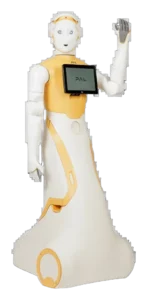
ARI operates on a wheeled humanoid base with an articulated upper body optimised for face-to-face interaction. Sensor suite supports indoor obstacle detection and proximity-aware navigation. PAL Robotics transitioned the platform’s software stack to ROS 2 compatibility during this period, aligning with the broader European robotics research community’s migration away from ROS 1.
Research Deployment Pattern
Academic outputs from EU Horizon-funded projects cited ARI as the physical platform for HRI experiments in hospital reception, elderly-care facility front-desk simulation, and university visitor guidance. Published studies noted the platform’s expressive head and arm gestures as central to interaction design. Experiment environments were consistently supervised; researchers managed task initiation and monitored for failures throughout trials.
Software Integration
PAL Robotics provided ROS 2 driver packages and a software development kit supporting custom skill development. Research teams reported building interaction pipelines atop this stack. No over-the-air firmware update mechanism for end-user institutions was publicly documented; updates were managed through vendor-assisted processes.