
- Changes
- 3
- Tracking since
- Mar 2025
- Latest
- Jul 7, 2025
- Net movement
- Wait to Ready Now
- 2025
-
Independent reviews find Roomba 205 DustCompactor Combo prone to getting stuck
Reviews published in mid-2025 documented recurring navigation problems on the Roomba 205 DustCompactor Combo, including the robot getting stuck on pet toys, cords and furniture legs.
Full assessment3 claims · 4 technical notes · 2 sources
Where it standsAutonomy LadderIIIIIIIVVLevel IIIConditional AutonomyHuman ReadinessReady NowNew to MarketWaitKnown IssuesRobovations Score04055708566CapableWhat happenedBoth reviews also flagged an inconsistent app and mop-pad performance that struggled at carpet edges. Owner reports over a longer period were not yet available to confirm whether the issues persisted after further use.
Bottom lineIndependent testing found the compacting bin worked as marketed, but navigation, mopping and app issues undercut the day-to-day experience.
ImpactOn autonomy
- Reviewers documented the robot frequently getting stuck on pet toys and furniture legs.
- Navigation at hard-floor to carpet boundaries was inconsistent, especially with the mop pad attached.
On readiness
- App settings did not always save, complicating scheduling and keep-out zone setup for owners.
- Mopping was described as spreading test debris rather than removing it from hard floors.
Claim check3 maker claims checked against the record. Open one to read the finding.
ClearView LiDAR Navigation enables improved mapping and obstacle avoidance.
Documented findingTwo hands-on reviews both reported the robot frequently getting stuck on pet toys, cords and furniture legs.The Combo's mop pad delivers a combined vacuum-and-mop clean in one pass.
Documented findingA hands-on review found the mop pad dragged across carpet edges and spread test debris rather than removing it.The Roomba Home App simplifies scheduling and custom cleaning preferences.
Documented findingReviewers described app settings that did not consistently save and controls that were hard to find.Evidence2 sources · all linked
- 1Tech Advisor7 Jul 2025
- 2TechRadar
Technical notes4 sectionsReview Coverage
One hands-on review of the Roomba 205 DustCompactor Combo published on July 7, 2025, and another hands-on review published the same month. Both reviews tested the mechanical compacting bin, LiDAR navigation and combined vacuum-and-mop function under normal household conditions.
Navigation Findings
Both reviews reported the robot getting stuck on low-profile obstacles, including pet toys, cords and furniture legs such as piano feet. One review also noted the roller tended to drop larger debris when the robot returned to its charging base.
Mopping and App
One review described the mop pad as struggling at hard-floor-to-carpet boundaries, at times dragging a wet pad onto carpet, and said mopping tended to spread test debris rather than lift it. Both reviews flagged the Roomba Home App, noting that settings did not always save and that key controls were buried in the interface.
Compacting Bin
Reviewers confirmed the compacting bin reduced how often the robot needed emptying compared with a standard bagged design, though one review described clearing it as messy, particularly in homes with shedding pets.
-
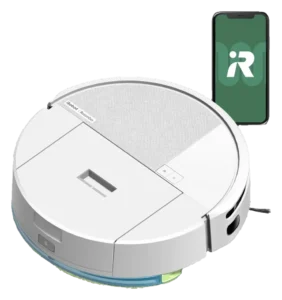
iRobot Roomba 205 DustCompactor Combo launches at $469
iRobot released the Roomba 205 DustCompactor Combo commercially on March 18, 2025, marking the first consumer robot vacuum with onboard dust compaction eliminating the need for a separate auto-empty dock.
Full assessment4 claims · 4 technical notes · 2 sources
Where it standsAutonomy LadderIIIIIIIVVLevel IIIConditional AutonomyHuman Readinessmoved by this entryReady NowNew to MarketWaitKnown IssuesRobovations Score04055708566CapableWhat happenedThe integrated compaction system is rated for approximately 60-day capacity in typical homes.
WatchingIRobot has not disclosed compaction cartridge pricing or replacement frequency, leaving total cost of ownership unresolved at launch.
Bottom lineThe hardware architecture is a genuine structural departure from dock-dependent systems; consumable economics remain unresolved and represent the primary open question for ownership assessment.
ImpactOn autonomy
- LiDAR plus camera navigation enables room-to-room multi-surface operation without dock return
- Retractable mop arm provides automatic carpet avoidance without user intervention
- Single-session vacuum and mop operation documented without manual mode switching
On readiness
- Commercial retail availability confirmed at launch with standard distribution channels
- Onboard 60-day compaction reduces maintenance frequency compared to weekly auto-empty dock bags
- Dock-free design reduces space requirements for apartment and smaller-home installations
- Consumable cartridge cost undisclosed; long-term ownership cost comparison not possible at launch
Claim check4 maker claims checked against the record. Open one to read the finding.
60-day dust capacity eliminates frequent emptying
Documented findingManufacturer specifications indicate 60-day capacity for typical homes (5,000-8,000 sq ft); owner reports from early adopters note high-shedding pet households may reduce this intervalAutomatic mop lift eliminates manual carpet management
Documented findingLiDAR and texture analysis enable automatic retraction on low-pile surfaces; owner feedback indicates inconsistent detection on high-pile and shag carpets per early user reportsReplaces auto-empty dock, reducing total cost
Documented findingiRobot has not disclosed cartridge pricing or lifespan; cost comparison with j-series dock bags ($200-300/year) is not calculable at launchSingle-session vacuum and mop for simplified cleaning
Documented findingDocumented in manufacturer specifications; single water tank limits wet-cleaning coverage per charge cycle on large or multi-floor spacesEvidence2 sources · all linked
1218 Mar 202519 Mar 2025filed 18 Mar 2025- 1iRobot Press Release18 Mar 2025
- 2The Verge19 Mar 2025
Technical notes4 sectionsHardware Architecture
The Roomba 205 DustCompactor Combo (model L124020) integrates a compaction mechanism directly into the robot body, replacing the external auto-empty dock found in j-series and s-series predecessors. Manufacturer specifications rate the onboard bin at approximately 60-day capacity for average home sizes.
Navigation System
Navigation combines LiDAR with a camera array and a dedicated mop-lift carpet detection system. The retractable mop arm operates automatically based on surface detection, enabling single-session multi-surface cleaning without dock return between floor types.
Specifications at Launch
MSRP: $469. Dimensions: 13.4 in diameter, 3.8 in height. Weight: 9.2 lbs. Battery: 42 Wh Li-ion, 100-minute runtime, 140-minute charge time. Suction: 7,000 Pa. Noise: 74 dB. Connectivity: Wi-Fi, Alexa, Google Home compatible.
Open Technical Questions
Compaction cartridge replacement cost and lifecycle not disclosed by iRobot at launch. Mop pad replacement estimated at $25-40 per set every 2-3 months; cartridge cadence unconfirmed.
-
iRobot unveils Roomba 205 DustCompactor Combo with mechanical debris-compacting design
iRobot introduced the Roomba 205 DustCompactor Combo as part of a five-model Roomba refresh, built around a mechanical bin that compacts debris inside the robot instead of routing it to a self-emptying dock.
Full assessment3 claims · 4 technical notes · 2 sources
Where it standsAutonomy LadderIIIIIIIVVLevel IIIConditional AutonomyHuman ReadinessReady NowNew to MarketWaitKnown IssuesRobovations Score04055708566CapableWhat happenedThe design promised a space-saving alternative to a bulky base station. Retail availability followed on March 18, and independent reviews testing the claim did not arrive until midyear.
Bottom lineThe compacting mechanism delivered the space savings iRobot promised, but reviewers later found it complicated the debris-handling experience it was meant to simplify.
ImpactOn autonomy
- ClearView LiDAR navigation announced for fast mapping and automatic carpet detection and avoidance.
- Object sensing and avoidance capability disclosed as standard across the new Roomba lineup.
On readiness
- Mechanical compacting bin claimed to extend intervals between emptying to roughly two months.
- No self-emptying dock required, reducing footprint versus prior tower-based Roomba Combo models.
Claim check3 maker claims checked against the record. Open one to read the finding.
Mechanical compacting bin holds debris for up to 60 days without emptying.
Documented findingOwner reports and later reviews describe the compacting bin as messy to clear, especially in homes with shedding pets.ClearView LiDAR Navigation delivers improved mapping and obstacle handling.
Documented findingLater reviews document the robot frequently getting stuck on low obstacles such as pet toys, cords and furniture legs.Compact single-unit design removes the need for a bulky self-emptying dock.
Documented findingReviewers confirmed the smaller footprint as a genuine space-saving advantage over tower-based docks.Evidence2 sources · 1 linked
- 1iRobot Press Release11 Mar 2025
- 2TechRadarnamed, not linked
Technical notes4 sections
Announcement
iRobot announced the Roomba 205 DustCompactor Combo on March 11, 2025, as part of a five-model lineup refresh that also introduced the Roomba 105, Plus 405, Plus 505 and, weeks later, the Max 705. The refresh replaced nearly all of iRobot’s prior consumer vacuum range.
DustCompactor Mechanism
The 205 DustCompactor Combo uses a mechanical bin that continuously compacts collected debris inside the robot itself, rather than ejecting it into a separate base-station bag. iRobot’s press materials describe the interval between emptying as up to 60 days, depending on debris volume and household conditions.
Navigation and Sensing
The robot ships with ClearView LiDAR Navigation for mapping, plus automatic carpet detection and avoidance and general object sensing and avoidance, consistent with the rest of the 2025 lineup.
Timeline
Pre-orders opened March 18, 2025, the date the Robovations record lists as the robot’s release, with retail availability across North America and select European markets following shortly after.