

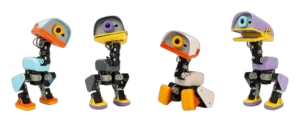
Hugging Face Microduck units shown syncing over Bluetooth to compose songs together
A robotics video roundup documented Hugging Face Microduck units syncing over Bluetooth with neighboring units and generating a shared piece of music in real time, without a fixed score or conductor, scaling to small multi-duck ensembles.
Full assessment3 claims · 3 technical notes · 2 sources
The capability adds peer-to-peer coordination to a robot that otherwise starts each behavior from a gamepad.
WatchingWhether Hugging Face documents the mechanism or ships it in a release.
The roundup documents a real-time, conductor-free sync behavior across multiple units, with no mechanism, unit count, or shipped-hardware status confirmed beyond that description.
On autonomy
- Units synced peer-to-peer over Bluetooth and generated real-time audio output together
- No fixed score or conductor directed the shared composition in the demo
On readiness
- Readiness still depends on pre-order delivery; no units have reached buyers yet
- The multi-unit sync shown was not confirmed as a shipped consumer feature
3 maker claims checked against the record. Open one to read the finding.
Microducks sync with neighboring units and compose a song together in real time
The behavior scales to small multi-duck ensembles
This is an autonomous group performance
2 sources · all linked
- 1IEEE Spectrum16 Oct 2026
- 2Hugging Face
Technical notes
3 sections
What The Roundup Described
A robotics video roundup covering recent robot demonstrations reported that Hugging Face Microduck units can sync with neighboring units over Bluetooth and generate a piece of music together in real time. The description states there is no fixed score and no conductor directing the output, and that the behavior scales to small multi-duck ensembles. The roundup did not specify an exact unit count, a song genre, or how the synchronization and composition mechanism works at a technical level.
How It Fits The Published Record
Microduck’s manufacturer specifications already list Bluetooth as a supported connectivity option alongside Wi-Fi, so wireless peer-to-peer sync between units is consistent with documented hardware. The manufacturer’s seven shipped behaviors are described as onboard reinforcement-learning policies that run without a teleoperator once started from a gamepad or laser pointer. A multi-unit audio behavior would be an addition to that behavior set rather than a documented change to how any single unit starts a task.
What Remains Unverified
No units had shipped to buyers as of this record’s last evaluation, and the roundup does not say whether the demonstrated units were pre-release hardware, a developer build, or software running on delivered units. The underlying synchronization protocol, latency, and composition method are not described in the available source.