
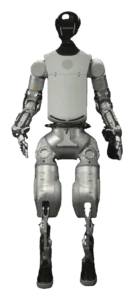
- Changes
- 3
- Tracking since
- Sep 2025
- Latest
- Apr 16, 2026
- Net movement
- Classification stable
- 2026
-
Siemens and Humanoid Report HMND 01 Alpha Passed Full Factory Shift Trial at Erlangen
Siemens and Humanoid disclosed the results of a two-week live production trial at Siemens' Erlangen Electronics Factory at Hannover Messe on April 16, 2026.
Full assessment5 claims · 3 technical notes · 2 sources
Where it standsAutonomy LadderIIIIIIIVVLevel IIIConditional AutonomyHuman ReadinessReady NowNew to MarketWaitKnown IssuesNot ratedPre-Consumer Assessment03050717675PromisingWhat happenedThe HMND 01 Alpha met all target metrics: 60 tote moves per hour, sustained uptime exceeding eight hours, and pick-and-place success rates above 90 percent across two tote sizes. A formalized Siemens-Humanoid partnership was announced in the days following the trial disclosure; watch whether production-scale deployment commitments or Beta pre-orders tied to Siemens are published.
Bottom lineThe Erlangen trial is the strongest evidence to date for the HMND 01 Alpha's task-level performance in a real production setting; the metrics are credible because they came from a Siemens press release, though the trial scope and target-setting remained within the Humanoid-Siemens partnership rather than independent audit.
ImpactOn autonomy
- End-to-end autonomous tote destacking in live production environment over 30-minute continuous runs
- Two distinct tote sizes handled without reconfiguration documented in trial results
- Overall and per-pick autonomous success rates exceeded 90 percent across the full trial window
- Operation ran alongside active human workers and other automated systems on the factory floor
On readiness
- First documented live factory trial in an active industrial production environment confirmed
- Sustained 8-hour uptime benchmark moves past short-demo evidence toward shift-level operational data
- Siemens partnership formalized following trial; reference architecture for deployment announced
- 30,000-unit pre-order backlog reported post-trial; no confirmed shipment schedule for production units
Claim check5 maker claims checked against the record. Open one to read the finding.
All target performance metrics were met" (Siemens press release)
Documented findingSiemens' own press release (Apr 16, 2026) confirms the 60 moves/hour throughput and 90%+ success rate; the targets themselves were set by Humanoid and Siemens jointly, not by an independent benchmarking body.Full factory shift operation demonstrated
Documented finding8-hour uptime is documented in the Siemens press release; "full factory shift" framing comes from third-party press coverage (mlq.ai), not from the primary Siemens disclosure, which states "exceeding 8 hours."Reference architecture for humanoid deployment in industry
Documented findingSiemens framed the trial as a replicable model for other companies; no second company has yet published a deployment using this architecture as of the announcement date.30,000 pre-order backlog
Documented findingFigure sourced from trade press post-announcement coverage (Apr 21, 2026); Humanoid has not published an independent verification of this backlog number or the conversion rate to confirmed orders.Physical AI at factory scale (Hannover Messe framing)
Documented findingThe Erlangen trial involved one robot in one production area; "factory scale" describes the operating environment, not multi-unit or multi-site deployment.Evidence2 sources · all linked
1216 Apr 202617 Apr 2026filed 16 Apr 2026- 1Siemens Press Release16 Apr 2026
- 2The Robot Report17 Apr 2026
Technical notes3 sectionsTrial Parameters
The Siemens Electronics Factory trial in Erlangen, Germany ran for two weeks in January 2026, based on trade publication coverage from April 17, 2026 noting the trial concluded shortly before the Hannover Messe announcement. The HMND 01 Alpha Wheeled operated in live production conditions alongside human workers and other automated systems. Tasks consisted of tote-destacking operations: removing stacked containers from storage and placing them on conveyors for downstream human processing.
Documented Performance Metrics
Per the Siemens press release (April 16, 2026): throughput reached 60 tote moves per hour; autonomous uptime exceeded 8 hours; overall pick-and-place success rates exceeded 90 percent. Two different tote sizes were handled. Extended autonomous runs of over 30 consecutive minutes were documented in third-party coverage (a trade publication, January 16, 2026, reporting on an earlier phase of the trial). The NVIDIA Jetson Thor compute stack and KinetIQ VLA framework were integral to the autonomous operation; Siemens Xcelerator portfolio integration was noted in the Siemens announcement.
Partnership Formalization
Siemens and Humanoid announced a formalized collaboration following the trial, described in coverage as a reference architecture for humanoid robot deployment in industrial logistics. Trade press (April 21, 2026) reported a 30,000-unit pre-order backlog for the platform following the announcement. The Beta wheeled model remains targeted for Q3 2026; production-scale commitments tied to the Siemens partnership have not been published.
-
HMND 01 Alpha Makes North American Debut at CES 2026 with Live Schaeffler Demo
At CES 2026 (January 6-9), the HMND 01 Alpha performed live autonomous bin picking at the Schaeffler Group booth, retrieving unsorted metallic bearing rings from cluttered bins and placing them onto a buffer table without human intervention.
Full assessment4 claims · 3 technical notes · 2 sources
Where it standsAutonomy LadderIIIIIIIVVLevel IIIConditional AutonomyHuman ReadinessReady NowNew to MarketWaitKnown IssuesNot ratedPre-Consumer Assessment03050717675PromisingWhat happenedThe task ran in an uncontrolled public environment rather than a lab. Verify whether throughput and success-rate data from this demonstration are published alongside the Siemens trial results.
Bottom lineThe Schaeffler bin-picking task is a concrete, third-party-hosted demonstration of autonomous manipulation in an uncontrolled venue; it advances the evidence base beyond Humanoid's own facility claims without yet proving sustained production-environment performance.
ImpactOn autonomy
- Cluttered bin picking from unsorted metallic parts documented in live public environment
- Autonomous recovery from unsorted input without operator intervention demonstrated at show
- KinetIQ VLA policy generalized from training to novel part geometry at CES conditions
- Schaeffler representative confirmed push-button autonomous operation per published reports
On readiness
- First independent third-party venue (Schaeffler booth) for public demonstration outside Humanoid facilities
- North American debut signals intent to address US industrial market alongside UK operations
- No pricing or RaaS terms disclosed at CES; early-access application process referenced
- Beta hardware remains Q3 2026; CES demo runs on Alpha-phase production-intent platform
Claim check4 maker claims checked against the record. Open one to read the finding.
Everything is automated from there" (Schaeffler representative quote)
Documented findingQuote sourced from press coverage (Jan 7, 2026); describes the autonomous operation observed at the booth, not a broader production deployment claim.CES demo mirrors real production workflows
Documented findingBearing-ring bin picking reflects genuine Schaeffler production tasks; however, the demo environment at CES is not a live factory floor subject to production tolerances and scheduling constraints.UK's first humanoid robot for industrial use
Documented findingDesignation applied by press coverage; no formal certification or independent body has verified this classification. The claim references the robot's UK origin and industrial intent, not tested production certification.Fastest-developed humanoid in history (repeated from reveal)
Documented findingThe company continued to use this framing at CES; no independent timeline audit was published in coverage of the event.Evidence2 sources · all linked
127 Jan 20269 Jan 2026filed 7 Jan 2026- 1Interesting Engineering7 Jan 2026
- 2The Robot Report9 Jan 2026
Technical notes3 sectionsDemonstration Task
At the Schaeffler Group booth, CES 2026 (Las Vegas, January 6-9, 2026), the HMND 01 Alpha Wheeled performed autonomous bin picking of unsorted metallic bearing rings. The robot retrieved individual rings from cluttered bins and placed them onto a buffer table without operator input between cycles. The Schaeffler representative described the workflow as “press one button, and everything is automated from there,” per press coverage from the show floor.
Platform Configuration
The demo unit is the same wheeled Alpha configuration documented at the September 2025 reveal: 220 cm, 300 kg, 29-DOF dual-arm assembly, NVIDIA Jetson Thor compute, KinetIQ VLA inference. No hardware changes between the reveal and CES 2026 appearance were documented. The five-fingered dexterous hand end-effector was used for the bearing-ring pick task based on available footage descriptions.
Context
The CES 2026 appearance marked the first North American public showing of the wheeled Alpha. The bipedal HMND 01 Alpha variant (179 cm, 90 kg, 5.4 km/h walking speed) was also announced in the December 2025 to January 2026 period, per a trade publication’s January 9, 2026 coverage, though the CES floor demonstration focused on the wheeled platform.
- 2025
-
Humanoid Unveils HMND 01 Alpha Wheeled Platform After Seven-Month Build
Humanoid announced the HMND 01 Alpha wheeled platform in September 2025, completing a dual-armed industrial manipulator from concept to working prototype in seven months.
Full assessment4 claims · 3 technical notes · 2 sources
Where it standsAutonomy LadderIIIIIIIVVLevel IIIConditional AutonomyHuman ReadinessReady NowNew to MarketWaitKnown IssuesNot ratedPre-Consumer Assessment03050717675PromisingWhat happenedThe platform entered early-access evaluation under a Robotics-as-a-Service model targeting warehouse logistics.
WatchingWhether the compressed timeline holds through Beta launch, scheduled for Q3 2026.
Bottom lineThe hardware milestone is real and the development timeline unusual; commercial readiness claims rest on Humanoid's own disclosures, with no third-party evidence available at the time of the announcement.
ImpactOn autonomy
- 29-DOF arm assembly with modular end-effectors documented at initial reveal
- NVIDIA Jetson Thor compute enables on-device KinetIQ VLA policy inference
- 360-degree RGB cameras and dual depth sensors give full-perimeter spatial awareness
- Reinforcement learning policies trained in Isaac Lab deploy to hardware within 24 hours
On readiness
- No commercial pricing or RaaS contract terms disclosed at announcement
- Early-access applications accepted; no confirmed production availability date
- Alpha designation signals pre-Beta, market-feedback phase with supervised deployment
- Beta wheeled model announced for Q3 2026; general access depends on that milestone
Claim check4 maker claims checked against the record. Open one to read the finding.
Fastest-developed humanoid in history" at seven months
Documented findingThe seven-month wheeled prototype claim is documented by a trade publication (Sep 18, 2025); no independent third-party audit of competing development timelines has been published.General-purpose industrial platform
Documented findingAt announcement, documented tasks were logistics-focused (tote handling); general-purpose capability across unstructured environments was not demonstrated at reveal.Commercially scalable Robotics-as-a-Service model
Documented findingRaaS model announced but no pricing, contract terms, or minimum deployment scale published as of reveal date.200 engineers across London, Boston, and Vancouver
Documented findingCompany headcount figure sourced from Humanoid's own communications; no independent verification published at time of announcement.Evidence2 sources · all linked
- 1The Robot Report18 Sep 2025
- 2Humanoids Daily18 Sep 2025
Technical notes3 sections
Platform Specifications
The HMND 01 Alpha Wheeled stands 220 cm tall (86.6 in) and weighs 300 kg, with an omnidirectional wheeled base reaching 7.2 km/h maximum speed. The dual-arm assembly spans 29 active degrees of freedom across both limbs. The platform accepts two modular end-effectors: a 12-DOF five-fingered dexterous hand for precision picking and a 1-DOF parallel gripper for high-cycle bin handling. Bimanual payload capacity is documented at 15 kg. Battery runtime is rated at 240 minutes (4 hours) under operational conditions.
Compute and Sensing
NVIDIA Jetson Thor serves as the primary edge compute unit. Perception uses a 360-degree RGB camera array mounted at head height, combined with dual depth sensors for proximity and volumetric mapping. Force/torque sensing at 6D is documented on both arms. Inference runs the KinetIQ VLA (Vision-Language-Action) framework for task planning and manipulation policies. Policy training occurs in NVIDIA Isaac Lab via reinforcement learning; Humanoid reports hardware-ready policies generated within approximately 24 hours of simulation training.
Development Approach
Humanoid adopted a simulation-first pipeline, compressing a typical 18-24 month development cycle to seven months for the wheeled Alpha variant. The bipedal variant was developed in parallel and completed in five months according to company communications. Founder Artem Sokolov established the company in 2024 under SKL Robotics Ltd., headquartered in London.