
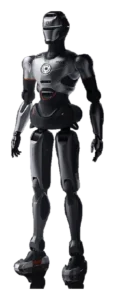
- Changes
- 3
- Tracking since
- Oct 2024
- Latest
- Jan 10, 2025
- Net movement
- Classification stable
- 2025
-
EngineAI SE01 shown at CES 2025 expanding international visibility
EngineAI exhibited the SE01 at CES 2025 in January, marking the platform's most prominent international exposure to date.
Full assessment4 claims · 4 technical notes · 2 sources
Where it standsAutonomy LadderIIIIIIIVVLevel IIAssisted AutonomyHuman ReadinessReady NowNew to MarketWaitKnown IssuesNot ratedPre-Consumer Assessment03050717675PromisingWhat happenedTrade-show floor demonstrations showed the straight-knee walking kinematics to an audience that included potential industrial partners and press. No commercial availability, pricing, or new technical specifications were announced at the event.
Bottom lineCES 2025 expanded awareness of the SE01 internationally without changing its pre-commercial research status.
ImpactOn autonomy
- Live gait demonstration in trade-show environment confirmed field mobility claims
- No new autonomy capabilities announced; locomotion scope unchanged from October 2024 reveal
- Interactive demonstrations showed real-time walking without visible teleoperation support
On readiness
- International trade-show presence signals manufacturer commitment to broader market engagement
- No pricing, distribution, or consumer availability announced at CES
- Platform remains research and industrial only; CES did not change commercial status
Claim check4 maker claims checked against the record. Open one to read the finding.
SE01 ready for industrial deployment
Documented findingCES demonstrations showed locomotion capability; no published industrial deployment case studies or customer references presented at the eventInternational market availability implied by CES presence
Documented findingCES attendance is a visibility event; no distribution agreements or regional availability announcements accompanied the SE01 appearanceStraight-knee gait outperforms conventional designs
Documented findingManufacturer positions the architecture as a differentiated approach; comparative benchmark data against other humanoid platforms not presented at CESEngine Sense perception system enables reliable navigation
Documented findingLiDAR and depth camera system described; performance validation in real industrial environments not disclosedEvidence2 sources · 1 linked
128 Jan 202514 Jan 2025filed 10 Jan 2025- 1CES 2025 Official Exhibitor Coverage8 Jan 2025
- 2Robotics Business Review14 Jan 2025named, not linked
Technical notes4 sectionsCES 2025 Demonstration Format
EngineAI presented the SE01 on the CES trade-show floor in January 2025. Live walking demonstrations on the flat convention-floor surface showed the straight-knee gait style. The Engine Sense perception module, comprising LiDAR-assisted 360-degree sensing and depth cameras, was described to attendees as the primary navigation system.
Specifications Highlighted
Manufacturer-stated walking speed up to 2 m/s referenced in booth materials. The 80 kg approximate mass and bipedal form factor were described as targeting industrial environments where humanoid form factor is advantageous over wheeled alternatives.
What Was Not Announced
No MSRP, lease price, or pilot program pricing disclosed. No SDK or developer access program announced. No manufacturing volume or delivery timeline communicated. Arm manipulation capability was not a focus of the CES demonstration materials.
Follow-On Activity
Post-CES coverage noted sustained interest from industrial robotics evaluators. No binding partnership or distribution agreement was publicly confirmed in the weeks following the event.
-
SE01 straight-knee gait videos circulate widely in early 2025
Circulating video demonstrations of the SE01's straight-knee bipedal gait attracted broad coverage from robotics media and social platforms in early 2025.
Full assessment4 claims · 4 technical notes · 2 sources
Where it standsAutonomy LadderIIIIIIIVVLevel IIAssisted AutonomyHuman ReadinessReady NowNew to MarketWaitKnown IssuesNot ratedPre-Consumer Assessment03050717675PromisingWhat happenedThe footage showed the robot walking smoothly on prepared flat surfaces, reinforcing the October 2024 announcement claims. No new performance benchmarks or pilot deployment data accompanied the wider distribution.
Bottom lineThe viral videos confirmed the locomotion style documented at the October 2024 reveal; they added public visibility but no new technical evidence.
ImpactOn autonomy
- Straight-knee gait stability confirmed across multiple publicly viewed clips
- Locomotion on prepared flat terrain shown without visible instability events
- No demonstrated adaptation to obstacles, stairs, or outdoor terrain in circulated footage
On readiness
- Increased public visibility without corresponding deployment or availability update
- No pricing, partner, or commercial timeline disclosed alongside footage distribution
- Research-platform positioning unchanged; media coverage did not signal consumer path
Claim check4 maker claims checked against the record. Open one to read the finding.
SE01 gait described in coverage as uniquely smooth
Documented findingVideo footage shows consistent flat-surface walking; subjective smoothness assessments vary across commentators; no biomechanics benchmark publishedStraight-knee design reduces mechanical complexity
Documented findingManufacturer claim supported by the observable absence of multi-articulated knee joints in footage; independent mechanical analysis not publishedIndustrial-ready platform
Documented findingNo pilot deployment results or customer testimonials released alongside early 2025 video distributionNeural network gait enables real-time adaptation
Documented findingFootage shows structured environment walking; adaptation to novel terrain not demonstrated in circulated clipsEvidence2 sources · all linked
12Jan 2025Feb 2025filed 9 Jan 2025- 1TechCrunch10 Feb 2025
- 2The Robot Report18 Feb 2025
Technical notes4 sectionsFootage Characteristics
Circulated video clips in early 2025 showed the SE01 walking on flat indoor and outdoor prepared surfaces. The straight-knee kinematic profile is visually distinct: the robot’s legs extend more fully through the stride cycle than humanoids using conventional bent-knee gait patterns.
Observed Capabilities
Video evidence shows smooth stride cadence, apparent balance recovery during normal walking, and operation without external support structures. No dynamic obstacle avoidance, stair climbing, or rough-terrain navigation is shown in the widely circulated clips.
What Was Not Shown
Arm manipulation tasks, payload carrying, stair negotiation, and outdoor uneven terrain navigation were absent from the footage that drove early 2025 attention. Gait speed benchmarks matching the manufacturer-stated 2 m/s figure were not independently verified from the footage.
Platform Status
As of the footage circulation period, SE01 remained a pre-commercial research platform. No firmware version, SDK release, or partner deployment announcement accompanied the media coverage wave.
- 2024
-
EngineAI SE01 unveiled with straight-knee bipedal gait demonstration
EngineAI publicly introduced the SE01 bipedal humanoid in October 2024, releasing video demonstrations of its straight-knee locomotion architecture.
Full assessment4 claims · 4 technical notes · 2 sources
Where it standsAutonomy LadderIIIIIIIVVLevel IIAssisted AutonomyHuman ReadinessReady NowNew to MarketWaitKnown IssuesNot ratedPre-Consumer Assessment03050717675PromisingWhat happenedThe reveal differentiated SE01 from conventional multi-articulated knee designs used by most humanoid platforms. Pilot deployment scope and research partner terms remain undisclosed as of the announcement.
Bottom lineThe October 2024 reveal documented a real kinematic architecture choice; deployment evidence was not yet available.
ImpactOn autonomy
- Straight-knee neural network gait demonstrated in video for first time
- End-to-end locomotion control architecture publicly described by manufacturer
- Autonomous bipedal walking at stated speed up to 2 m/s confirmed in footage
On readiness
- Platform revealed as research and industrial unit, not consumer product
- No retail pricing or distribution channel disclosed at announcement
- Pilot partner engagement model described but specific terms not published
Claim check4 maker claims checked against the record. Open one to read the finding.
Straight-knee gait as a breakthrough walking architecture
Documented findingVideo footage confirms the kinematic approach; independent biomechanics analysis of trade-offs not published at launchSE01 suitable for industrial deployment
Documented findingManufacturer describes industrial and research use cases; no deployment case studies released at announcementAutonomous operation via end-to-end neural network
Documented findingFootage shows autonomous walking; task-level autonomy beyond locomotion not demonstrated at revealUp to 2 m/s walking speed
Documented findingManufacturer-stated figure; independent verification in controlled benchmark not yet publishedEvidence2 sources · 1 linked
12Oct 2024Nov 2024filed 28 Oct 2024- 1EngineAI Official Website28 Oct 2024named, not linked
- 2IEEE Spectrum5 Nov 2024
Technical notes4 sections
Platform Architecture
The SE01 is a full-size bipedal humanoid with manufacturer-reported dimensions of approximately 170 cm height and 55 kg mass. The distinguishing mechanical feature is straight-knee walking kinematics, a design that reduces joint articulation complexity compared to multi-DOF knee assemblies used in competing platforms.
Locomotion System
Manufacturer documentation describes an end-to-end neural network for gait control. LiDAR-assisted 360-degree perception (Engine Sense module) and a depth camera array provide environmental sensing. Multi-microphone array included for acoustic sensing. Maximum stated walking speed is 2 m/s on prepared surfaces.
Connectivity and Control
Wi-Fi connectivity confirmed. Remote monitoring and parameter adjustment implied by industrial deployment framing; specific SDK or API access not disclosed at announcement.
Availability Status
No consumer availability. Research partnership and industrial pilot model described as primary distribution at announcement stage.