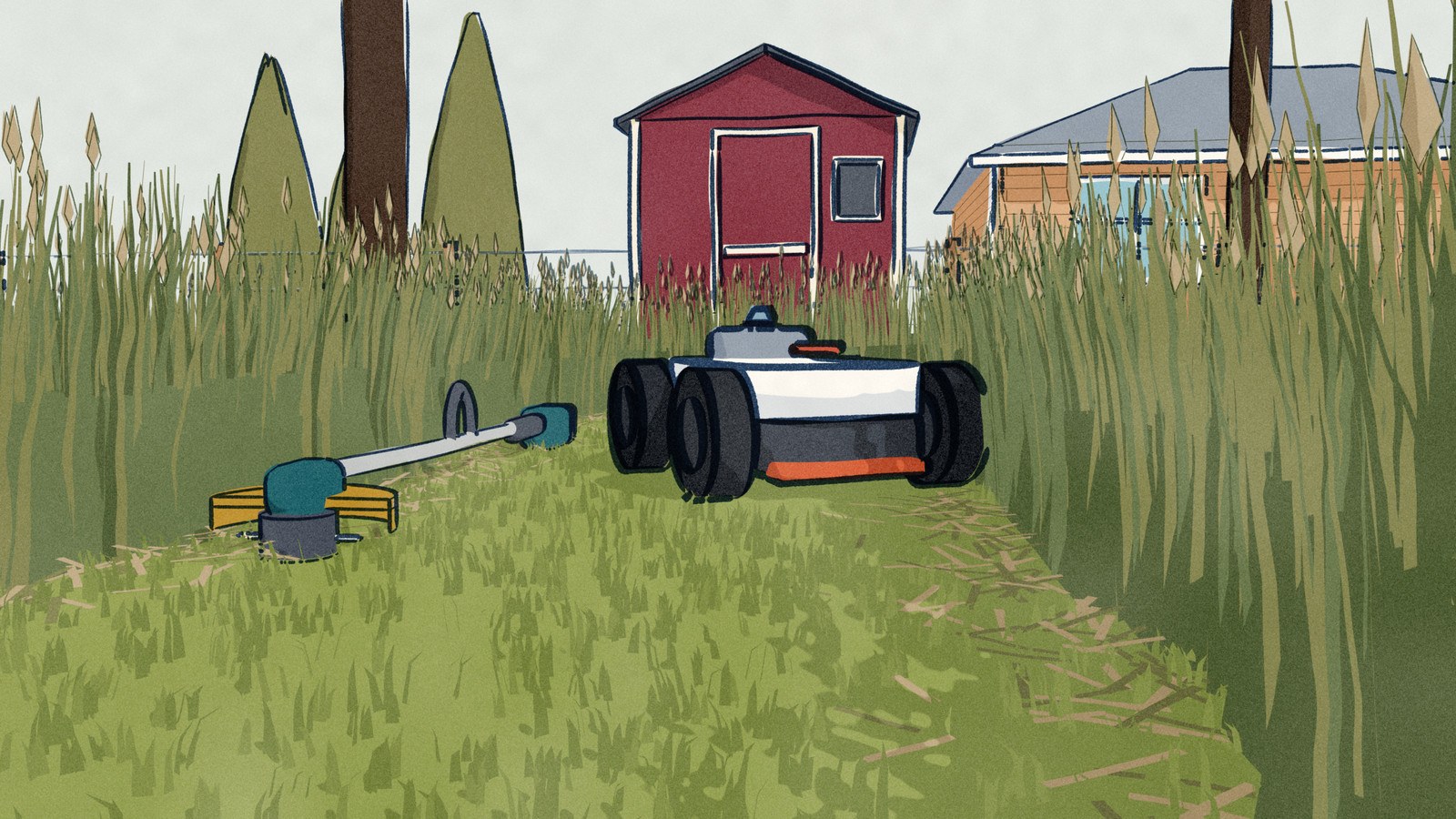
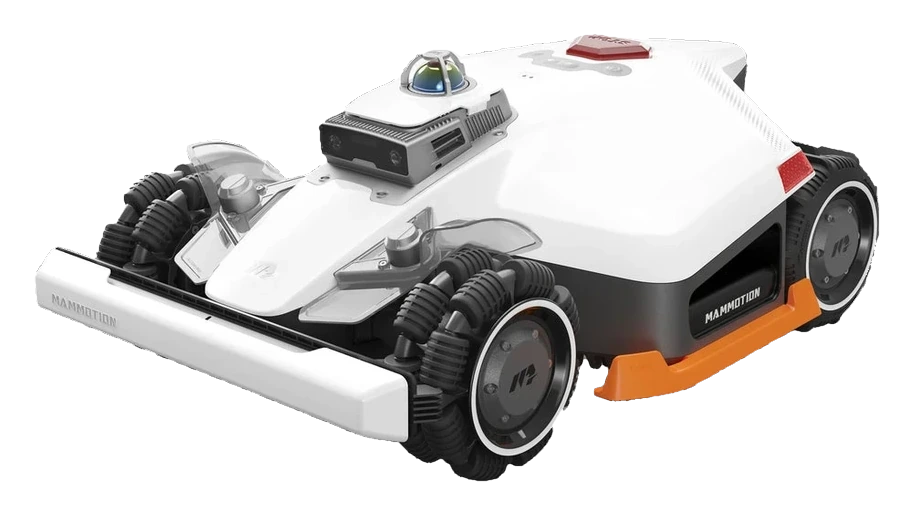
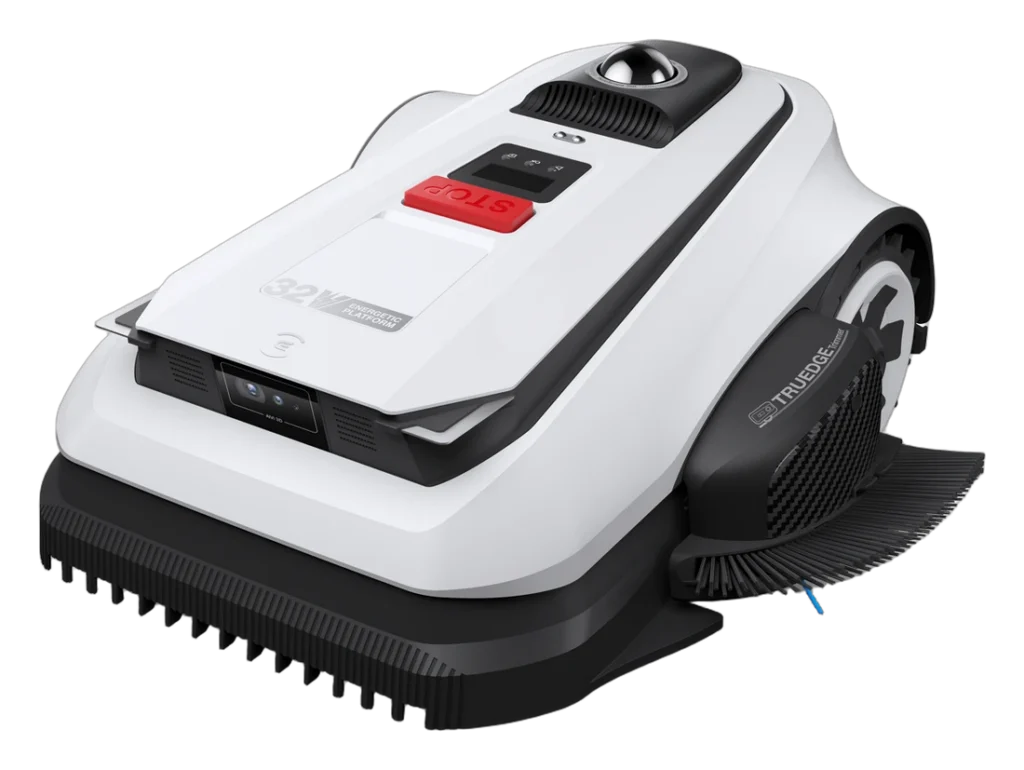
Can robot mowers handle tall grass on a neglected lawn?
Manufacturers market robot mowers as capable of handling any lawn, but blade intake geometry and motor load ceilings create real-world pre-cut thresholds that vary by platform.
Classification, not a ranking. Every mark below is documented evidence, not a purchase recommendation.
We may earn commission from qualifying purchases. This does not influence the comparison.
Claims under test
5 marketing claims, measured against documented evidence
Each claim below pairs the marketing language with what owner reports, demos, and engineering documentation actually show. The meter summarizes how far each claim sits from the evidence.
Autonomous mowing confirmed for maintained lawns; overgrown grass requires pre-cut on at least two platforms
What marketing promises
Autonomous mowing across the full lawn without manual preparation or intervention required
Composite from LUBA 3 AWD, Dreame A1, EcoFlow Blade, Ecovacs Goat G1 product pages, 2023-2026
What the evidence shows
Documented failure modes across all four platforms show that grass exceeding roughly 8 cm triggers blade jams, motor stalls, or missed-patch events. Dreame A1 manufacturer documentation explicitly cites dense thatch and very tall grass over 8 cm as the blade-jam threshold. Owner reports for LUBA 3 describe torn rather than cleanly cut grass when blade dulling meets dense turf, suggesting a similar intake-height ceiling.
Dreame A1 blade-jam threshold
Over 8 cm
LUBA 3 AWD blade behavior in dense turf
Dulling accelerates; cut quality degrades
EcoFlow Blade tall-grass limit
Not documented
Goat G1 tall-grass limit
Not documented
One-third rule implication
Pre-cut to 5-6 cm before first run
Claim 02 / 05
No manual pre-cut required
~Partial
Pre-cut requirement documented for Dreame A1; implied by blade-care guidance on LUBA 3; unspecified on Blade and Goat G1
What marketing promises
Set the schedule and the robot handles the rest, including first use on established lawns
Mammotion LUBA 3 AWD product page and app onboarding copy, 2025-2026; EcoFlow Blade marketing, 2023
What the evidence shows
The one-third rule for rotary mowing means a 10 cm lawn requires reducing height by no more than one-third per pass. Robot mowers using fixed blade decks cannot raise cutting height dynamically to accommodate multiple passes on very tall grass, so owner manuals and community documentation consistently recommend pre-cutting to within the robot's operating range before the first autonomous session.
All four platforms eliminate physical perimeter wire, but each substitutes a different hardware or software dependency. RTK systems require a base station and clear-sky satellite lock. UWB systems require beacon placement and tuning. Vision-GPS systems require seasonal boundary recalibration as foliage density changes.
LUBA 3 AWD dependency
RTK base station + open sky
EcoFlow Blade dependency
RTK receiver + virtual boundary setup
Dreame A1 dependency
GPS + seasonal recalibration
Goat G1 dependency
UWB beacons, placement-sensitive
True wire-free?
Wire eliminated; hardware not
Claim 04 / 05
All-terrain capability on slopes
~Partial
LUBA 3 AWD documented up to 35 degrees; Goat G1 limited to 20 degrees; other platform slope specs unverified
What marketing promises
Designed for slopes, uneven terrain, and real-world residential topography
Slope capability varies substantially across the four platforms. Manufacturer documentation for the LUBA 3 AWD specifies 35-degree operation; owner reports confirm reliable performance up to 25-30 degrees. EcoFlow Blade and Dreame A1 slope ratings are not explicitly stated in subject context. Ecovacs Goat G1 is rated to 20 degrees, with wheeled suspension limiting steeper inclines; owner reports document traction loss above that threshold.
LUBA 3 AWD rated slope
35 degrees (manufacturer spec)
LUBA 3 AWD owner-confirmed slope
25-30 degrees (owner reports)
Goat G1 rated slope
20 degrees (manufacturer spec)
Dreame A1 slope rating
Not verified in subject context
EcoFlow Blade slope rating
Not verified in subject context
Claim 05 / 05
Weather and season adaptability
~Partial
Rain pause documented across all four; over-deferral and false positives limit true schedule autonomy on Blade and Dreame A1
What marketing promises
Adapts to weather and seasonal changes, mowing on your schedule regardless of conditions
All four platforms include rain-triggered pause logic, but the mechanism and reliability differ. LUBA 3 AWD and Dreame A1 both document automatic pause on rain detection and resumption once soil moisture drops. EcoFlow Blade rain-sensor deferral can persist longer than conditions warrant, requiring user override. Dreame A1 explicitly notes false positives in tropical climates. Ecovacs Goat G1's UWB positioning works in rain and low light where vision-only systems stall.
LUBA 3 AWD rain response
Auto-pause; resumes in 4-8 hours
Dreame A1 rain response
Auto-pause; false positives in humidity >85%
EcoFlow Blade rain response
Deferral may outlast conditions; override available
Handles any residential lawn autonomously~Pre-cut implied✕>8 cm jams blade~Threshold not pub.~Threshold not pub.
No manual pre-cut required~Blade guidance✕Pre-cut to 6 cm~Boundary setup req.~Beacon placement
Wire-free setup simplifies deployment~Base station req.~Seasonal recalib.~RTK + boundary~Beacon hardware
All-terrain capability on slopes✓35 deg. documented~Slope unverified~Spec not verified✕20 deg. limit
Weather and season adaptability✓Auto-pause works~False positives~Over-deferral risk✓UWB rain-stable
Common questions
What readers ask about this comparison.
Q.
What is the maximum grass height these robot mowers can handle before requiring a manual pre-cut?
Dreame A1 manufacturer documentation explicitly cites dense thatch and grass over 8 cm as the blade-jam threshold; owner guidance specifies pre-cutting to 6 cm or less before the first run. The one-third rule applies: reducing grass from 12 cm to 8 cm still exceeds safe intake for most consumer robot mowers. LUBA 3 AWD, EcoFlow Blade, and Goat G1 do not publish a specific maximum intake height; blade maintenance documentation implies similar limits based on blade-dulling patterns in dense turf.
Q.
What is the one-third rule and why does it apply to robot mowers?
The one-third rule states that no more than one-third of the grass blade height should be removed per mowing pass. Cutting more than one-third stresses both the turf and the mower blade. Robot mowers with fixed-height decks cannot accommodate multiple graduated passes the way a human operator can manually lower the deck between runs, so very tall grass requires a human pre-cut before the robot can take over.
Q.
Does the Mammotion LUBA 3 AWD 5000 require a boundary wire?
No. Manufacturer documentation confirms zero-wire operation via RTK GPS positioning. The work zone boundary is defined digitally in the mobile app as a polygon map. A physical RTK base station must be installed, which is a hardware dependency separate from perimeter wire.
Q.
Which platform handles wet grass and rain most reliably?
Ecovacs Goat G1 has the documented advantage here: UWB beacon positioning is unaffected by rain, low light, and overcast conditions, and owner reports from humid climates confirm reliable wet-weather operation. LUBA 3 AWD auto-pauses during rain and resumes automatically once soil moisture drops (owner reports cite 4-8 hours). EcoFlow Blade’s rain-deferral logic can outlast actual weather conditions, requiring user override per manufacturer documentation.
Q.
Can any of these mowers handle a completely neglected lawn without any preparation?
None of the four platforms document capability on completely neglected lawns without preparation. Dreame A1 documentation is explicit that grass over 8 cm causes blade jams. LUBA 3 AWD blade maintenance notes accelerated dulling in dense turf. Industry practice for rotary robot mowers is to manually cut overgrown lawns down to 6-8 cm before deploying the robot for the first session.
Next up
Do robot mowers work in shaded, tree-canopy yards?
We use privacy-friendly first-party analytics to see which pages get read, plus one optional Google Analytics cookie. No ads, no cross-site tracking. Privacy policy