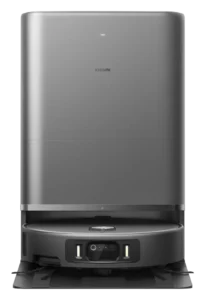
Roborock S8 MaxV Ultra · Xiaomi Robot Vacuum 6 Max
All robot vacuums. Every measure below is plotted against the full class, so a difference can be read against how much the class itself varies.
- Roborock S8 MaxV Ultra
- Xiaomi Robot Vacuum 6 Max
What each one does on its own.
The Autonomy Ladder is the same five rungs for every robot on the site. A rung describes the conditions a robot handles without you, not how good it is.
Where they actually differ.
The Robovations Score is nine inputs across three pillars, each weighted as shown and each scored so that more is better. A robot can lead on one and trail on another, which is the point of showing them apart. Cost of ownership and data handling are reported on each robot's own page and are never averaged into the score.
Capability
- Roborock S8 MaxV Ultra75
- Xiaomi Robot Vacuum 6 Max76
- Roborock S8 MaxV Ultra100
- Xiaomi Robot Vacuum 6 Max75
- Roborock S8 MaxV Ultra62
- Xiaomi Robot Vacuum 6 Max55
- Roborock S8 MaxV Ultra75
- Xiaomi Robot Vacuum 6 Max74
Dependability
- Roborock S8 MaxV Ultra91
- Xiaomi Robot Vacuum 6 Max70
- Roborock S8 MaxV Ultra95
- Xiaomi Robot Vacuum 6 Max65
- Roborock S8 MaxV Ultra94
- Xiaomi Robot Vacuum 6 Max58
Ownership burden
- Roborock S8 MaxV Ultra84
- Xiaomi Robot Vacuum 6 Max82
- Roborock S8 MaxV Ultra83
- Xiaomi Robot Vacuum 6 Max70
How far apart is a long way?
A number only means something next to the spread it sits in. Each track below is the real range across every classified robot in the class, with the median marked.
- Roborock S8 MaxV Ultra10,000 Pa
- Xiaomi Robot Vacuum 6 Max35,000 Pa
- Roborock S8 MaxV Ultra180 min
- Xiaomi Robot Vacuum 6 Max270 min
- Roborock S8 MaxV Ultra4.1 in
- Xiaomi Robot Vacuum 6 Max3.5 in
Not compared, because fewer than two of these robots carry a published figure: Price, Runtime, Noise, Weight.
What the numbers leave out.
The trade-off
What each design gives up to be good at what it is good at.
Establishment time (30-45 min initial training, room marking) buys hands-off cycles (leave home, returns to dock, scheduled mopping prep).
All-in-one dock adds mopping and hot-water drying but increases weekly maintenance complexity (filter + nozzle + water-tank lifecycle).
The 6 cm climbing legs are a genuine differentiator, while Computer Bild’s pickup test placed it behind rival flagships.
A 4.5-hour recharge is the cost of a large battery: long jobs may pause for most of an afternoon.
Who each one is wrong for
Stated by the record itself. A robot being wrong for a household is a fact about fit, not a fault.
- Frequent furniture rearrangement or clutter-heavy homes
- Dynamic layouts require map retraining; cluttered rooms with low-profile items confuse camera detection. Manual map updates add 15-20 minutes per change cycle.
- Budget-first or privacy-conscious buyers
- The purchase price is the barrier, not the running cost: official dock bags are about $4.30 each in Roborock's 6-pack, roughly $25 a year. On privacy, the app requires an account and maps and camera images sync to Roborock's cloud servers, with no user-facing local-only mode.
- Hands-off operation without dock maintenance
- Weekly dock filter cleaning, monthly nozzle inspection and periodic bag changes are not optional. Neglected dock maintenance shows up in mopping quality within 2-3 months.
- Homes with only hard floors or minimalist spaces
- Mopping capability adds complexity and dock footprint. Budget L2 vacuums better suited for straightforward hard-floor-only maintenance without wet-cleaning overhead.
- US buyers wanting domestic retail and support
- The Robot Vacuum 6 Max is not sold in the US; Notebookcheck reports it listed through Xiaomi's global site and European retailers.
- Buyers who want the strongest carpet pickup available
- Computer Bild recovered 96.9 g of 100 g of test debris, and competing Roborock, Dreame and MOVA models scored higher, per The Gadgeteer.
- Buyers who need a published runtime
- Xiaomi lists a 6,400 mAh battery and a 4.5-hour charge time but no runtime figure.
- Households that want a camera-free robot
- Navigation relies on a three-camera AI system alongside LiDAR.
What stays your job
The upkeep ownership hands back to you, whatever the autonomy level says.
- After every use: Empty the mopping water tank, rinse the mop tray, check dock dust cap alignment.
- Weekly: Wash the dock filter, clear hair from the main brush and the FlexiArm side brush, inspect the spray nozzles for clogs.
- Monthly: Wipe the dock spray heads and wash tray with clean water, check suction, wipe the LiDAR window and the front camera. Water only: vinegar and descaling acid attack the dock’s pump and seals.
- Every 3-6 months: Replace main brush bristles (approximately $25 replacement cost).
- Every 60-90 days: Replace the dock’s 2.5 L disposable dust bag. Roborock sells the official 6-pack for $25.59, about $4.30 a bag, so bags run roughly $25 a year.
- Annually: Inspect all seals and water tanks for leakage and calibrate camera focus.
- As needed: Manual tangle removal from the side brush, remapping if furniture moves significantly, unclogging water nozzles. Refill the dock’s detergent reservoir with Roborock’s own solution only.
- Weekly: Refill the station’s clean-water tank and empty the dirty-water tank.
- Every 3-6 months: Replace the station’s disposable dust bag.
- Monthly: Wipe the three front cameras and the dToF radar window.
- As needed: Replace the roller mop pad, edge-cleaning mop pad and side brushes as they wear.
- As needed: Clean the dust compartment filter.
How much each of these is standing on.
Classifications rest on different depths of evidence. A pre-release assessment and a verified one are not the same kind of claim.
| Robot | Evidence status | Sources reviewed | Last assessed |
|---|---|---|---|
| Roborock S8 MaxV Ultra | Provisional | 15 | Aug 2026 |
| Xiaomi Robot Vacuum 6 Max | Provisional | 8 | Sep 2026 |
Add a robot
Comparing across classes is allowed — the page will switch to per-class positioning and tell you it has.