Skip to content
Saved
Comparison · 2 robots

Prosper Alfie · SwitchBot Onero H1

All humanoid robots. Every measure below is plotted against the full class, so a difference can be read against how much the class itself varies.
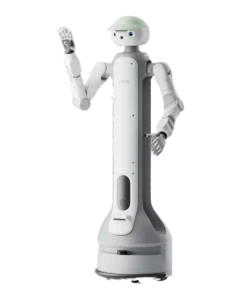
  1. Prosper Alfie
  2. SwitchBot Onero H1
Prosper Robotics

Prosper Alfie

Autonomy
II Assisted Autonomy
Score
48/100 Plausible
Readiness
Promising Progress
Price
$15,000list
SwitchBot

SwitchBot Onero H1

Autonomy
II Assisted Autonomy
Score
49/100 Plausible
Readiness
Promising Progress
Price
$9,999list

Up to three

01 Classification

What each one does on its own.

The Autonomy Ladder is the same five rungs for every robot on the site. A rung describes the conditions a robot handles without you, not how good it is.

V
Generalized
Any task, any setting
IV
Environmental
Handles new obstacles without help
III
Conditional
Finishes familiar jobs on its own
II
Assisted
Runs preset routines, needs rescue
Prosper AlfieSwitchBot Onero H1
I
Manual
One action, on command
02 Assessment

Where they actually differ.

The Robovations Score is nine inputs across three pillars, each weighted as shown and each scored so that more is better. A robot can lead on one and trail on another, which is the point of showing them apart. Cost of ownership and data handling are reported on each robot's own page and are never averaged into the score.

None of these robots carries a scored assessment yet, so there is nothing to plot here. The classification and evidence below still apply.

03 Measured against the class

How far apart is a long way?

A number only means something next to the spread it sits in. Each track below is the real range across every classified robot in the class, with the median marked.

Price16 with a published figure
  • Prosper Alfie$15,000
  • SwitchBot Onero H1$9,999
$1,385median $26,250$250,000
Height46 with a published figure
  • Prosper Alfie66.9 in
  • SwitchBot Onero H151.2 in
37 inmedian 67 in86.6 in

Not compared, because fewer than two of these robots carry a published figure: Suction, Runtime, Charge time, Noise, Weight.

04 Ownership

What the numbers leave out.

The trade-off

What each design gives up to be good at what it is good at.

Prosper Alfie

Teleoperators are the product’s current engine: every task a human pilot completes trains the AI, but it also means a remote operator sees live video from inside the home for roughly 80% of early tasks, and that a $15,000 machine depends on remote staffing to function.

The wheeled base avoids the instability of bipedal locomotion and saved Prosper years of development, but it confines a unit to one step-free floor. Prosper’s published answer for multi-story homes is a lift system or a second unit per floor, which makes stairs a cost and installation question rather than a capability the robot has.

SwitchBot Onero H1

The wheeled base makes flat-surface navigation tractable but rules out the stair-climbing and floor-transition capability that household generalization requires.

On-device VLA processing preserves privacy and offline function; it also means capability is bounded by what the embedded hardware can run, with no published ceiling on task complexity.

Who each one is wrong for

Stated by the record itself. A robot being wrong for a household is a fact about fit, not a fault.

Prosper Alfie
Households with stairs, pets, or young children
Prosper's own pilot constraints exclude these environments. Alfie's wheeled base and current autonomy level make stair navigation impossible; safety margins with pets or children are undisclosed.
Buyers expecting autonomous unsupervised operation
Approximately 80% of early tasks require a human teleoperator. Buyers expecting a set-and-forget home assistant should wait for post-pilot autonomy evidence.
Households unwilling to have a remote operator see inside the home
Teleoperated tasks run on live video from Alfie's cameras, watched by a contractor who may be on another continent; Prosper has described staffing those sessions offshore. Video retention and operator vetting are not documented.
Cost-sensitive deployments
At $15,000 purchase or roughly £400/month subscription, plus the overhead of coordinated teleoperator scheduling, the per-task cost is not competitive with existing cleaning or meal-prep services.
Deployments outside London in the near term
Prosper's initial pilot is geographically restricted to London. No distribution timeline for other regions has been announced.
SwitchBot Onero H1
Households expecting autonomous, unsupervised daily chores
No shipping evidence supports unattended, repeatable task execution. CES demonstrations were controlled; the platform is in pre-release beta. Autonomous independence across varied household conditions is not documented.
Multi-floor homes with stairs or significant elevation changes
The Onero H1 uses a wheeled cylindrical base with no documented stair-climbing capability. Press and manufacturer materials describe it as designed for flat-surface navigation only.
Buyers on a budget or seeking near-term ROI
At $9,999 pre-release price with no consumer shipping date confirmed and task speed demonstrated at roughly two minutes per laundry sequence, the platform is not positioned for cost-justified daily utility.
Households with heavy clutter, uneven floors, or irregular layouts
The VLA model adapts to shape and position of objects but CES demos operated in staged environments. Complex, variable floorplans introduce conditions not yet documented as within the robot's operating design domain.
Buyers without an existing SwitchBot ecosystem
SwitchBot's Smart Home 2.0 positions the H1 as an orchestrator of its own device lineup. Households without SwitchBot vacuums, hubs, or connected appliances lose the primary coordination layer the robot is designed around.

What stays your job

The upkeep ownership hands back to you, whatever the autonomy level says.

Prosper Alfie
  • As needed: Attachment cleaning after each task (mop heads, suction surfaces); documented cadence not yet published.
  • As needed: Software and firmware updates via manufacturer; update frequency undisclosed.
  • Monthly: Charging dock check and battery health review; specific intervals not yet documented.
  • Annually: Joint and actuator inspection; service cadence not yet published for production units.
  • As needed: Operator session scheduling and task configuration through Prosper’s app interface.
SwitchBot Onero H1
  • As needed: Software updates via SwitchBot app; update cadence and process not yet published.
  • As needed: Sensor lens cleaning on Intel RealSense cameras across head, arms, and abdomen to maintain visual accuracy.
  • As needed: Charging via docking station; runtime per charge not yet published.
  • As needed: Arm and hand joint inspection for wear; service interval not yet documented by manufacturer.
  • As needed: Firmware-driven task model updates; OmniSense VLA learning cadence not specified.
05 Evidence

How much each of these is standing on.

Classifications rest on different depths of evidence. A pre-release assessment and a verified one are not the same kind of claim.

Evidence behind each classification
Robot Evidence status Sources reviewed Last assessed
Prosper Alfie Pre-Release 7 Aug 2026
SwitchBot Onero H1 Pre-Release 1 Aug 2026

Robovations classifies robots; it does not rank them. Nothing on this page is a recommendation, and no manufacturer influences a classification or its placement here.