Skip to content
Saved
Comparison · 2 robots

Misty II · temi V3

All specialty robots. Every measure below is plotted against the full class, so a difference can be read against how much the class itself varies.
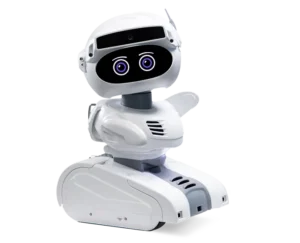
  1. Misty II
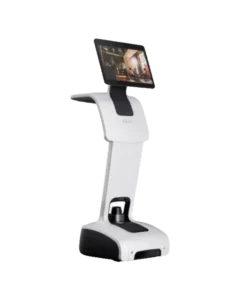
  2. temi V3
Misty Robotics

Misty II

Autonomy
II Assisted Autonomy
Score
Not scored
Readiness
Promising Progress
Price
$3,199list
temi

temi V3

Autonomy
II Assisted Autonomy
Score
65/100 Capable
Readiness
Ready Now
Price
$3,950list

Up to three

01 Classification

What each one does on its own.

The Autonomy Ladder is the same five rungs for every robot on the site. A rung describes the conditions a robot handles without you, not how good it is.

V
Generalized
Any task, any setting
IV
Environmental
Handles new obstacles without help
III
Conditional
Finishes familiar jobs on its own
II
Assisted
Runs preset routines, needs rescue
Misty IItemi V3
I
Manual
One action, on command
02 Assessment

Where they actually differ.

The Robovations Score is nine inputs across three pillars, each weighted as shown and each scored so that more is better. A robot can lead on one and trail on another, which is the point of showing them apart. Cost of ownership and data handling are reported on each robot's own page and are never averaged into the score.

Capability

Task completion16% of score
Does it finish the job it is sold to do, unattended
  • temi V360

Not scored: Misty II

Coverage and navigation10% of score
Does it work the whole area, and hold that between runs
  • temi V372

Not scored: Misty II

Edge-case recovery10% of score
Does it recover from the failures its category presents
  • temi V343

Not scored: Misty II

Operating envelope4% of score
How far conditions can vary before performance drops
  • temi V375

Not scored: Misty II

Dependability

Field failure rate16% of score
Documented hardware failures per owner-year
  • temi V364

Not scored: Misty II

Software stability14% of score
Whether updates fix more than they break
  • temi V365

Not scored: Misty II

Support longevity10% of score
Committed parts, service and updates, with dates
  • temi V355

Not scored: Misty II

Ownership burden

Routine maintenance12% of score
Hands-on time it asks for in normal operation
  • temi V375

Not scored: Misty II

Consumables8% of score
Parts that must be bought to keep it working
  • temi V357

Not scored: Misty II

03 Measured against the class

How far apart is a long way?

A number only means something next to the spread it sits in. Each track below is the real range across every classified robot in the class, with the median marked.

Price24 with a published figure
  • Misty II$3,199
  • temi V3$3,950
$29median $849$100,000
Runtime26 with a published figure
  • Misty II120 min
  • temi V3480 min
30 minmedian 250 min960 min
Charge time17 with a published figure
  • Misty II150 min
  • temi V3120 min
30 minmedian 150 min360 min
Weight31 with a published figure
  • Misty II6 lbs
  • temi V326.5 lbs
0.1 lbsmedian 24.3 lbs2,646 lbs
Height30 with a published figure
  • Misty II14 in
  • temi V339.4 in
0.9 inmedian 20.4 in82 in

Not compared, because fewer than two of these robots carry a published figure: Suction, Noise.

04 Ownership

What the numbers leave out.

The trade-off

What each design gives up to be good at what it is good at.

Misty II

The expressive face and programmable arms allow unlimited behavioral customization, but nothing happens until someone writes it; the robot performs no task of its own.

The perception work is already done: SLAM, occupancy grids and path following ship with the robot, and the built-in SLAM service can be switched off for teams that would rather drive the Occipital sensor through its native SDK. The fixed part is the hardware. At 2.7 kg on a wheeled base with small arms, the chassis sets a hard ceiling on what any skill built on it can physically do.

temi V3

temi solves getting a screen and a small payload to a room and nothing past that. The navigation is genuinely hands-off, but the machine’s entire output is presence and transport: it picks nothing up, cleans nothing, and operates nothing, so the value rests on someone being on the other end of the screen or on the tray carrying something worth moving.

Navigation is confined to mapped indoor floors. Inside that map temi holds a published 5 cm accuracy, but there is no weather sealing, no stair capability, and no travel over anything rougher than a smooth floor, so a deployment covers one level of one building unless an elevator is part of the route.

Who each one is wrong for

Stated by the record itself. A robot being wrong for a household is a fact about fit, not a fault.

Misty II
Consumer home use or turnkey task execution
Sold as a development platform, not a household appliance. It maps and navigates out of the box, but nothing is built on top of that: no cleaning, no security routine, no scheduled chores until someone writes them. No consumer roadmap is documented.
Organizations without technical staff
Misty Studio drives mapping and basic commands with no code, but anything past that means writing skills in JavaScript, .NET/C#, or against the REST API from a language of your choice. Organizations with nobody to own a development cycle will not get past the built-in demos.
Budget-constrained educational settings
The Standard Edition launched at $3,199, and the real cost adds the staff time to develop against it. Open-source ROS-based platforms cost less in hardware, though they ask the team to assemble the perception stack that Misty ships assembled.
temi V3
Work that requires handling objects
temi has no arm. It carries whatever a person places on its tray, up to a published 3 kg (6.6 lb), and cannot pick anything up, open anything, or set anything down. Delivery here means transport, not handover.
Outdoor or unstructured environments
No weather sealing; navigation assumes smooth indoor floors. Stairs, uneven terrain, and outdoor surfaces are impassable.
Spaces that have not been mapped
Autonomous travel is to destinations that were mapped and named first. Until someone walks temi through the space and saves those locations, a spoken command has nowhere to send it.

What stays your job

The upkeep ownership hands back to you, whatever the autonomy level says.

Misty II
  • Monthly: Firmware check and update availability via web dashboard; manual decision to upgrade required (backward compatibility review needed).
  • As needed: Servo calibration for arm positioning accuracy (typically after 200+ hours of active manipulation).
  • As needed: Screen brightness adjustment and dust cleaning on camera lenses, the depth sensor window and microphone ports.
  • Annually: Battery health check via API. Misty publishes no replacement-part pricing.
  • As needed: Wheel bearing lubrication (minimal; no documented wear patterns in research deployments).
temi V3
  • Weekly: Inspect wheels for debris and moisture; wipe touchscreen.
  • Monthly: Check Wi-Fi signal strength in deployment areas; verify patrol route clarity.
  • Every 6-12 months: Wheel replacement or tread inspection; battery health check.
  • As needed: Remap patrol routes after furniture changes or layout updates.
05 Evidence

How much each of these is standing on.

Classifications rest on different depths of evidence. A pre-release assessment and a verified one are not the same kind of claim.

Evidence behind each classification
Robot Evidence status Sources reviewed Last assessed
Misty II Discontinued 5 Aug 2026
temi V3 Verified 7 Aug 2026

Robovations classifies robots; it does not rank them. Nothing on this page is a recommendation, and no manufacturer influences a classification or its placement here.