Skip to content
Saved
Comparison · 2 robots

Labrador Systems Retriever · Piaggio gitamini

All specialty robots. Every measure below is plotted against the full class, so a difference can be read against how much the class itself varies.
  1. Labrador Systems Retriever
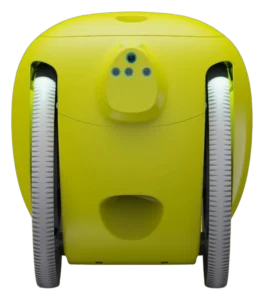
  2. Piaggio gitamini
Labrador Systems

Labrador Systems Retriever

Autonomy
IIIConditional Autonomy
Score
71/100 Promising
Readiness
Not assessed
Price
Not tracked

Up to three

01 Classification

What each one does on its own.

The Autonomy Ladder is the same five rungs for every robot on the site. A rung describes the conditions a robot handles without you, not how good it is.

V
Generalized
Any task, any setting
IV
Environmental
Handles new obstacles without help
III
Conditional
Finishes familiar jobs on its own
Labrador Systems RetrieverPiaggio gitamini
II
Assisted
Runs preset routines, needs rescue
I
Manual
One action, on command
02 Assessment

Where they actually differ.

The Robovations Score is nine inputs across three pillars, each weighted as shown and each scored so that more is better. A robot can lead on one and trail on another, which is the point of showing them apart. Cost of ownership and data handling are reported on each robot's own page and are never averaged into the score.

Capability

Task completion16% of score
Does it finish the job it is sold to do, unattended
  • Piaggio gitamini35
18median 72 across 433 scored robots100

Not scored: Labrador Systems Retriever

Coverage and navigation10% of score
Does it work the whole area, and hold that between runs
  • Piaggio gitamini55
0median 70 across 421 scored robots100

Not scored: Labrador Systems Retriever

Edge-case recovery10% of score
Does it recover from the failures its category presents
  • Piaggio gitamini26
18median 52 across 320 scored robots100

Not scored: Labrador Systems Retriever

Operating envelope4% of score
How far conditions can vary before performance drops
  • Piaggio gitamini60
28median 68 across 397 scored robots100

Not scored: Labrador Systems Retriever

Dependability

Field failure rate16% of score
Documented hardware failures per owner-year
  • Piaggio gitamini48
6median 70 across 359 scored robots100

Not scored: Labrador Systems Retriever

Software stability14% of score
Whether updates fix more than they break
  • Piaggio gitamini65
15median 65 across 342 scored robots100

Not scored: Labrador Systems Retriever

Support longevity10% of score
Committed parts, service and updates, with dates
  • Piaggio gitamini36
0median 62 across 429 scored robots100

Not scored: Labrador Systems Retriever

Ownership burden

Routine maintenance12% of score
Hands-on time it asks for in normal operation
  • Piaggio gitamini68
22median 67 across 434 scored robots100

Not scored: Labrador Systems Retriever

Consumables8% of score
Parts that must be bought to keep it working
  • Piaggio gitamini69
8median 69 across 434 scored robots100

Not scored: Labrador Systems Retriever

03 Measured against the class

How far apart is a long way?

A number only means something next to the spread it sits in. Each track below is the real range across every classified robot in the class, with the median marked.

Charge time19 with a published figure
  • Labrador Systems Retriever240 min
  • Piaggio gitamini120 min
30 minmedian 180 min360 min

Not compared, because fewer than two of these robots carry a published figure: Price, Suction, Runtime, Noise, Weight, Height.

04 Ownership

What the numbers leave out.

The trade-off

What each design gives up to be good at what it is good at.

Labrador Systems Retriever

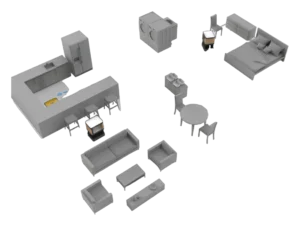
It solves reaching by changing the kitchen: pallets attached to counters stand in for a grasping arm.

A consumer product on the reservation page, a care-provider service in practice.

Piaggio gitamini

Every outing re-establishes the follow lock from scratch: nothing is mapped or retained between trips, unlike a routed delivery robot.

Nothing carried or worn pairs it to a walker, but no leader means no delivery: the robot cannot run the route alone.

The lidded 20 lb bin frees both hands on a walk, but a 28 lb frame with no stair-climbing still gets carried up porches and building steps.

No charging dock: a 7-hour runtime on a 2-hour charge is a plug-in the owner performs after every outing.

Who each one is wrong for

Stated by the record itself. A robot being wrong for a household is a fact about fit, not a fault.

Labrador Systems Retriever
Households hoping to buy one outright in 2026
Labrador's availability page ties the consumer Retriever to Retriever Pro demand and gives no date. Its reservation page still quotes a delivery estimate for the second half of 2023.
Homes where daily life spans two or more floors
The Robot Report describes cliff sensors that detect stairs and drops, and no stair-climbing ability is published. One unit serves one floor, so items still need carrying between levels.
Anyone needing loose objects picked up from floors or shelves
Retrieval works only with prepared trays on installed pallets, as IEEE Spectrum described it. Nothing in Labrador's material describes grasping an arbitrary object.
Loads heavier than 25 pounds across both decks
Labrador lists 25 pounds as the carrying limit over two decks, and its launch release caps each retrievable tray at 10 pounds.
Buyers who require a published data policy for camera devices
Labrador's privacy policy, last updated December 2021, covers its website only. It says nothing about the robot's 3D camera imagery, home map or voice commands.
Piaggio gitamini
Multi-floor buildings and stair access
No stair-climbing and no elevator integration is documented, so moving between levels means carrying the robot. It will follow its user through buildings as well as along sidewalks; the constraint is vertical, not the surface.
Autonomous operation with no person to follow
The core function is following a person it has been paired with. It cannot perform independent cargo delivery or run scheduled unattended routes.
Heavy cargo or multi-unit fleet operations
20-pound capacity limits scalability for freight centers. No fleet-management system or multi-robot coordination documented.

What stays your job

The upkeep ownership hands back to you, whatever the autonomy level says.

Labrador Systems Retriever
  • Daily: Stage trays on the counter-mounted pallets before the robot is sent to fetch them.
  • Daily: Keep the route to the self-charging dock clear; Labrador lists about 4 hours for a full recharge.
  • Weekly: Wipe both decks and the trays that carry food, drinks and dishes.
  • As needed: Keep passages at least 28 inches wide after moving furniture.
  • As needed: Arrange service through the care provider or Labrador; no public parts or repair channel is listed.
Piaggio gitamini
  • Weekly: Clear debris from the wheels and check the body for damage.
  • Monthly: Wipe the camera and radar surfaces; tracking depends on an unobstructed view of the person being followed.
  • As needed: Charge between outings; clean out the cargo bin.
  • Service: Piaggio Fast Forward publishes no consumer service schedule and no parts pricing for the gitamini. Tires, battery and repair work go through the company directly.
05 Evidence

How much each of these is standing on.

Classifications rest on different depths of evidence. A pre-release assessment and a verified one are not the same kind of claim.

Evidence behind each classification
Robot Evidence status Sources reviewed Last assessed
Labrador Systems Retriever Not Consumer-Ready 10 Sep 2026
Piaggio gitamini Provisional 3 Aug 2026

Robovations classifies robots; it does not rank them. Nothing on this page is a recommendation, and no manufacturer influences a classification or its placement here.