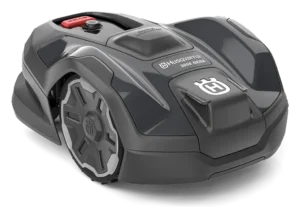
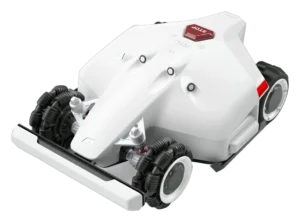
Husqvarna Automower 305E NERA · Mammotion LUBA AWD 1000
All robot lawn mowers. Every measure below is plotted against the full class, so a difference can be read against how much the class itself varies.
- Husqvarna Automower 305E NERA
- Mammotion LUBA AWD 1000


Mammotion LUBA AWD 1000
- Autonomy
- IVEnvironmental Autonomy
- Score
- Not scored
- Readiness
- Not assessed
- Price
- $1,499list
Up to three
What each one does on its own.
The Autonomy Ladder is the same five rungs for every robot on the site. A rung describes the conditions a robot handles without you, not how good it is.
Where they actually differ.
The Robovations Score is nine inputs across three pillars, each weighted as shown and each scored so that more is better. A robot can lead on one and trail on another, which is the point of showing them apart. Cost of ownership and data handling are reported on each robot's own page and are never averaged into the score.
Capability
- Husqvarna Automower 305E NERA78
Not scored: Mammotion LUBA AWD 1000
- Husqvarna Automower 305E NERA72
Not scored: Mammotion LUBA AWD 1000
- Husqvarna Automower 305E NERA48
Not scored: Mammotion LUBA AWD 1000
- Husqvarna Automower 305E NERA62
Not scored: Mammotion LUBA AWD 1000
Dependability
- Husqvarna Automower 305E NERA57
Not scored: Mammotion LUBA AWD 1000
- Husqvarna Automower 305E NERA0
Not scored: Mammotion LUBA AWD 1000
- Husqvarna Automower 305E NERA78
Not scored: Mammotion LUBA AWD 1000
Ownership burden
- Husqvarna Automower 305E NERA62
Not scored: Mammotion LUBA AWD 1000
- Husqvarna Automower 305E NERA80
Not scored: Mammotion LUBA AWD 1000
How far apart is a long way?
A number only means something next to the spread it sits in. Each track below is the real range across every classified robot in the class, with the median marked.
- Husqvarna Automower 305E NERA60 dB
- Mammotion LUBA AWD 100060 dB
- Husqvarna Automower 305E NERA27.8 lbs
- Mammotion LUBA AWD 100022 lbs
- Husqvarna Automower 305E NERA11 in
- Mammotion LUBA AWD 100011.4 in
Not compared, because fewer than two of these robots carry a published figure: Price, Suction, Runtime, Charge time.
What the numbers leave out.
The trade-off
What each design gives up to be good at what it is good at.
EdgeCut trims to the very boundary using a second deck, but obstacle avoidance is practically non-existent, with no onboard camera to back up the satellite map.
Wire-free installation removes the buried perimeter entirely, on one condition: Wi-Fi has to reach every part of the lawn, or the physical-wire fallback is the only option.
TechRadar calls the cutting efficient yet the behavior temperamental, and complex layouts need the map manually corrected to stop it straying or getting stuck.
Wire-free boundary freedom trades directly against signal reliability: open lots with clear sky view get Level IV consistency; wooded or heavily shaded yards inherit RTK’s documented canopy weakness.
You get genuine Level IV slope performance at $1,499; the LUBA 2 adds camera-assisted obstacle detection for roughly $600 more, which is the meaningful capability gap between the two generations.
Who each one is wrong for
Stated by the record itself. A robot being wrong for a household is a fact about fit, not a fault.
- Homes without Wi-Fi coverage across the whole lawn
- Husqvarna states wire-free virtual boundary installation requires Wi-Fi coverage across the full lawn; without it, only the physical-wire fallback is available, adding back the trench-digging step.
- Yards over 9,690 sq ft
- 9,690 sq ft systematic and 6,458 sq ft irregular are the documented coverage ceilings; anything larger falls outside what this Automower is rated for in either mowing pattern.
- Complex layouts needing frequent obstacle handling
- TechRadar reports obstacle avoidance is practically non-existent with no onboard cameras, and complex layouts need the map manually tweaked to stop it straying or getting stuck.
- Gardens with poor satellite sky visibility
- TechRadar states the machine is far too reliant on perfect satellite reception, and coverage degrades specifically where the sky view is obstructed by trees or structures overhead.
- Yards exceeding 0.25 acre requiring single-charge coverage
- Coverage capacity is 1,000 sq m (roughly 0.25 acre) per charge. Larger properties require the LUBA AWD 3000 or LUBA AWD 5000 variants or multiple mowing sessions.
- Dense tree canopy blocking RTK satellite signal
- RTK-GNSS positioning degrades under heavy tree cover. Owner reports document boundary drift and paused sessions in yards with substantial canopy; a wire-guided mower maintains consistent paths in those conditions.
- Owners who prefer perimeter-wire boundary systems
- The LUBA AWD 1000 has no perimeter-wire mode. Households already invested in Husqvarna or WORX wire infrastructure cannot reuse it; this mower operates only with the RTK base-station setup.
- Thick, overgrown grass requiring heavy cutting passes
- Dual cutting discs handle standard turfgrass efficiently. Owner reports note reduced cutting consistency on unmaintained tall grass over 4-5 inches; pre-cutting by conventional mower improves first-season results.
- Buyers seeking simple out-of-box setup without app dependency
- Virtual boundaries require the Mammotion app and a satellite-map session at first use. The RTK base station must be installed at a stable outdoor location with clear sky view. Setup is documented at 1-3 hours.
What stays your job
The upkeep ownership hands back to you, whatever the autonomy level says.
- Weekly: Clean the chassis, wheels and blade disc guard with a brush or garden hose (never a pressure washer) and examine the mower for damage and wear; grass-packed wheels degrade slope performance.
- Weekly: Check the blade discs and blades; the manual asks for weekly blade inspection while the mower is new, stretching the interval only once wear proves slow.
- Monthly: Replace the three main-disc blades and their screws as a set; Husqvarna documents a usual life of 3-6 weeks. EdgeCut disc blades run 9-12 weeks, so swap those every second or third blade service. Blade packs start at $26.99 on Husqvarna’s shop.
- Annually: Book the dealer service; the manual assigns the wheel, collision-column, airflow-filter and sealing checks to servicing dealers, and the charging plates and station contacts get polished.
- Seasonally: For winter, fully charge, switch OFF, clean, and store the mower dry and frost free; the charging station top can come indoors while the baseplate stays planted.
- As needed: Replace the battery when runtime between charges shortens; the manual names that as the battery’s end-of-life signal.
- Seasonally: Inspect and replace dual blade discs; replacement discs run approximately $20-40 per set depending on configuration.
- Seasonally: Perform full winter storage: clean chassis, shelter RTK base station, charge battery to storage level (approximately 50%).
- Monthly: Inspect cutting disc mounts and fasteners for wear or debris accumulation; remove lodged grass clippings from underside.
- Monthly: Clean RTK base station antenna and housing; verify mounting stability after wind events.
- After every use: Clear grass buildup from chassis underside and wheel wells, particularly after wet mowing sessions.
- As needed: Clean charging station contacts and dock surface; verify dock is level and contact pins are unobstructed.
- Annually: Review and update virtual boundary maps in the Mammotion app after any significant yard landscaping changes.
How much each of these is standing on.
Classifications rest on different depths of evidence. A pre-release assessment and a verified one are not the same kind of claim.
| Robot | Evidence status | Sources reviewed | Last assessed |
|---|---|---|---|
| Husqvarna Automower 305E NERA | Verified | 6 | Aug 2026 |
| Mammotion LUBA AWD 1000 | Discontinued | 2 | Aug 2026 |
Add a robot
Comparing across classes is allowed — the page will switch to per-class positioning and tell you it has.