Skip to content
Saved
Comparison · 2 robots

Hugging Face Microduck · Serve Robotics Gen 3

All specialty robots. Every measure below is plotted against the full class, so a difference can be read against how much the class itself varies.
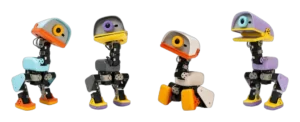
  1. Hugging Face Microduck
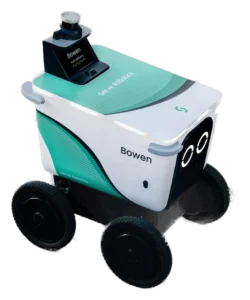
  2. Serve Robotics Gen 3
Hugging Face (built with Pollen Robotics)

Hugging Face Microduck

Autonomy
IIAssisted Autonomy
Score
65/100 Plausible
Readiness
Not assessed
Price
$399list

Serve Robotics

Serve Robotics Gen 3

Autonomy
IIAssisted Autonomy
Score
87/100 Pre-Order Ready
Readiness
Not assessed
Price
Not tracked

Up to three

01 Classification

What each one does on its own.

The Autonomy Ladder is the same five rungs for every robot on the site. A rung describes the conditions a robot handles without you, not how good it is.

V
Generalized
Any task, any setting
IV
Environmental
Handles new obstacles without help
III
Conditional
Finishes familiar jobs on its own
II
Assisted
Runs preset routines, needs rescue
Hugging Face MicroduckServe Robotics Gen 3
I
Manual
One action, on command
02 Assessment

Where they actually differ.

The Robovations Score is nine inputs across three pillars, each weighted as shown and each scored so that more is better. A robot can lead on one and trail on another, which is the point of showing them apart. Cost of ownership and data handling are reported on each robot's own page and are never averaged into the score.

None of these robots carries a scored assessment yet, so there is nothing to plot here. The classification and evidence below still apply.

03 Measured against the class

How far apart is a long way?

A number only means something next to the spread it sits in. Each track below is the real range across every classified robot in the class, with the median marked.

Runtime31 with a published figure
  • Hugging Face Microduck60 min
  • Serve Robotics Gen 3720 min
30 minmedian 300 min960 min

Not compared, because fewer than two of these robots carry a published figure: Price, Suction, Charge time, Noise, Weight, Height.

04 Ownership

What the numbers leave out.

The trade-off

What each design gives up to be good at what it is good at.

Hugging Face Microduck

The code is open and the body is not: every shipped policy can be retrained, but the chassis those policies drive can only come from Pollen.

A 1 TOPS onboard NPU keeps the price at $399 and the policies local, and it also caps how heavy a model the duck can run itself.

Ten thousand orders in five days measures demand, not delivery; new buyers now wait 4-6 months for a robot nobody has yet owned.

Serve Robotics Gen 3

Claims Level IV sidewalk autonomy but requires remote operators for complex scenarios; actual deployment autonomy is closer to Level II-Level III, bounded by jurisdiction and decision edge cases.

Who each one is wrong for

Stated by the record itself. A robot being wrong for a household is a fact about fit, not a fault.

Hugging Face Microduck
Anyone who needs open hardware to fabricate or modify
Pollen's press kit states the mechanical and electronic designs are not open-source hardware. Only the software stack is published, so the body cannot be reproduced from Pollen's files.
Buyers who need the robot delivered this year
Launch demand pushed new orders to a 4-6 month estimate on the store page, past the original before-Christmas 2026 target that now applies to early orders.
Owners expecting long sessions between charges
The press kit quotes around one hour of runtime per removable NP-F550 battery depending on use. Longer play means swapping batteries, and a two-battery charger pack is sold separately.
Buyers wanting a household helper that carries real loads
The beak is a small gripper. The Register reports a lifting capacity of roughly 100 grams, enough for a sock or a marker and nowhere near a household chore.
Families wanting durability evidence before buying
No units had been delivered by mid-September 2026, so there are no owner reports on servo wear, fall damage or battery life across months of use.
Serve Robotics Gen 3
Fully autonomous operation without human fallback
Serve keeps remote assistance in the loop for situations the robot does not resolve on its own, and does not publish how often operators take over. Unattended operation cannot be assumed.
Buying or operating a unit yourself
Serve runs the fleet itself and sells delivery as a service. The robot is not offered for purchase, lease, or operator licensing.
Scenarios requiring arm manipulation or package handling
Gen 3 is a sidewalk transport platform with a cargo compartment about 15 percent larger than Gen 2, sized to take four 16-inch pizzas. It has no arm: the merchant loads it and the customer unloads it. No pickup, placement, or signature capability is documented.

What stays your job

The upkeep ownership hands back to you, whatever the autonomy level says.

Hugging Face Microduck
  • After every use: Recharge or swap the removable NP-F550 battery, rated for around one hour of runtime.
  • As needed: Check the beak gripper and leg joints after falls, kicks or roller-skating; no service interval is published.
  • As needed: Replace worn motor parts from the optional $119 dev pack, which also carries batteries.
  • As needed: Install signed software releases, which the draft updater design pulls from GitHub releases.
  • As needed: Re-pair the included game controller over Bluetooth if the connection drops.
Serve Robotics Gen 3
  • Daily: Battery charge cycle management and route software updates from Serve operations center.
  • Weekly: Sensor cleaning (cameras, LiDAR) and wheel tread inspection for debris.
  • Monthly: Software security patches and navigation model updates; remote diagnostics from Serve support.
  • As needed: Wheel replacement if flat or worn; bumper/skirt damage repair.
  • Seasonally: Weather-proofing inspection; firmware version management across fleet.
05 Evidence

How much each of these is standing on.

Classifications rest on different depths of evidence. A pre-release assessment and a verified one are not the same kind of claim.

Evidence behind each classification
Robot Evidence status Sources reviewed Last assessed
Hugging Face Microduck Pre-Release 5 Sep 2026
Serve Robotics Gen 3 Not Consumer-Ready 4 Aug 2026

Robovations classifies robots; it does not rank them. Nothing on this page is a recommendation, and no manufacturer influences a classification or its placement here.