Skip to content
Saved
Comparison · 2 robots

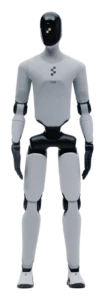
Figure 03 · Hexagon AEON

All humanoid robots. Every measure below is plotted against the full class, so a difference can be read against how much the class itself varies.
  1. Figure 03
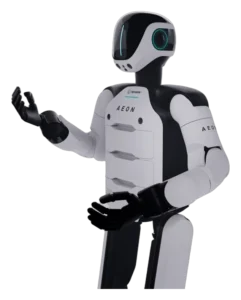
  2. Hexagon AEON
Figure AI

Figure 03

Autonomy
IIAssisted Autonomy
Score
58/100 Plausible
Readiness
Not assessed
Price
Not tracked

Hexagon Robotics

Hexagon AEON

Autonomy
IIAssisted Autonomy
Score
44/100 Concept Stage
Readiness
Not assessed
Price
Not tracked

Up to three

01 Classification

What each one does on its own.

The Autonomy Ladder is the same five rungs for every robot on the site. A rung describes the conditions a robot handles without you, not how good it is.

V
Generalized
Any task, any setting
IV
Environmental
Handles new obstacles without help
III
Conditional
Finishes familiar jobs on its own
II
Assisted
Runs preset routines, needs rescue
Figure 03Hexagon AEON
I
Manual
One action, on command
02 Assessment

Where they actually differ.

The Robovations Score is nine inputs across three pillars, each weighted as shown and each scored so that more is better. A robot can lead on one and trail on another, which is the point of showing them apart. Cost of ownership and data handling are reported on each robot's own page and are never averaged into the score.

None of these robots carries a scored assessment yet, so there is nothing to plot here. The classification and evidence below still apply.

03 Measured against the class

How far apart is a long way?

A number only means something next to the spread it sits in. Each track below is the real range across every classified robot in the class, with the median marked.

Weight47 with a published figure
  • Figure 03134.5 lbs
  • Hexagon AEON132.3 lbs
26.5 lbsmedian 142.2 lbs661.4 lbs
Height50 with a published figure
  • Figure 0366.1 in
  • Hexagon AEON65 in
34.7 inmedian 66.9 in86.6 in

Not compared, because fewer than two of these robots carry a published figure: Price, Suction, Runtime, Charge time, Noise.

04 Ownership

What the numbers leave out.

The trade-off

What each design gives up to be good at what it is good at.

Figure 03

End-to-end neural network approach enables flexible task reasoning but makes behavior hard to predict on conditions outside the training distribution.

Biped locomotion offers human-like navigation but limits deployment to controlled indoor environments.

Manufacturer-direct deployment enables customization but introduces dependency on Figure’s support cadence and unclear commercial terms.

Hexagon AEON

Hexagon has never shipped a humanoid before this one, so the 1,000-unit Schaeffler commitment is a bet on a first-generation platform, not a proven one.

The pilot replaces no job outright yet: on-site safety staff remain present at every documented deployment, which is supervision, not autonomy.

Who each one is wrong for

Stated by the record itself. A robot being wrong for a household is a fact about fit, not a fault.

Figure 03
Anyone who needs a robot they can buy
Figure 03 is designed for the home and Figure has said so plainly, but there is no consumer price, no retail pathway and no purchase date. Home use is limited to alpha testing that Figure runs. Intended for the home is not the same as available to buy.
Budget-conscious operators
Institutional deployment without pricing data means unpredictable total cost of ownership and integration effort.
Outdoor or unstructured environments
Figure 03 is designed for controlled indoor settings. Outdoor terrain, weather, and unstructured spaces degrade performance.
Plug-and-play task execution
Deployment requires robotics expertise, task specification, and iterative refinement with manufacturer. No turn-key operation.
High-reliability production use
Development-phase robotics. Reliability data is minimal. Not suitable for mission-critical or high-throughput production roles.
Hexagon AEON
Households or consumer buyers of any kind
AEON is not sold, priced, or available to individual consumers; every documented deployment is an industrial pilot partnership.
Buyers needing unsupervised, hands-off operation today
Every documented deployment runs with on-site safety staff present; no hands-off or unsupervised use has been shown.
Smaller operations wanting a single unit or short trial
The disclosed commitment is roughly 1,000 units with Schaeffler; there is no published path to a small-scale or single-unit order.
Buyers requiring a proven safety or reliability record
No independent safety certification, failure-rate data, or multi-year track record exists yet for this first-generation platform.

What stays your job

The upkeep ownership hands back to you, whatever the autonomy level says.

Figure 03
  • Daily: Battery charging and visual inspection for collision damage.
  • Weekly: Firmware update checks and motor/joint movement verification.
  • Monthly: Sensor calibration and optical cleaning.
  • As needed: Joint realignment or part replacement following falls or collisions.
  • As needed: Task retraining or workflow adjustment with Figure support.
Hexagon AEON
  • Daily: Battery charging between shifts; no published downtime or hot-swap figures.
  • Weekly: Sensor and camera calibration checks by on-site technical staff.
  • Monthly: Software and behavior updates pushed via Hexagon’s fleet management.
  • Every 3-6 months: Actuator and joint wear inspection; no published parts-replacement cadence.
  • As needed: Wheeled-leg component service; no independent failure or repair data published.
05 Evidence

How much each of these is standing on.

Classifications rest on different depths of evidence. A pre-release assessment and a verified one are not the same kind of claim.

Evidence behind each classification
Robot Evidence status Sources reviewed Last assessed
Figure 03 Not Consumer-Ready 8 Aug 2026
Hexagon AEON Not Consumer-Ready 1 Sep 2026

Robovations classifies robots; it does not rank them. Nothing on this page is a recommendation, and no manufacturer influences a classification or its placement here.