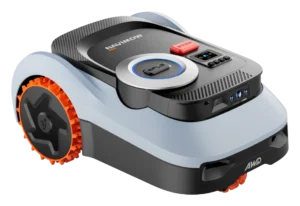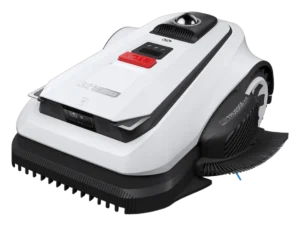
Ecovacs GOAT A2000 LiDAR PRO · Segway Navimow i2 LiDAR Pro
All robot lawn mowers. Every measure below is plotted against the full class, so a difference can be read against how much the class itself varies.
- Ecovacs GOAT A2000 LiDAR PRO
- Segway Navimow i2 LiDAR Pro
What each one does on its own.
The Autonomy Ladder is the same five rungs for every robot on the site. A rung describes the conditions a robot handles without you, not how good it is.
Where they actually differ.
The Robovations Score is nine inputs across three pillars, each weighted as shown and each scored so that more is better. A robot can lead on one and trail on another, which is the point of showing them apart. Cost of ownership and data handling are reported on each robot's own page and are never averaged into the score.
Capability
- Ecovacs GOAT A2000 LiDAR PRO82
- Segway Navimow i2 LiDAR Pro72
- Ecovacs GOAT A2000 LiDAR PRO82
- Segway Navimow i2 LiDAR Pro82
- Ecovacs GOAT A2000 LiDAR PRO42
- Segway Navimow i2 LiDAR Pro72
- Ecovacs GOAT A2000 LiDAR PRO70
- Segway Navimow i2 LiDAR Pro74
Dependability
- Ecovacs GOAT A2000 LiDAR PRO70
- Segway Navimow i2 LiDAR Pro70
- Ecovacs GOAT A2000 LiDAR PRO65
- Segway Navimow i2 LiDAR Pro65
- Ecovacs GOAT A2000 LiDAR PRO70
- Segway Navimow i2 LiDAR Pro62
Ownership burden
- Ecovacs GOAT A2000 LiDAR PRO60
- Segway Navimow i2 LiDAR Pro64
- Ecovacs GOAT A2000 LiDAR PRO70
- Segway Navimow i2 LiDAR Pro66
How far apart is a long way?
A number only means something next to the spread it sits in. Each track below is the real range across every classified robot in the class, with the median marked.
- Ecovacs GOAT A2000 LiDAR PRO$1,999
- Segway Navimow i2 LiDAR Pro$1,599
- Ecovacs GOAT A2000 LiDAR PRO39.2 lbs
- Segway Navimow i2 LiDAR Pro38.3 lbs
- Ecovacs GOAT A2000 LiDAR PRO13.2 in
- Segway Navimow i2 LiDAR Pro11.4 in
Not compared, because fewer than two of these robots carry a published figure: Suction, Runtime, Charge time, Noise.
What the numbers leave out.
The trade-off
What each design gives up to be good at what it is good at.
The trimmer removes most edge work on a tidy border, and on an irregular one it is where the mower gets stuck.
Wire-free LiDAR setup takes minutes; blades wear out every 4 to 6 weeks, per the manual.
LiDAR navigation keeps it on course under trees without an antenna, but there is no edge deck and about 20 cm of border stays uncut.
Quiet in use, below 55 dB in Notebookcheck’s measurement, yet about 13 W on standby lifts its monthly energy use.
Who each one is wrong for
Stated by the record itself. A robot being wrong for a household is a fact about fit, not a fault.
- Yards with brick edging, retaining walls or irregular borders
- EFTM had to mark no-go areas along brick fences and a rock wall because the mower was coming unstuck too often, and it needed repeated recovery.
- Overgrown lawns expecting one-tap automatic mapping
- Digital Reviews found automatic mapping failed on an overgrown backyard and had to drive the mower around the boundary by hand.
- Owners who want square corners trimmed without touch-ups
- EFTM reports the trimmer does not reach far enough into square corners, and it stops trimming when a person comes within about 1.5 m.
- Households unwilling to change blades every few weeks
- The manual lists blade replacement every 4 to 6 weeks and trimmer line and brush every 4 to 8 weeks.
- Owners who prefer drawing no-go zones on a phone map
- EFTM found it had to drive the mower into an area to mark it off rather than draw the exclusion on the map.
- Owners who want crisp lawn edges
- Notebookcheck found an unmowed border of around 20 cm where there is no ground-level transition, and no edge-cutting deck.
- Owners focused on energy use
- Notebookcheck measured about 13 W on standby and nearly 12 kWh a month for a 500 m² lawn mowed three times a week.
- Lawns larger than 2,000 m²
- Segway rates the i220 LiDAR Pro for 2,000 m² and the i210 for 1,000 m².
- Lawns scattered with small balls
- Notebookcheck saw a neon-yellow tennis ball usually run over or touched, though larger objects were avoided.
What stays your job
The upkeep ownership hands back to you, whatever the autonomy level says.
- Weekly: Wipe the rotating LiDAR sensor, per the manual.
- Monthly: Replace the blades, trimmer line and trimmer brush on the manual’s 4 to 8 week cadence (kits sold on Ecovacs’ US store).
- As needed: Brush grass from the blade disc and wheels and wipe the camera and ToF sensor.
- Seasonally: Charge fully, clean, cover the LiDAR and store the mower dry over winter; recharge every 6 months in storage.
- Weekly: Trim the roughly 20 cm border the mower leaves along raised lawn edges, per Notebookcheck.
- As needed: Clear tennis balls and small toys before mowing.
- As needed: Replace the blades on the six-blade disc; six spares come in the box.
- As needed: Edit mowing areas and restricted zones in the Navimow app map editor.
- Annually: Renew 4G data at 29.99 euros a year after the first free year if remote control is wanted.
How much each of these is standing on.
Classifications rest on different depths of evidence. A pre-release assessment and a verified one are not the same kind of claim.
| Robot | Evidence status | Sources reviewed | Last assessed |
|---|---|---|---|
| Ecovacs GOAT A2000 LiDAR PRO | Provisional | 10 | Sep 2026 |
| Segway Navimow i2 LiDAR Pro | Provisional | 4 | Sep 2026 |
Add a robot
Comparing across classes is allowed — the page will switch to per-class positioning and tell you it has.