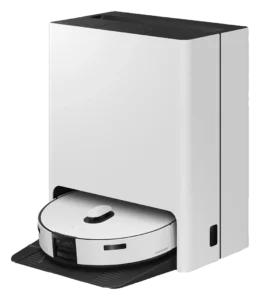
Dreame X60 Ultra · Samsung Bespoke Jet Bot Combo AI
All robot vacuums. Every measure below is plotted against the full class, so a difference can be read against how much the class itself varies.
- Dreame X60 Ultra
- Samsung Bespoke Jet Bot Combo AI
What each one does on its own.
The Autonomy Ladder is the same five rungs for every robot on the site. A rung describes the conditions a robot handles without you, not how good it is.
Where they actually differ.
The Robovations Score is nine inputs across three pillars, each weighted as shown and each scored so that more is better. A robot can lead on one and trail on another, which is the point of showing them apart. Cost of ownership and data handling are reported on each robot's own page and are never averaged into the score.
Capability
- Dreame X60 Ultra82
- Samsung Bespoke Jet Bot Combo AI80
- Dreame X60 Ultra70
- Samsung Bespoke Jet Bot Combo AI75
- Dreame X60 Ultra62
- Samsung Bespoke Jet Bot Combo AI55
- Dreame X60 Ultra80
- Samsung Bespoke Jet Bot Combo AI92
Dependability
- Dreame X60 Ultra56
- Samsung Bespoke Jet Bot Combo AI48
- Dreame X60 Ultra50
- Samsung Bespoke Jet Bot Combo AI69
- Dreame X60 Ultra85
- Samsung Bespoke Jet Bot Combo AI88
Ownership burden
- Dreame X60 Ultra75
- Samsung Bespoke Jet Bot Combo AI94
- Dreame X60 Ultra89
- Samsung Bespoke Jet Bot Combo AI66
How far apart is a long way?
A number only means something next to the spread it sits in. Each track below is the real range across every classified robot in the class, with the median marked.
- Dreame X60 Ultra$1,349
- Samsung Bespoke Jet Bot Combo AI$1,700
- Dreame X60 Ultra35,000 Pa
- Samsung Bespoke Jet Bot Combo AI6,000 Pa
- Dreame X60 Ultra180 min
- Samsung Bespoke Jet Bot Combo AI180 min
- Dreame X60 Ultra67 dB
- Samsung Bespoke Jet Bot Combo AI74 dB
- Dreame X60 Ultra10.4 lbs
- Samsung Bespoke Jet Bot Combo AI10.6 lbs
- Dreame X60 Ultra3.1 in
- Samsung Bespoke Jet Bot Combo AI3.9 in
Not compared, because fewer than two of these robots carry a published figure: Charge time.
What the numbers leave out.
The trade-off
What each design gives up to be good at what it is good at.
The 212 degree F pad wash is real, and it is bounded by what the dock holds: a 4.2 litre clean tank and a 3 litre dirty tank that a large home works through before both need hand attention.
LiDAR navigation is robust on stable maps, but multi-floor handoff reliability degrades when furniture moves without map reset.
You are paying Level III money for a station that washes, sanitizes and dries the pads without you, and the bill is a 44.4 by 51.0 cm floor footprint standing 54.7 cm tall plus a Samsung account to reach the scheduling.
SmartThings integration simplifies automation for Samsung-invested homes but creates vendor lock-in and limited interoperability with competing platforms.
Station-based washing and disposal reduce manual handling but move the chore rather than remove it: the clean tank is filled and the waste tank emptied by hand, and the wash and dry cycle draws 1200 W each time it runs.
Who each one is wrong for
Stated by the record itself. A robot being wrong for a household is a fact about fit, not a fault.
- Renters or homes with frequent layout changes
- Effective operation depends on stable maps. Furniture rearrangement requires remapping. No documented quick-reset feature for iterative home changes.
- Homes relying on 5GHz-only Wi-Fi networks
- Dreame app operates on 2.4GHz. Dual-band routers required. No WiFi6E or mesh-network fallback documented.
- Households unwilling to put a camera on the floor
- Obstacle recognition uses an RGB camera alongside 3D structured light and a retractable LiDAR, covering 280-plus object classes, and the robot is cloud-connected. Where camera frames are processed and what the app's remote view exposes has not been established.
- Homes with nowhere to put a large dock
- The 10-in-1 dock is not optional and not small. It holds a 4.2 litre clean tank and a 3 litre dirty tank, heats water, and needs a mains outlet with clearance around it. In a small apartment the dock is the larger of the two objects.
- Owners expecting a steam mop for floors
- Steam on this model is a Clean Station function that sanitizes the mop pads after a run. Nothing is steamed on the floor; the robot mops with two counter-rotating pads and water from its onboard tank.
- Space-constrained apartments
- Clean Station dimensions of 44.4 cm wide by 51.0 cm deep, standing 54.7 cm tall, put it well past under-sink storage. It needs a permanent floor position beside an outlet and is not moved between runs.
- Non-Samsung smart-home users
- SmartThings requirement creates friction for Apple Home or Google Home-native households. Third-party integration limited.
- Owners wanting a plumbed, hands-off station
- The Clean Station has no water connection. The 4 L clean tank is filled by hand and the 3.6 L waste tank emptied by hand, on a cadence set by how much mopping the home needs.
What stays your job
The upkeep ownership hands back to you, whatever the autonomy level says.
- After every use: Empty and rinse the 3 litre dirty tank; top up the 4.2 litre clean tank.
- Weekly: Rinse the dock wash bay, and clear hair and fibre from the brush and the mop pads.
- Monthly: Wash or replace the filter when the app calls for it, and check the pads for matting.
- Every 3-6 months: Descale the dock’s heating path in hard-water areas, and replace the side brush.
- Annually: Deep-clean the dock intake and the dust bag compartment.
- After every run: Handled by the Clean Station, which empties the dustbin into its bag, washes the mop pads, sanitizes them with steam and dries them with hot air.
- Weekly, or as mopping requires: Refill the 4 L clean water tank and empty the 3.6 L waste tank; wipe the station’s docking contacts.
- Monthly: Clear hair from the brush roll and side brush; check the pre-motor filter.
- Every 2-3 months: Replace the microfiber mop pads as they lose absorbency; replace the 2.5 L station dust bag when full.
- Every 6 months: Replace the pre-motor and fine dust exhaust filters; wipe the anti-cliff sensor lenses and the dToF window.
How much each of these is standing on.
Classifications rest on different depths of evidence. A pre-release assessment and a verified one are not the same kind of claim.
| Robot | Evidence status | Sources reviewed | Last assessed |
|---|---|---|---|
| Dreame X60 Ultra | Verified | 5 | Sep 2026 |
| Samsung Bespoke Jet Bot Combo AI | Verified | 10 | Sep 2026 |
Add a robot
Comparing across classes is allowed — the page will switch to per-class positioning and tell you it has.