Dreame Matrix10 Ultra · Roborock Saros Z70
All robot vacuums. Every measure below is plotted against the full class, so a difference can be read against how much the class itself varies.
- Dreame Matrix10 Ultra
- Roborock Saros Z70
What each one does on its own.
The Autonomy Ladder is the same five rungs for every robot on the site. A rung describes the conditions a robot handles without you, not how good it is.
Where they actually differ.
The Robovations Score is nine inputs across three pillars, each weighted as shown and each scored so that more is better. A robot can lead on one and trail on another, which is the point of showing them apart. Cost of ownership and data handling are reported on each robot's own page and are never averaged into the score.
Capability
- Dreame Matrix10 Ultra97
- Roborock Saros Z7068
- Dreame Matrix10 Ultra75
- Roborock Saros Z7076
- Dreame Matrix10 Ultra74
- Roborock Saros Z7048
- Dreame Matrix10 Ultra75
- Roborock Saros Z7078
Dependability
- Dreame Matrix10 Ultra73
- Roborock Saros Z7073
- Dreame Matrix10 Ultra74
- Roborock Saros Z7070
- Dreame Matrix10 Ultra70
- Roborock Saros Z7088
Ownership burden
- Dreame Matrix10 Ultra100
- Roborock Saros Z7075
- Dreame Matrix10 Ultra71
- Roborock Saros Z7071
How far apart is a long way?
A number only means something next to the spread it sits in. Each track below is the real range across every classified robot in the class, with the median marked.
- Dreame Matrix10 Ultra$1,999.99
- Roborock Saros Z70$2,599
- Dreame Matrix10 Ultra30,000 Pa
- Roborock Saros Z7022,000 Pa
- Dreame Matrix10 Ultra3.5 in
- Roborock Saros Z703.1 in
Not compared, because fewer than two of these robots carry a published figure: Runtime, Charge time, Noise, Weight.
What the numbers leave out.
The trade-off
What each design gives up to be good at what it is good at.
Three mop modules and a washing station mean the machine handles pad changes and pad washing itself, but that is a lot of new mechanism in the dock: three swappable modules, 20 wash nozzles and a water heater, all on a product less than a year in market.
LiDAR navigation is solid across typical home layouts. Reactive obstacle avoidance covers documented scenarios. Generalization beyond the learned floor plan is not published. If your home layout shifts substantially, re-mapping overhead is real.
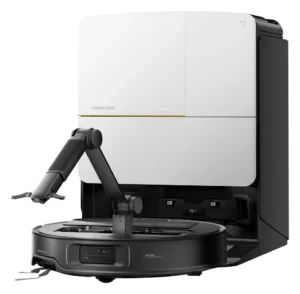
The OmniGrip arm adds autonomous item pickup, a real capability, but operates on the robot’s terms: shape and weight constraints mean manual intervention remains necessary for fragile and irregular objects.
The flagship price reflects integrated dock and arm, yet mid-tier Roborock models deliver comparable Level III autonomy for half the cost, making the arm itself a premium component for specific use cases only.
Who each one is wrong for
Stated by the record itself. A robot being wrong for a household is a fact about fit, not a fault.
- Compact homes under 1,500 sqft
- Flagship pricing and capability exceed compact-home needs. A mid-tier Dreame model (e.g., X30 Ultra) delivers equivalent Level III autonomy for under $900.
- High-pile or shag-carpeted homes
- Mop system is not designed for deep-pile carpet. Owner reports of high-pile homes report dust settling beneath the mop; full-coverage vacuuming requires no-mop zones.
- 5 GHz-only Wi-Fi networks
- App connectivity requires 2.4 GHz band support. Homes with 5 GHz-only Wi-Fi will not support remote scheduling or status monitoring.
- Minimalist, clutter-free spaces
- The arm's value diminishes without floor scatter. Standard navigation and mopping alone do not justify the $2400+ premium over mid-tier Level III models costing half as much.
- Owners with fragile or oddly-shaped items
- The arm applies fixed gripping force without adaptive sensing. Delicate objects risk damage; manual pre-clearing remains necessary for breakables and irregular shapes.
- Budget-conscious buyers
- Mid-tier Roborock models deliver 90% of navigation autonomy at half the cost. The arm itself accounts for the substantial price premium and complexity burden.
- Very small apartments
- Dock footprint requires 60cm clearance; arm extension adds spatial demand. Compact homes benefit from smaller, less complex models.
- Homes with wall-mounted obstacles or low clearance
- Wall shelves, low-hanging art, or tight corners obscure the arm's reach zone. Pickup attempts fail in confined spaces.
What stays your job
The upkeep ownership hands back to you, whatever the autonomy level says.
- Weekly: Check the station’s water tanks and wipe the dock tray (~5 min).
- Monthly: Filter clean and side-brush bristle check (~10 min).
- Every 3 months: Dust bag replacement (~$24); Dreame rates the 3.2 L bag at up to 100 days.
- Every 3-6 months: Main brush and side brush replacement (~$30-50 per set).
- Every 6-12 months: Filter replacement (~$15); inspect the three mop modules for wear.
- After every use: Empty dock bag if indicator shows capacity near full, typically weekly in normal households.
- Weekly: Visual inspection of arm gripper fingers for debris; compressed air cleanup if hair wrapping detected.
- Monthly: Replace main filter, rinse side brush, check dock connection for dust accumulation.
- Every 3-6 months: Deep clean dock gaskets, test camera clarity with mapping pass, inspect mopping pad for mineral buildup.
- As needed: Manual item extraction if arm encounters stuck or oversized object during cycle.
How much each of these is standing on.
Classifications rest on different depths of evidence. A pre-release assessment and a verified one are not the same kind of claim.
| Robot | Evidence status | Sources reviewed | Last assessed |
|---|---|---|---|
| Dreame Matrix10 Ultra | Verified | 6 | Aug 2026 |
| Roborock Saros Z70 | Verified | 11 | Aug 2026 |
Add a robot
Comparing across classes is allowed — the page will switch to per-class positioning and tell you it has.