
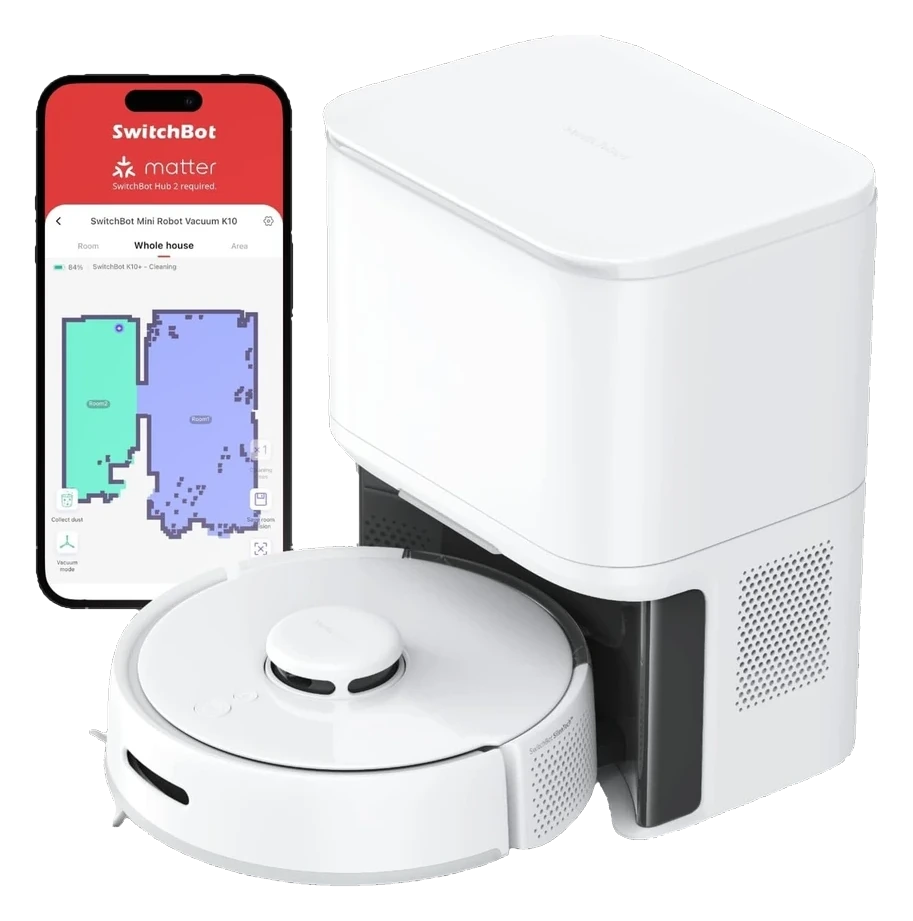
SwitchBot
SwitchBot K10+
- Autonomy
- IIIConditional
- Score
- 69/100Capable
- Readiness
- Ready Now
- Price
- $499.99list
SwitchBot
Up to three
All robot vacuums. Every figure below is placed against the whole class, so a gap can be read against how much the class itself varies.
The conditions each robot was assessed against, side by side. Rows marked in gold are where these machines genuinely differ.
| Condition | SwitchBot K10+ |
|---|---|
| Home size | |
| Under 1,500 sqft | GoodEngineered for apartments under 1500 sqft. Runtime allows single-pass coverage of compact layouts. |
| 1,500 – 3,000 | DependsFeasible with 60-minute runtime but requires two sessions or manual repositioning for larger single-floor homes. |
| Over 3,000 | PoorRuntime and suction insufficient for homes over 3000 sqft; multiple manual repositioning and dock resets required. |
| Primary floors | |
| Hard floors | GoodHard floors suit compact suction and lightweight design. Daily dust and light pet hair managed effectively. |
| Low / medium pile | DependsAdequate for light low-pile with LiDAR navigation. Owner reports show decent performance on thin carpet. |
| High pile / shag | Poor2700 Pa suction insufficient for high-pile or shag carpet; owner reports document significant cleaning degradation. |
| Mopping needs | |
| Vacuum only | GoodVacuums first; the mop pad is optional. |
| Light mopping | GoodFlat mop pad handles light, routine wiping of hard floors. |
| Frequent mopping | DependsA dragged pad freshens floors but lacks the pressure or scrubbing for heavy, frequent mopping. |
| You want to… | |
| Empty bin myself | GoodMonthly dust-bag replacement and weekly filter/brush maintenance fit active homeowners well. |
| Empty occasionally | GoodSelf-emptying dock reduces hands-on effort compared to bagless vacuums. Seasonal maintenance only. |
| Set-and-forget | DependsSelf-emptying dock reduces frequency, but monthly bag replacement and filter cleaning still required for optimal performance. |
A robot being poor for a condition is a fact about fit, not a fault. “Depends” means the record names a limit worth reading, not that the answer is unknown.
Nine inputs across three pillars, each weighted as shown and each scored so more is better. A robot can lead on one and trail on another, which is the point of showing them apart.
A number only means something next to the spread it sits in. Each track is the real range across every classified robot in the class, with the median marked.
These robots share no measured specification with enough published figures to plot. That is a gap in the record, not a finding about the robots.
Written on each record, and the only thing here every robot on the site carries.
What each design gives up to be good at what it is good at.
The K10+ keeps both its footprint and its endurance: what the 24.8 cm body gives up is suction, at 2,700 Pa, not runtime. SwitchBot publishes 150 minutes in quiet mode, so the compromise shows up on thick carpet rather than in how much floor one charge covers.
Stated by the record itself. A robot being wrong for a household is a fact about fit, not a fault.
The upkeep ownership hands back to you, whatever the autonomy level says.
Classifications rest on different depths of evidence. A pre-release assessment and a verified one are not the same kind of claim.
| Robot | Evidence status | Sources reviewed | Last assessed |
|---|---|---|---|
| SwitchBot K10+ | Provisional | 6 | Aug 2026 |
Evidence status counts the sources behind a classification, not their kind. A high count can be maker documentation and price coverage, so read it as how much was reviewed rather than as independent testing. How we weigh evidence.
Robovations classifies robots; it does not rank them. Nothing on this page is a recommendation, and no manufacturer influences a classification or its placement here.
Comparing across classes is allowed — the page will switch to per-class positioning and tell you it has.
