
Maytronics
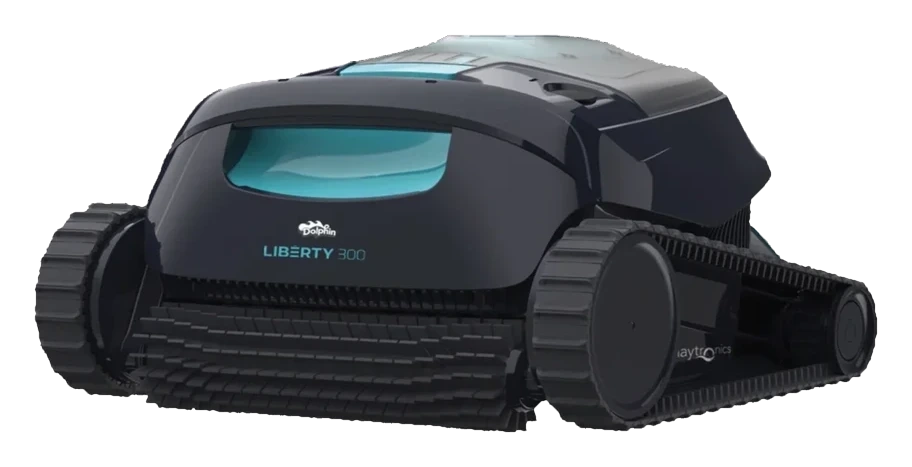
Maytronics Dolphin Liberty 300
- Autonomy
- IIIConditional
- Score
- 57/100Capable
- Readiness
- Ready Now
- Price
- $1,249list
Maytronics

Maytronics
Up to three
All robot pool cleaners. Every figure below is placed against the whole class, so a gap can be read against how much the class itself varies.
The conditions each robot was assessed against, side by side. Rows marked in gold are where these machines genuinely differ.
| Condition | Dolphin Liberty 300 | Dolphin EON 120d |
|---|---|---|
| Pool type | ||
| In-ground | GoodMagnetic dock and climbing capability optimized for standard in-ground installations. | GoodCordless design assumes permanent dock at pool edge; in-ground installation is the primary market. |
| Above-ground | PoorCordless form factor and dock design not suited to above-ground frame geometries. | PoorCordless dock requires stable, integrated placement; above-ground pools lack power infrastructure for dock installation. |
| Mixed setup | GoodStandard cordless pool cleaner fit for any standard pool type. | GoodIn-ground preferred; above-ground not supported per current documentation. |
| Pool size | ||
| Small (< 400 sqft) | GoodBelow documented range; cordless design and dock footprint may exceed needs for pools under 8,000 gallons. | GoodMSRP $1,199 targets larger pools; smaller pools may find similar coverage in lower-tier cordless models. |
| Medium (400 – 800) | GoodManufacturer-targeted range of 12,000-20,000 gallons; runtime and coverage align with medium pool cycle expectations. | Good12,000–25,000 gallons aligns with manufacturer documentation and DebrisLock design specifications. |
| Large (> 800)they differ | DependsPools above 25,000 gallons may require multiple charge cycles per pass; heavy debris load shortens cartridge intervals. | GoodSmart mapping supports multi-session coverage for pools over 25,000 gallons; runtime per cycle undocumented. |
| Debris load | ||
| Fine (sand / silt) | GoodFilter-cartridge design handles fine sediment; weekly rinse maintains suction for sand and silt. | GoodStandard filters and backwash handle algae and fine particles; DebrisLock not primarily designed for fine debris. |
| Leaves / large debristhey differ | DependsCartridge clogging accelerates with heavy leaf fall; pre-skimming recommended during peak shedding season. | GoodDebrisLock backwash system engineered specifically for leaf and organic debris volume without filter clogging. |
| Algae / heavy fouling | DependsCleaner removes settled algae; active algae blooms require chemical treatment. Cartridge washings increase with algae frequency. | DependsAlgae requires chemical treatment and brush scrubbing; Dolphin handles removal but does not address root cause. |
| Coverage you want | ||
| Floor only | GoodPrimary documented function with predictable floor coverage per cycle. | GoodSmart mapping documented for floor-only coverage patterns; baseline autonomy performance. |
| Floor + walls | GoodWall-climbing capability documented; sustained waterline reach varies by pool condition and cleaner pitch. | GoodEON 120d reaches walls per manufacturer specs; waterline and tanning-ledge coverage included. |
| Floor + walls + waterline | DependsWaterline brush reach documented but performance on calcium buildup and algae line varies; depends on pool chemistry. | DependsWaterline reach confirmed; full waterline scrub cadence depends on smart-map programming and documented test cycles. |
A robot being poor for a condition is a fact about fit, not a fault. “Depends” means the record names a limit worth reading, not that the answer is unknown.
Nine inputs across three pillars, each weighted as shown and each scored so more is better. A robot can lead on one and trail on another, which is the point of showing them apart.
A number only means something next to the spread it sits in. Each track is the real range across every classified robot in the class, with the median marked.
Not compared, because fewer than two of these robots carry a published figure: Noise, Height.
Written on each record, and the only thing here every robot on the site carries.
What each design gives up to be good at what it is good at.
Cordless convenience comes with battery discipline. The pack goes into winter storage charged and gets topped up during the off-season, and between cycles the unit is lifted out and charged by hand rather than returning to a dock.
DebrisLock backwashes in the water the moment the filter starts to clog, but it reduces filter handling rather than removing it: early press testing still found clearing a leaf-packed filter an awkward job.
Cordless operation removes the tether, but the run is bounded by the pack: 1.5, 2 or 2.5 hours per cycle and a lift-out to recharge, against a mains cleaner that keeps going from the outlet.
Stated by the record itself. A robot being wrong for a household is a fact about fit, not a fault.
The upkeep ownership hands back to you, whatever the autonomy level says.
Classifications rest on different depths of evidence. A pre-release assessment and a verified one are not the same kind of claim.
| Robot | Evidence status | Sources reviewed | Last assessed |
|---|---|---|---|
| Maytronics Dolphin Liberty 300 | Pending | 1 | Aug 2026 |
| Maytronics Dolphin EON 120d | Pending | 8 | Aug 2026 |
Evidence status counts the sources behind a classification, not their kind. A high count can be maker documentation and price coverage, so read it as how much was reviewed rather than as independent testing. How we weigh evidence.
 The full recordMaytronics Dolphin Liberty 300Specifications, evidence, the Fit Check in full, and every tracked change.
 The full recordMaytronics Dolphin EON 120dSpecifications, evidence, the Fit Check in full, and every tracked change.
Robovations classifies robots; it does not rank them. Nothing on this page is a recommendation, and no manufacturer influences a classification or its placement here.
Comparing across classes is allowed — the page will switch to per-class positioning and tell you it has.