
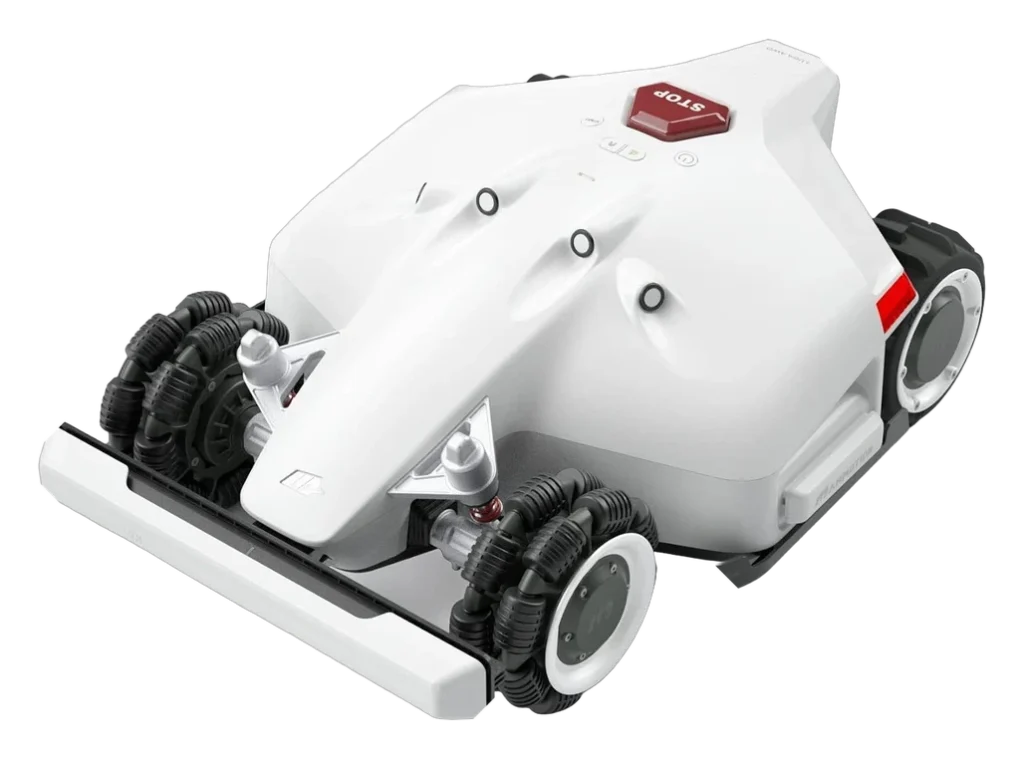
Mammotion
Mammotion LUBA AWD 1000
- Autonomy
- IIIConditional
- Score
- 57/100Capable
- Readiness
- Not assessed
- Price
- Not tracked
Mammotion
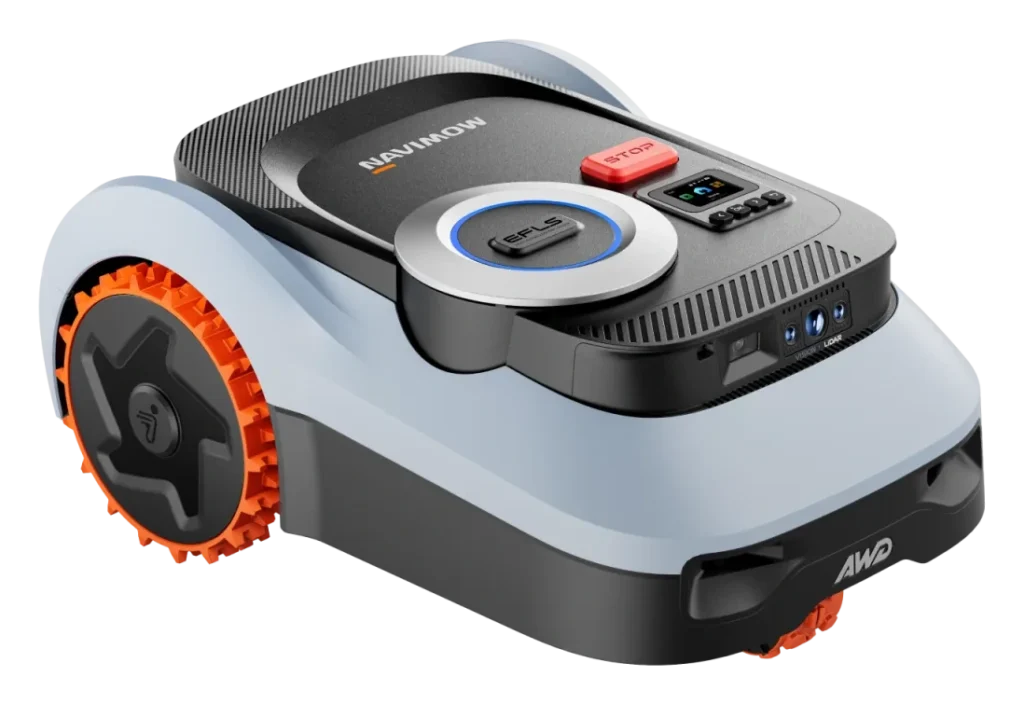
Segway
Up to three
All robot lawn mowers. Every figure below is placed against the whole class, so a gap can be read against how much the class itself varies.
The conditions each robot was assessed against, side by side. Rows marked in gold are where these machines genuinely differ.
| Condition | LUBA AWD 1000 | Navimow i2 LiDAR Pro |
|---|---|---|
| Yard size | ||
| Under ¼ acre | GoodRated for up to 0.25 acre (1,000 sq m); sub-quarter-acre lots are fully within single-charge range. | GoodSegway rates the i210 for 1,000 m², about a quarter acre, and Notebookcheck tested it on 300 m². |
| ¼ – ½ acrethey differ | DependsCoverage tops out at 0.25 acre per charge; quarter-to-half-acre lots require multiple sessions or a higher-capacity LUBA variant. | GoodSegway rates the i220 LiDAR Pro for 2,000 m², close to half an acre. |
| Over ½ acre | PoorThe 0.25-acre coverage cap means over-half-acre yards need multiple daily sessions; the LUBA AWD 3000 or 5000 are the appropriate variants for this size. | PoorLawns over half an acre exceed Segway's 2,000 m² rating for the larger i220 LiDAR Pro. |
| Terrain | ||
| Mostly flat | GoodAll-wheel-drive and RTK navigation handle flat terrain without issue; fully capable on level lots. | GoodNotebookcheck saw straight paths, full coverage and an even cut on open lawn. |
| Gentle slopes | GoodFour in-hub motors sustain traction and systematic path coverage on moderate gradients well within the 65% rated slope. | GoodAll-wheel drive and front-wheel steering gave Notebookcheck's unit off-road capability on uneven lawns. |
| Steep / hilly | DependsRated for up to 65% (33-degree) slopes; manufacturer and owner reports advise dry-condition scheduling for steep zones for reliable traction. | DependsIt climbed a 55% artificial-turf ramp for Notebookcheck, but no test on real steep grass was found. |
| Grass type | ||
| Typical lawn grass | GoodDual cutting discs with 16-inch cutting width handle standard turfgrass at 30-70 mm height settings reliably. | GoodNotebookcheck found the cutting deck produced an even cut on open lawn areas. |
| Mixed / tall growth | DependsOwner reports recommend a conventional first-pass cut for unmaintained tall grass over 4-5 inches before switching to automated schedule. | DependsNo test of the i2 LiDAR Pro in long or overgrown grass was found. |
| Thick (Bermuda / Zoysia) | DependsThick or dense warm-season grasses may require slower per-zone schedule settings; blade disc replacement interval shortens under sustained heavy cutting. | DependsNo test in thick or dense turf was found for its 22 cm six-blade disc. |
| Boundary setup | ||
| Wireless required | GoodRTK-GNSS virtual boundaries drawn via satellite map are this mower's native mode; no wire installation required. | GoodIt maps and navigates with LiDAR, network RTK and vision, with no wire or antenna. |
| Wire required | PoorThe LUBA AWD 1000 has no perimeter-wire mode and cannot integrate with existing wire-based boundary systems. | PoorSegway sells it as wire-free only, with no boundary wire installation option listed. |
| No preference | GoodWireless RTK virtual-boundary setup is straightforward on open lots with clear sky view; suitable for owners with no preference between boundary approaches. | GoodIts wire-free setup meets a buyer with no boundary preference. |
A robot being poor for a condition is a fact about fit, not a fault. “Depends” means the record names a limit worth reading, not that the answer is unknown.
Nine inputs across three pillars, each weighted as shown and each scored so more is better. A robot can lead on one and trail on another, which is the point of showing them apart.
A number only means something next to the spread it sits in. Each track is the real range across every classified robot in the class, with the median marked.
Not compared, because fewer than two of these robots carry a published figure: Price, Runtime, Charge time, Weight, Height.
Written on each record, and the only thing here every robot on the site carries.
What each design gives up to be good at what it is good at.
Wire-free boundary freedom trades directly against signal reliability: open lots with clear sky view get Level III consistency; wooded or heavily shaded yards inherit RTK’s documented canopy weakness.
You get genuine Level III slope performance; the LUBA 2 adds camera-assisted obstacle detection, which is the meaningful capability gap between the two generations.
LiDAR navigation keeps it on course under trees without an antenna, but there is no edge deck and about 20 cm of border stays uncut.
Quiet in use, below 55 dB in Notebookcheck’s measurement, yet about 13 W on standby lifts its monthly energy use.
Stated by the record itself. A robot being wrong for a household is a fact about fit, not a fault.
The upkeep ownership hands back to you, whatever the autonomy level says.
Classifications rest on different depths of evidence. A pre-release assessment and a verified one are not the same kind of claim.
| Robot | Evidence status | Sources reviewed | Last assessed |
|---|---|---|---|
| Mammotion LUBA AWD 1000 | Discontinued | 3 | Sep 2026 |
| Segway Navimow i2 LiDAR Pro | Provisional | 4 | Sep 2026 |
Evidence status counts the sources behind a classification, not their kind. A high count can be maker documentation and price coverage, so read it as how much was reviewed rather than as independent testing. How we weigh evidence.
 The full recordMammotion LUBA AWD 1000Specifications, evidence, the Fit Check in full, and every tracked change.
 The full recordSegway Navimow i2 LiDAR ProSpecifications, evidence, the Fit Check in full, and every tracked change.
Robovations classifies robots; it does not rank them. Nothing on this page is a recommendation, and no manufacturer influences a classification or its placement here.
Comparing across classes is allowed — the page will switch to per-class positioning and tell you it has.