
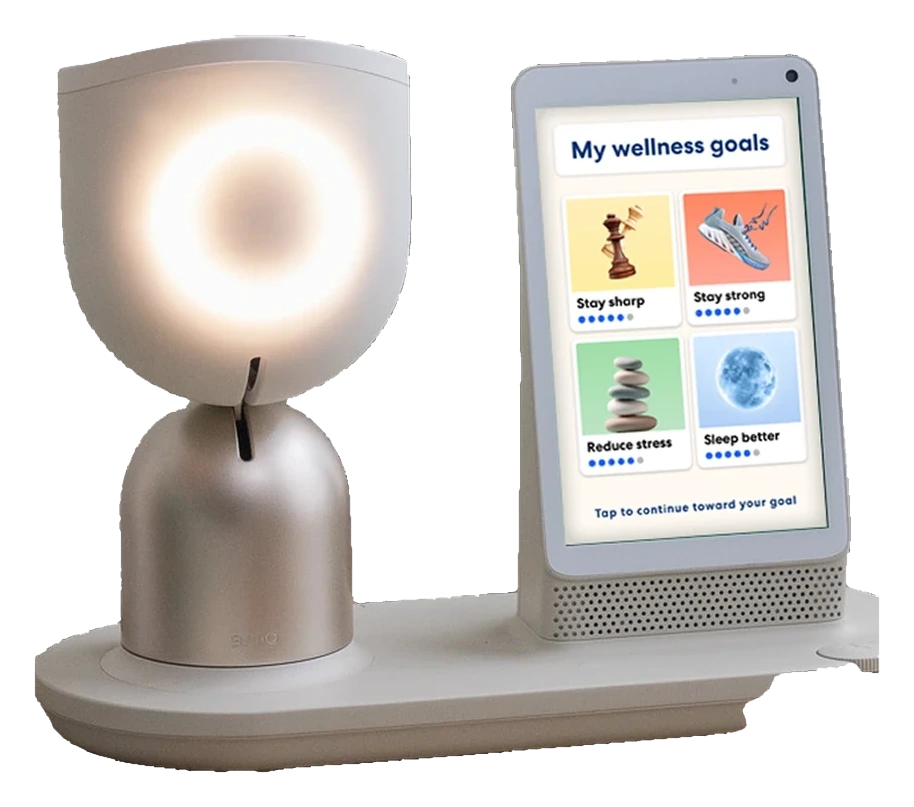
Intuition Robotics
Intuition Robotics
Up to three
All specialty robots. Every figure below is placed against the whole class, so a gap can be read against how much the class itself varies.
The conditions each robot was assessed against, side by side. Rows marked in gold are where these machines genuinely differ.
| Condition | ElliQ 3 |
|---|---|
| Family involvement | |
| Family checks in | GoodCompanion app logs activity and enables family notifications for daily check-ins. |
| Lives independently | DependsUser must maintain app pairing; app connection lapses interrupt family oversight. |
| Combating isolation | GoodDesigned to mitigate isolation through daily voice interaction and family visibility. |
| Living situation | |
| Aging in place | GoodStationary placement and voice-only interaction suit safety-conscious aging-in-place environments. |
| Shared household | DependsMultiple units required for shared homes; reminder context can get confused with roommates. |
| Care facility | PoorDesigned for single-home occupancy; assisted-living facilities have different communication protocols. |
| Tech comfort | |
| Family is app-savvy | GoodFamily members manage app; minimal smartphone demands on the elder themselves. |
| Low-tech user | DependsUser needs basic Wi-Fi understanding; technical support required if connection drops. |
| Spotty internet | PoorCloud-mandatory operation; unreliable connectivity makes the device non-functional for days at a time. |
| Interaction style | |
| Passive check-ins | GoodDaily automated reminders and check-ins require no active effort from the user. |
| User initiates | DependsUser must say wake word to start interaction; minimal initiation friction but not fully passive. |
| Games & chat | GoodSubscription includes games, trivia, and conversation starters for cognitive engagement. |
A robot being poor for a condition is a fact about fit, not a fault. “Depends” means the record names a limit worth reading, not that the answer is unknown.
Nine inputs across three pillars, each weighted as shown and each scored so more is better. A robot can lead on one and trail on another, which is the point of showing them apart.
A number only means something next to the spread it sits in. Each track is the real range across every classified robot in the class, with the median marked.
These robots share no measured specification with enough published figures to plot. That is a gap in the record, not a finding about the robots.
Written on each record, and the only thing here every robot on the site carries.
What each design gives up to be good at what it is good at.
The subscription funds the cloud processing but carries most of the cost: $249.99 to enroll once, then an annual plan listed at $359.88 on ElliQ’s own store, with monthly plans reported between $39.99 and $59.99. Cancellation halts check-ins, reminders, and conversation.
Stationary placement reduces setup burden but limits utility to one room; mobility needs or multi-room homes must place multiple units.
Stated by the record itself. A robot being wrong for a household is a fact about fit, not a fault.
The upkeep ownership hands back to you, whatever the autonomy level says.
Classifications rest on different depths of evidence. A pre-release assessment and a verified one are not the same kind of claim.
| Robot | Evidence status | Sources reviewed | Last assessed |
|---|---|---|---|
| ElliQ 3 | Provisional | 2 | Aug 2026 |
Evidence status counts the sources behind a classification, not their kind. A high count can be maker documentation and price coverage, so read it as how much was reviewed rather than as independent testing. How we weigh evidence.
Robovations classifies robots; it does not rank them. Nothing on this page is a recommendation, and no manufacturer influences a classification or its placement here.
Comparing across classes is allowed — the page will switch to per-class positioning and tell you it has.
