Skip to content
Saved
Comparison · 2 robots

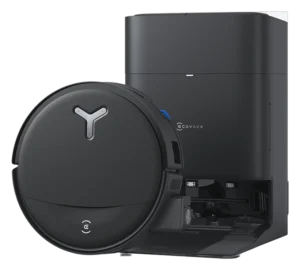
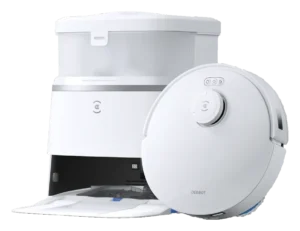
Ecovacs Deebot T30 Pro Omni · Ecovacs Deebot T80S Omni

All robot vacuums. Every measure below is plotted against the full class, so a difference can be read against how much the class itself varies.

  1. Ecovacs Deebot T30 Pro Omni
  2. Ecovacs Deebot T80S Omni

Up to three

01 Classification

What each one does on its own.

The Autonomy Ladder is the same five rungs for every robot on the site. A rung describes the conditions a robot handles without you, not how good it is.

V
Generalized
Any task, any setting
IV
Environmental
Handles new obstacles without help
III
Conditional
Finishes familiar jobs on its own
Ecovacs Deebot T30 Pro OmniEcovacs Deebot T80S Omni
II
Assisted
Runs preset routines, needs rescue
I
Manual
One action, on command
02 Assessment

Where they actually differ.

The Robovations Score is nine inputs across three pillars, each weighted as shown and each scored so that more is better. A robot can lead on one and trail on another, which is the point of showing them apart. Cost of ownership and data handling are reported on each robot's own page and are never averaged into the score.

Capability

Task completion16% of score
Does it finish the job it is sold to do, unattended
  • Ecovacs Deebot T30 Pro Omni72
  • Ecovacs Deebot T80S Omni84
18median 72 across 428 scored robots100
Coverage and navigation10% of score
Does it work the whole area, and hold that between runs
  • Ecovacs Deebot T30 Pro Omni75
  • Ecovacs Deebot T80S Omni68
0median 70 across 416 scored robots100
Edge-case recovery10% of score
Does it recover from the failures its category presents
  • Ecovacs Deebot T30 Pro Omni40
  • Ecovacs Deebot T80S Omni70
18median 52 across 317 scored robots100
Operating envelope4% of score
How far conditions can vary before performance drops
  • Ecovacs Deebot T30 Pro Omni75
  • Ecovacs Deebot T80S Omni66
28median 68 across 392 scored robots100

Dependability

Field failure rate16% of score
Documented hardware failures per owner-year
  • Ecovacs Deebot T30 Pro Omni80
  • Ecovacs Deebot T80S Omni70
6median 70 across 355 scored robots100
Software stability14% of score
Whether updates fix more than they break
  • Ecovacs Deebot T30 Pro Omni82
  • Ecovacs Deebot T80S Omni65
15median 65 across 339 scored robots100
Support longevity10% of score
Committed parts, service and updates, with dates
  • Ecovacs Deebot T30 Pro Omni73
  • Ecovacs Deebot T80S Omni62
0median 62 across 424 scored robots100

Ownership burden

Routine maintenance12% of score
Hands-on time it asks for in normal operation
  • Ecovacs Deebot T30 Pro Omni94
  • Ecovacs Deebot T80S Omni84
22median 67 across 429 scored robots100
Consumables8% of score
Parts that must be bought to keep it working
  • Ecovacs Deebot T30 Pro Omni57
  • Ecovacs Deebot T80S Omni72
8median 69 across 429 scored robots100
03 Measured against the class

How far apart is a long way?

A number only means something next to the spread it sits in. Each track below is the real range across every classified robot in the class, with the median marked.

Suction (mode not stated)207 with a published figure
  • Ecovacs Deebot T30 Pro Omni11,000 Pa
  • Ecovacs Deebot T80S Omni24,800 Pa
1,000 Pamedian 10,000 Pa42,000 Pa
Runtime186 with a published figure
  • Ecovacs Deebot T30 Pro Omni290 min
  • Ecovacs Deebot T80S Omni205 min
60 minmedian 180 min360 min
Height223 with a published figure
  • Ecovacs Deebot T30 Pro Omni4.1 in
  • Ecovacs Deebot T80S Omni3.9 in
2.6 inmedian 3.8 in7.8 in

Not compared, because fewer than two of these robots carry a published figure: Price, Charge time, Noise, Weight.

04 Ownership

What the numbers leave out.

The trade-off

What each design gives up to be good at what it is good at.

Ecovacs Deebot T30 Pro Omni

The dock eliminates manual mop rinsing, but introduces a 20-30 minute wash-and-dry cycle that conflicts with quiet household hours.

Ecovacs publishes up to 290 minutes in silent mode on hard floor, but that is a best case; raising suction toward the 11,000 Pa maximum shortens a charge substantially, and no runtime at that setting is published.

The automated dock adds convenience but brings its own upkeep, mop pads, dust bags and tank refills, that a budget vacuum does not carry.

Ecovacs Deebot T80S Omni

Cleaning scores sit well above average, while navigation runs below it: Vacuum Wars measured 0.62 m² per minute.

At $649.99 it posts suction and hair results near far pricier models, and a 20 mm climb limit keeps it off higher thresholds.

Who each one is wrong for

Stated by the record itself. A robot being wrong for a household is a fact about fit, not a fault.

Ecovacs Deebot T30 Pro Omni
Buyers who will not accept a networked camera in the home
The robot carries a camera and depends on the Ecovacs cloud, and no fully local mode is documented. Ecovacs has a documented security incident history across the Deebot line, including a 2024 DEF CON demonstration of Bluetooth takeover and a subsequent CISA advisory covering Deebot vacuums and base stations.
Homes requiring silent daytime operation
Dock wash cycles run 20-30 minutes at 60-70 dB after mop sessions. Owner reports note scheduling conflicts in work-from-home environments.
Buyers requiring offline or local-only operation
All advanced features depend on Ecovacs cloud servers. No documented local-only scheduling or mapping mode. Cloud connectivity is required for routine operation.
Single-floor homes exceeding 3,000 sq ft
Ecovacs publishes up to 290 minutes in silent mode on hard floor, which is a best case; higher suction modes draw that down, so very large floors take a mid-session recharge and a longer total elapsed time.
Ecovacs Deebot T80S Omni
Large homes that need a fast single run
Vacuum Wars measured navigation efficiency at 0.62 m² per minute against a 0.71 average, with slightly below-average coverage per charge.
Homes with raised thresholds
Ecovacs rates obstacle crossing at 20 mm with the mop attached, and Vacuum Wars measured 19 mm against a 24.5 mm average.
Households that run it during TV or calls
Pedestrian found it a little too noisy to run while watching television, and Ecovacs lists 65 dBA for mop washing.
Owners who want a plumbed or hands-free water supply
The 4 L clean and 2.2 L dirty tanks are filled and emptied by hand, per Ecovacs' spec sheet.

What stays your job

The upkeep ownership hands back to you, whatever the autonomy level says.

Ecovacs Deebot T30 Pro Omni
  • Weekly: Empty dustbin and mop water tank; refill clean water tank ($0).
  • Monthly: Swap mop pads; clean dock water filter ($15-25 per pair pads).
  • Monthly: Rinse vacuum dustbin filter; replace when clogged ($0).
  • Every 3-6 months: Replace vacuum motor filter and side brush ($20-40 total per Ecovacs pricing).
  • Every 3-6 months: Clean LiDAR window and camera lenses; inspect cliff sensors for dust accumulation ($0).
  • Annually: Inspect dock brush and replace if bristles are flattened; clean dock jets ($0 unless replacement brush ordered).
Ecovacs Deebot T80S Omni
  • Weekly: Refill the 4 L clean-water tank and empty the 2.2 L dirty-water tank.
  • Every 3-6 months: Replace the dock dust bag, rated for up to 90 days of auto-emptying.
  • As needed: Refill the cleaning solution tank for automatic dosing.
  • Monthly: Wipe the ToF and structured-light sensors and the RGB camera window.
  • Annually: Remove and clean the mop washing tray, which Ecovacs says needs it once or twice a year.
05 Evidence

How much each of these is standing on.

Classifications rest on different depths of evidence. A pre-release assessment and a verified one are not the same kind of claim.

Evidence behind each classification
Robot Evidence status Sources reviewed Last assessed
Ecovacs Deebot T30 Pro Omni Provisional 7 Aug 2026
Ecovacs Deebot T80S Omni Provisional 6 Sep 2026

Robovations classifies robots; it does not rank them. Nothing on this page is a recommendation, and no manufacturer influences a classification or its placement here.