
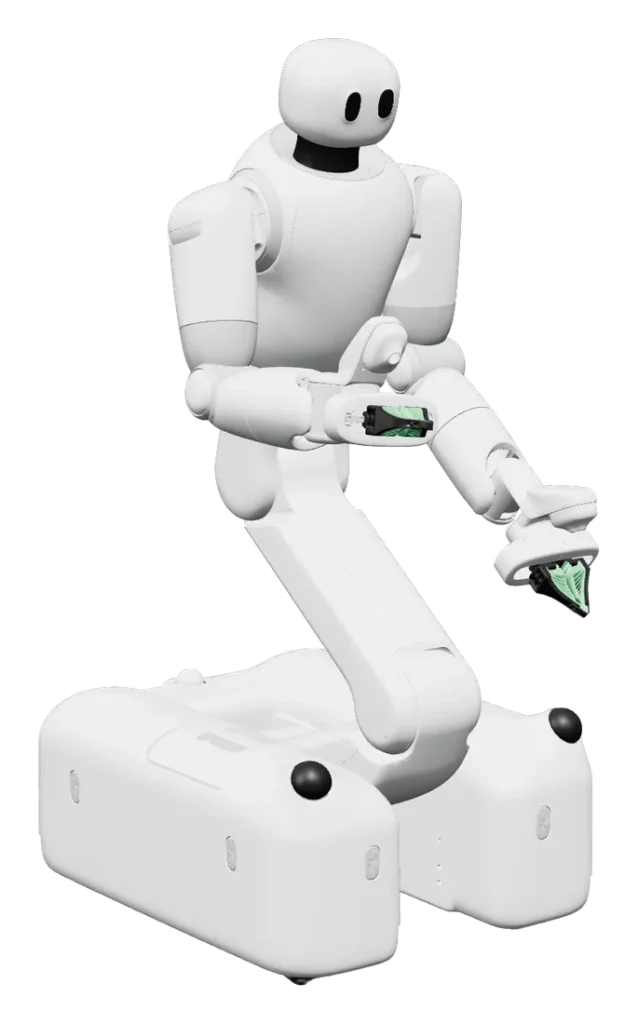
DYNA Robotics
DYNA 2.1
- Autonomy
- IIIConditional
- Pre-release
- 74/100Promising
- Readiness
- Not assessed
- Price
- Not tracked
DYNA Robotics
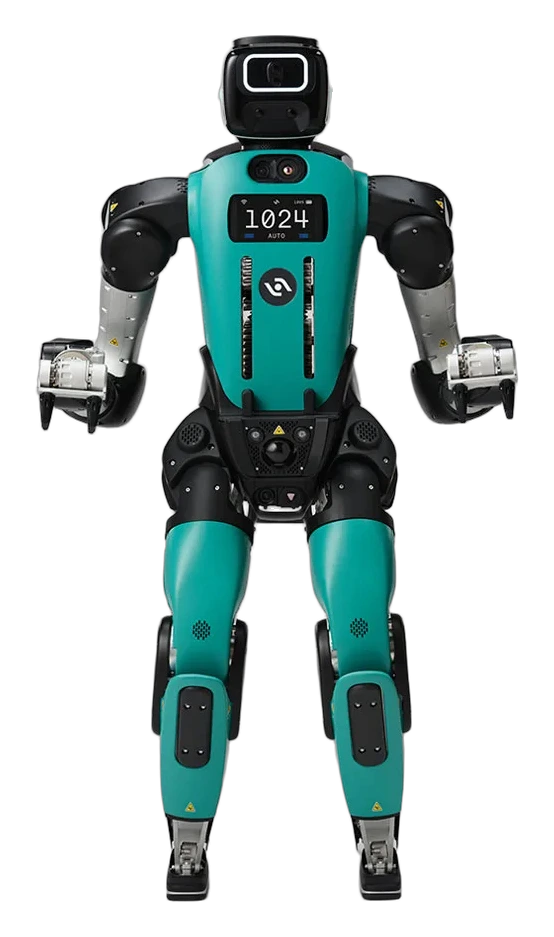
Agility Robotics
Up to three
All humanoid robots. Every figure below is placed against the whole class, so a gap can be read against how much the class itself varies.
The conditions each robot was assessed against, side by side. Rows marked in gold are where these machines genuinely differ.
| Condition | DYNA 2.1 | Digit 5 |
|---|---|---|
| Where it operates | ||
| Home / residential | PoorSold only as a commercial deployment to businesses; no consumer purchase path or home installation exists. | PoorEnterprise-only industrial hardware and a $150,000+ build cost rule out any home deployment path. |
| Office / retailthey differ | GoodPurpose-built for hotels, laundromats and restaurants; already running paid shifts at named sites. | DependsDocumented deployments are warehouse and manufacturing floors; no retail, office or public-facing pilot has been reported. |
| Warehouse / factory | GoodMaker also cites warehouse and fulfillment deployments with throughput and placement figures published. | GoodMatches its documented customer base: GXO, Amazon, Schaeffler and Toyota all run warehouse or manufacturing floors. |
| Primary tasks | ||
| Household choresthey differ | DependsHandles chore-like tasks such as folding and shelving, but only within a staffed commercial workflow, not general household chores. | PoorNo household task set exists; every documented deployment is warehouse material handling, not domestic chores. |
| Social / care | PoorNo conversational, companionship or social-interaction capability is documented for this robot. | PoorNo social, service or customer-facing use case has been documented for this platform. |
| Specialized job | GoodBuilt around one long-horizon commercial workflow at a time. Laundry, housekeeping or food service. Not general-purpose tasks. | GoodBox and tote picking, sorting and transport is the entire documented task envelope, now with a 50 lb repeatable lift. |
| Supervision needs | ||
| Fully autonomousthey differ | DependsRuns unattended for a shift, but the maker's own Mean Time Between Interventions metric assumes periodic human help. | PoorNo unsupervised deployment is documented; every customer site pairs it with trained operators for oversight. |
| With oversight | GoodMatches its documented deployment: autonomous operation with on-site staff present at each launch site. | GoodMatches the documented model: dedicated facility staff handle exceptions, safety zones and task reassignment. |
| Teleoperated | PoorNo teleoperation or remote-pilot mode is documented; the system is designed to run without a human driving it. | PoorDigit 5 runs pre-trained autonomous sequences; it is not a teleoperated or directly piloted platform. |
| Timeline | ||
| Ready todaythey differ | GoodAlready deployed and doing paid commercial work at hotels, laundromats and restaurants as of this launch. | PoorNo unit has shipped to a customer; early access does not begin until the first half of 2027. |
| Near-term (1–2 yrs) | GoodExceeds a near-term timeline. Deployments are running now, not projected for a future quarter. | GoodEarly access is dated for the first half of 2027, with general availability by year-end 2027. |
| Research phase | GoodPast the research stage: this is a fielded commercial product, not a lab-only demo. | GoodA $300 million order book and a dated 2027 timeline place it well past speculative research-stage robots. |
A robot being poor for a condition is a fact about fit, not a fault. “Depends” means the record names a limit worth reading, not that the answer is unknown.
None of these has shipped, so they are assessed on track record, engineering plausibility and how the demonstrations match the claims.
Excluded as unevidenced, so it is left out of the number: DYNA 2.1
Never averaged into it. These describe how much the maker has disclosed, not what the machine does.
| DYNA 2.1 | Digit 5 | |
|---|---|---|
| ReadinessShip-date specificity, pricing transparency, distribution and regulatory status. Published beside the number; never averaged in. | 40/100 | 58/100 |
| DisclosureHow much of the product is disclosed. Higher means fewer fundamental unknowns remain. Published beside the number; never averaged in. | 35/100 | 38/100 |
A number only means something next to the spread it sits in. Each track is the real range across every classified robot in the class, with the median marked.
These robots share no measured specification with enough published figures to plot. That is a gap in the record, not a finding about the robots.
Written on each record, and the only thing here every robot on the site carries.
What each design gives up to be good at what it is good at.
The whole-body workflow is proven on laundry alone. Folding, sorting, shelving. While food prep and warehouse handling stay marketing claims until a second published demo backs them.
No published price, MTBI figure, or safety certification: a buyer evaluates this on one video and one named laundromat, not a spec sheet.
Digit 5 pairs a proven warehouse task set with unproven redesigned legs.
The payload increase comes from a new leg and actuator design, so the predecessor’s three-year reliability record does not carry over to this generation.
Enterprise-only distribution: no price, retailer or consumer path exists to evaluate it independently.
Stated by the record itself. A robot being wrong for a household is a fact about fit, not a fault.
The upkeep ownership hands back to you, whatever the autonomy level says.
Classifications rest on different depths of evidence. A pre-release assessment and a verified one are not the same kind of claim.
| Robot | Evidence status | Sources reviewed | Last assessed |
|---|---|---|---|
| DYNA 2.1 | Not Consumer-Ready | 5 | Sep 2026 |
| Digit 5 | Pre-Release | 4 | Sep 2026 |
Evidence status counts the sources behind a classification, not their kind. A high count can be maker documentation and price coverage, so read it as how much was reviewed rather than as independent testing. How we weigh evidence.
 The full recordDYNA 2.1Specifications, evidence, the Fit Check in full, and every tracked change.
 The full recordDigit 5Specifications, evidence, the Fit Check in full, and every tracked change.
Robovations classifies robots; it does not rank them. Nothing on this page is a recommendation, and no manufacturer influences a classification or its placement here.
Comparing across classes is allowed — the page will switch to per-class positioning and tell you it has.