Skip to content
Saved
Comparison · 2 robots

Dreame X60 Ultra · Roborock Saros Z70

All robot vacuums. Every measure below is plotted against the full class, so a difference can be read against how much the class itself varies.

  1. Dreame X60 Ultra
  2. Roborock Saros Z70

Up to three

01 Classification

What each one does on its own.

The Autonomy Ladder is the same five rungs for every robot on the site. A rung describes the conditions a robot handles without you, not how good it is.

V
Generalized
Any task, any setting
IV
Environmental
Handles new obstacles without help
III
Conditional
Finishes familiar jobs on its own
Dreame X60 UltraRoborock Saros Z70
II
Assisted
Runs preset routines, needs rescue
I
Manual
One action, on command
02 Assessment

Where they actually differ.

The Robovations Score is nine inputs across three pillars, each weighted as shown and each scored so that more is better. A robot can lead on one and trail on another, which is the point of showing them apart. Cost of ownership and data handling are reported on each robot's own page and are never averaged into the score.

Capability

Task completion16% of score
Does it finish the job it is sold to do, unattended
  • Dreame X60 Ultra82
  • Roborock Saros Z7068
18median 72 across 381 scored robots100
Coverage and navigation10% of score
Does it work the whole area, and hold that between runs
  • Dreame X60 Ultra70
  • Roborock Saros Z7076
15median 70 across 371 scored robots100
Edge-case recovery10% of score
Does it recover from the failures its category presents
  • Dreame X60 Ultra62
  • Roborock Saros Z7048
18median 50 across 287 scored robots100
Operating envelope4% of score
How far conditions can vary before performance drops
  • Dreame X60 Ultra80
  • Roborock Saros Z7078
25median 68 across 345 scored robots100

Dependability

Field failure rate16% of score
Documented hardware failures per owner-year
  • Dreame X60 Ultra56
  • Roborock Saros Z7073
6median 70 across 371 scored robots100
Software stability14% of score
Whether updates fix more than they break
  • Dreame X60 Ultra50
  • Roborock Saros Z7070
15median 65 across 300 scored robots100
Support longevity10% of score
Committed parts, service and updates, with dates
  • Dreame X60 Ultra85
  • Roborock Saros Z7088
0median 63 across 377 scored robots100

Ownership burden

Routine maintenance12% of score
Hands-on time it asks for in normal operation
  • Dreame X60 Ultra75
  • Roborock Saros Z7075
22median 65 across 382 scored robots100
Consumables8% of score
Parts that must be bought to keep it working
  • Dreame X60 Ultra89
  • Roborock Saros Z7071
8median 69 across 381 scored robots100
03 Measured against the class

How far apart is a long way?

A number only means something next to the spread it sits in. Each track below is the real range across every classified robot in the class, with the median marked.

Price196 with a published figure
  • Dreame X60 Ultra$1,349
  • Roborock Saros Z70$2,599
$160median $799.99$2,599
Suction (mode not stated)174 with a published figure
  • Dreame X60 Ultra35,000 Pa
  • Roborock Saros Z7022,000 Pa
1,000 Pamedian 8,000 Pa36,000 Pa
Runtime174 with a published figure
  • Dreame X60 Ultra180 min
  • Roborock Saros Z70180 min
60 minmedian 180 min360 min
Noise151 with a published figure
  • Dreame X60 Ultra67 dB
  • Roborock Saros Z7067 dB
43 dBmedian 67 dB80 dB
Height192 with a published figure
  • Dreame X60 Ultra3.1 in
  • Roborock Saros Z703.1 in
2.6 inmedian 3.8 in7.8 in

Not compared, because fewer than two of these robots carry a published figure: Charge time, Weight.

04 Ownership

What the numbers leave out.

The trade-off

What each design gives up to be good at what it is good at.

Dreame X60 Ultra

The 212 degree F pad wash is real, and it is bounded by what the dock holds: a 4.2 litre clean tank and a 3 litre dirty tank that a large home works through before both need hand attention.

LiDAR navigation is robust on stable maps, but multi-floor handoff reliability degrades when furniture moves without map reset.

Roborock Saros Z70

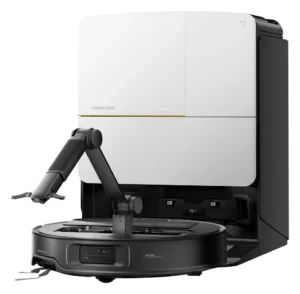
The OmniGrip arm adds autonomous item pickup, a real capability, but operates on the robot’s terms: shape and weight constraints mean manual intervention remains necessary for fragile and irregular objects.

The flagship price reflects integrated dock and arm, yet mid-tier Roborock models deliver comparable Level III autonomy for half the cost, making the arm itself a premium component for specific use cases only.

Who each one is wrong for

Stated by the record itself. A robot being wrong for a household is a fact about fit, not a fault.

Dreame X60 Ultra
Renters or homes with frequent layout changes
Effective operation depends on stable maps. Furniture rearrangement requires remapping. No documented quick-reset feature for iterative home changes.
Homes relying on 5GHz-only Wi-Fi networks
Dreame app operates on 2.4GHz. Dual-band routers required. No WiFi6E or mesh-network fallback documented.
Households unwilling to put a camera on the floor
Obstacle recognition uses an RGB camera alongside 3D structured light and a retractable LiDAR, covering 280-plus object classes, and the robot is cloud-connected. Where camera frames are processed and what the app's remote view exposes has not been established.
Homes with nowhere to put a large dock
The 10-in-1 dock is not optional and not small. It holds a 4.2 litre clean tank and a 3 litre dirty tank, heats water, and needs a mains outlet with clearance around it. In a small apartment the dock is the larger of the two objects.
Roborock Saros Z70
Minimalist, clutter-free spaces
The arm's value diminishes without floor scatter. Standard navigation and mopping alone do not justify the $2400+ premium over mid-tier Level III models costing half as much.
Owners with fragile or oddly-shaped items
The arm applies fixed gripping force without adaptive sensing. Delicate objects risk damage; manual pre-clearing remains necessary for breakables and irregular shapes.
Budget-conscious buyers
Mid-tier Roborock models deliver 90% of navigation autonomy at half the cost. The arm itself accounts for the substantial price premium and complexity burden.
Very small apartments
Dock footprint requires 60cm clearance; arm extension adds spatial demand. Compact homes benefit from smaller, less complex models.
Homes with wall-mounted obstacles or low clearance
Wall shelves, low-hanging art, or tight corners obscure the arm's reach zone. Pickup attempts fail in confined spaces.

What stays your job

The upkeep ownership hands back to you, whatever the autonomy level says.

Dreame X60 Ultra
  • After every use: Empty and rinse the 3 litre dirty tank; top up the 4.2 litre clean tank.
  • Weekly: Rinse the dock wash bay, and clear hair and fibre from the brush and the mop pads.
  • Monthly: Wash or replace the filter when the app calls for it, and check the pads for matting.
  • Every 3-6 months: Descale the dock’s heating path in hard-water areas, and replace the side brush.
  • Annually: Deep-clean the dock intake and the dust bag compartment.
Roborock Saros Z70
  • After every use: Empty dock bag if indicator shows capacity near full, typically weekly in normal households.
  • Weekly: Visual inspection of arm gripper fingers for debris; compressed air cleanup if hair wrapping detected.
  • Monthly: Replace main filter, rinse side brush, check dock connection for dust accumulation.
  • Every 3-6 months: Deep clean dock gaskets, test camera clarity with mapping pass, inspect mopping pad for mineral buildup.
  • As needed: Manual item extraction if arm encounters stuck or oversized object during cycle.
05 Evidence

How much each of these is standing on.

Classifications rest on different depths of evidence. A pre-release assessment and a verified one are not the same kind of claim.

Evidence behind each classification
Robot Evidence status Sources reviewed Last assessed
Dreame X60 Ultra Verified 5 Sep 2026
Roborock Saros Z70 Verified 9 Aug 2026

Robovations classifies robots; it does not rank them. Nothing on this page is a recommendation, and no manufacturer influences a classification or its placement here.