
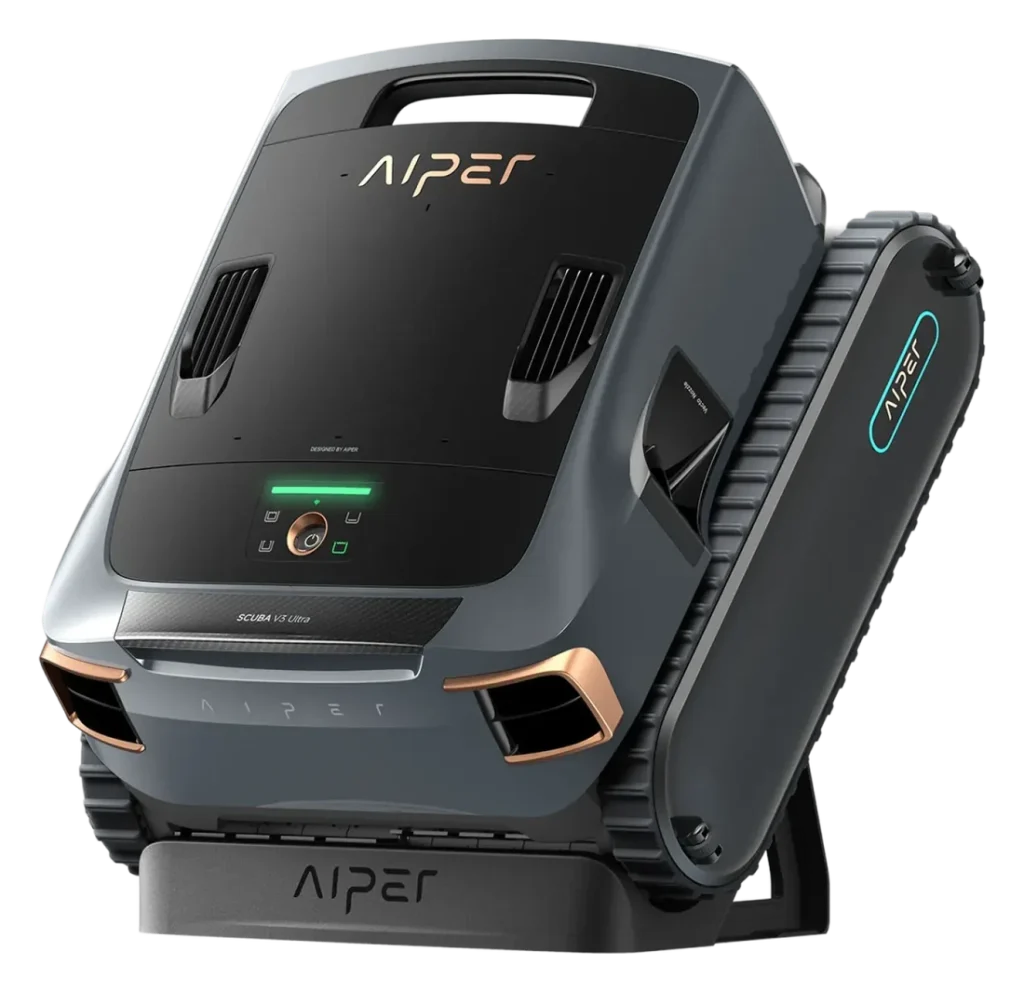
Aiper
Aiper Scuba V3 Ultra
- Autonomy
- IIIConditional
- Score
- 57/100Capable
- Readiness
- Ready Now
- Price
- $2,299.99list
Aiper

Wybot
Up to three
All robot pool cleaners. Every figure below is placed against the whole class, so a gap can be read against how much the class itself varies.
The conditions each robot was assessed against, side by side. Rows marked in gold are where these machines genuinely differ.
| Condition | Aiper Scuba V3 Ultra | Wybot S3 |
|---|---|---|
| Pool type | ||
| In-ground | GoodV3 Ultra designed for in-ground pools; 6-in-1 coverage scales to large in-ground layouts. | GoodDesigned for in-ground gunite pools. Dock positioning and waterline reach optimized for standard depth/slope geometry. |
| Above-ground | DependsCordless dock mounting and cable-free operation reduce constraints, but above-ground depth and narrow entry limit effectiveness; wired models better suited. | DependsAbove-ground pools under 10,000 gallons risk over-capacity for dock footprint. Shallow models may limit wall coverage; confirm dock fit before purchase. |
| Mixed setup | GoodFlexibility to deploy in either setting; in-ground benefits from cordless advantage more noticeably. | GoodThis robot addresses both pool types. Verify dock placement and cable routing for your setup. |
| Pool size | ||
| Small (< 400 sqft) | Good$2,300 flagship exceeds requirements for pools under 5,000 gallons; entry-level Aiper models deliver same core cleaning for less. | GoodUnder 5,000 gallons: flagship robot and self-emptying dock exceed small-pool maintenance needs. Overkill for compact pools; mid-range cordless models more economical. |
| Medium (400 – 800) | GoodOptimized for 5,000-12,000 gallon pools; single-charge coverage likely completes routine cleaning in one session. | Good5,000–15,000 gallons: ideal range. 90–120 min per charge handles single-pass coverage or multi-session cleaning for heavy debris weeks. |
| Large (> 800) | GoodExcellent for 12,000-25,000 gallon pools with heavy seasonal debris; 6-in-1 coverage and thorough waterline cleaning justify the scale. | Good15,000–30,000 gallons: dock automation and cordless freedom shine. Multi-session scheduling manageable; dock self-emptying reduces operator burden. |
| Debris load | ||
| Fine (sand / silt) | GoodFine sediment (sand, silt) is the standard operating condition for pool cleaners; V3 Ultra filter handles fine loads efficiently. | GoodSand and fine sediment: dock suction handles routine drainage; filter manageable with dock assist. Confirm filter mesh durability in high-silt environments. |
| Leaves / large debris | GoodLeaf-shedding seasons are the V3 Ultra's primary use case; thorough coverage and large debris basket support heavy seasonal loads. | GoodLeaf-heavy pools: cordless operation supports frequent short runs without cable hassle. Large debris basket and dock capacity suit seasonal leaf management. |
| Algae / heavy fouling | DependsWaterline-specific cleaning addresses algae at the transition zone, but heavy algae blooms may overwhelm the cleaner's designed maintenance scope. | DependsAlgae bloom recovery: robot aids removal, but chemical treatment required first. Dock filter may clog after algae cleanup; manual rinse likely needed. |
| Coverage you want | ||
| Floor only | GoodFloor cleaning is the baseline function; V3 Ultra executes this reliably per 6-in-1 coverage claims. | GoodFloor coverage only: 3D mapping optimizes floor paths. Waterline and wall features unused; simpler maintenance profile than full-reach model. |
| Floor + walls | GoodWall and floor coverage via cognitive mapping enables thorough cleaning without manual repositioning between zones. | GoodFloor and wall cleaning: strong suit. 36-sensor suite maps vertical surfaces; dock placement matters for wall-reach consistency. |
| Floor + walls + waterline | GoodWaterline cleaning is a key V3 Ultra differentiator; three-zone coverage (floor, walls, waterline) is executed as part of the standard autonomous cycle. | GoodFull waterline reach: designed for this mode. Dock automation minimizes manual waterline supplementation, though mineral buildup may persist in hard-water pools. |
A robot being poor for a condition is a fact about fit, not a fault. “Depends” means the record names a limit worth reading, not that the answer is unknown.
Nine inputs across three pillars, each weighted as shown and each scored so more is better. A robot can lead on one and trail on another, which is the point of showing them apart.
A number only means something next to the spread it sits in. Each track is the real range across every classified robot in the class, with the median marked.
Not compared, because fewer than two of these robots carry a published figure: Noise.
Written on each record, and the only thing here every robot on the site carries.
What each design gives up to be good at what it is good at.
Battery-powered autonomy relies entirely on dock reliability and overnight charging. A failed dock connection or degraded charge cycle breaks the hands-off promise faster than cable entanglement breaks wired cleaners.
Cordless premium ($500+ over comparable wired models) is justified only if multi-season battery degradation rates prove acceptable. Early market data on battery cycle life (2-4 years baseline) will determine whether the cordless convenience translates to lower total-cost ownership.
Cordless, self-docking, and self-emptying comes at flagship price: $2,999 regular, currently discounted to $2,499 on pre-order, places it above mid-range robotic cleaners; the upgrade premium is substantial if dock automation is not the point.
Waterline reach is mapped, not guaranteed: 3D mapping places cleaner at waterline, but scaling and mineral buildup may require supplemental manual brushing on heavy-stain pools.
Stated by the record itself. A robot being wrong for a household is a fact about fit, not a fault.
The upkeep ownership hands back to you, whatever the autonomy level says.
Classifications rest on different depths of evidence. A pre-release assessment and a verified one are not the same kind of claim.
| Robot | Evidence status | Sources reviewed | Last assessed |
|---|---|---|---|
| Aiper Scuba V3 Ultra | Provisional | 9 | Aug 2026 |
| Wybot S3 | Pending | 2 | Aug 2026 |
Evidence status counts the sources behind a classification, not their kind. A high count can be maker documentation and price coverage, so read it as how much was reviewed rather than as independent testing. How we weigh evidence.
 The full recordAiper Scuba V3 UltraSpecifications, evidence, the Fit Check in full, and every tracked change.
 The full recordWybot S3Specifications, evidence, the Fit Check in full, and every tracked change.
 Written comparisonIs premium AI navigation in pool robots worth it?We have examined this pairing in full, with a stated finding.
Robovations classifies robots; it does not rank them. Nothing on this page is a recommendation, and no manufacturer influences a classification or its placement here.
Comparing across classes is allowed — the page will switch to per-class positioning and tell you it has.