Does the Matter standard work with robot vacuums and other home robots?
A Matter badge promises that any smart home app can run your robot vacuum. The assistant you own, and the version the robot carries, set how far that goes.
On this page3 sections
When Roborock put Matter firmware on its robot vacuums in April 2025, its announcement pictured the payoff. On an S8 MaxV Ultra with the update, you could ask Siri to “clean the kitchen” hands-free. It also carried a caveat: functionality “may vary not only by Roborock device, but also by ecosystem.”
An ecosystem, here, is the assistant your household already talks to: Apple Home, Google Home or Alexa. So will yours send the robot to the kitchen, or only start it? And what about the mower on the lawn and the robot in the pool?
The answers decide what the Matter badge on a robot’s box gets you. Matter exists so that one app can run devices from any maker. For robots, though, its commands arrived in stages, and each assistant has taken up a different share of them.
The Connectivity Standards Alliance, which develops Matter, published Matter 1.2 on October 23, 2023. It added a batch of new device types, most of them appliances: refrigerators, dishwashers, washing machines, room air conditioners, air purifiers. One was the robotic vacuum.
The Alliance promised the basics and a little more. Beyond remote start and progress notifications, it said, the type supports “cleaning modes (dry vacuum vs wet mopping) and additional status details (brush status, error reporting, charging status).”
Matter sorts those features into clusters, named sets of commands that any certified controller can read or send. Think of a cluster as one row of buttons on a remote. The robot supplies the rows, and the app or speaker you talk to decides which ones it shows you.
Term
Matter controllerThe platform that reads a certified device’s clusters and sends it commands, which this piece also calls the hub. Google Home, Alexa and Apple Home are controllers, and so are SmartThings and Home Assistant.The vacuum type launched with three rows. Run Mode switches the robot between states such as idle and cleaning. Clean Mode chooses vacuuming or mopping. Operational State starts it, stops it and sends it back to the dock. Maps, no-go zones and schedules had no row at all.
What each assistant can tell it to do
Google Home reads all three rows, at Matter 1.2, so on paper a Google speaker can start the robot, switch it to mopping and send it back to the dock. Rooms have no row there, as of Google’s last update on December 20, 2024.
Yet in April 2025, an explainer reading Google’s developer release notes found that Google “has not yet added the product category.” Both can hold, because Google’s table carries its own warning: many device types are supported, “though not all are fully supported.”
Alexa reads less: one row, Run Mode, which it treats as a general mode switch. That is enough to start a Matter vacuum and stop it. It was still the only required row when Amazon updated its list of Matter categories on April 8, 2026.
Apple brought robot vacuums into its Home app with iOS 18.4. A certified robot can be run from the app, added to automations and spoken to through Siri. Your home needs Apple’s updated Home architecture for it, and the old one lost support in February 2026.
Room commands turn up on Apple’s side. Roborock’s kitchen request went to Siri, and its sample automation cleans the living room every day at 2 p.m. For Google Home and Alexa, the same release promises only “enhanced connectivity.”
Mowers and pool robots
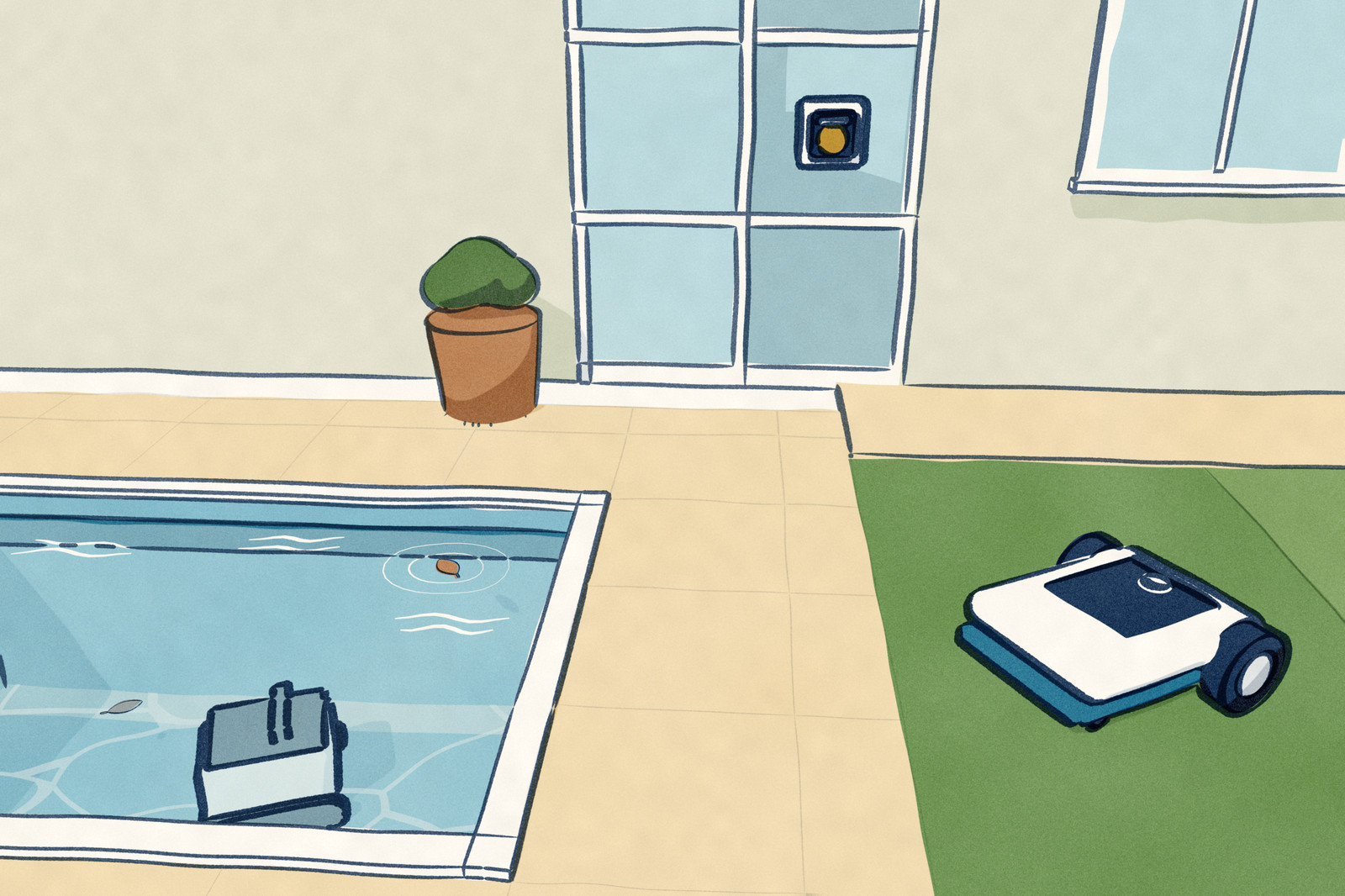
Google’s list and Amazon’s each hold one robot, the vacuum. A lawn mower, a pool cleaner or a window-cleaning robot reaches a voice assistant, where it reaches one at all, through a link its maker builds for itself.
Husqvarna’s mowers show how that works. Every Automower with cellular or Wi-Fi can be connected to Amazon Alexa or Google Home, and answers voice commands through either one, “but not with Siri.” If your house runs on Siri, you run the mower from Husqvarna’s app.
Pool robots keep more to themselves. The AquaSense 2 Ultra runs from Beatbot’s own app, where you set its speed and direction, tap a parking button to bring it to the poolside and look over its map and cleaning path after a run.
Which vacuums have it, and at which version
Matter reaches a vacuum through firmware, one model at a time. Roborock scheduled the update for seven models in the first ten days of April 2025: the S8 MaxV Ultra, Saros Z70, Saros 10, Saros 10R, Qrevo Curv, Qrevo Edge and Qrevo Master.
Five Ecovacs models, the X2 Combo among them, made an April 2025 list of Matter vacuums, along with SwitchBot’s S10 and iRobot’s Roomba Combo 10 Max. When iRobot introduced that robot in July 2024, it promised Matter in a firmware update from October, “rolled out across the entire Roomba fleet.”
Three eufy models, the Robot Vacuum S2, Omni E28 and Omni E25, are named in the maker’s own guide, updated in January 2026. Its advice is to confirm Matter support on the product page, or in an announcement from the maker, before you buy.
Matter on robot vacuums
The models each source names
| Maker | Models named | What the source says |
|---|---|---|
| Roborock | S8 MaxV Ultra, Saros Z70, Saros 10, Saros 10R, Qrevo Curve, Qrevo Edge, Qrevo Master | Roborock said Matter firmware would ship to all seven by April 10, 2025, a trade publication reported |
| Ecovacs | Deebot X2, X2 Combo, T50, T50 Max, X8 | On the April 2025 rundown of Matter vacuums |
| SwitchBot | S10 | Also on that rundown |
| iRobot | Roomba Combo 10 Max | Matter to follow in a firmware update from October, launch coverage reported in July 2024. On the April 2025 rundown |
| eufy | Robot Vacuum S2, Omni E28, Omni E25 | Named in eufy’s own guide, updated January 2026 |
The Matter version a robot was certified under sets what a hub can ask of it. Early Matter vacuums, SwitchBot’s among them, were certified under 1.2. By spring 2025, the newest Roborock and Ecovacs machines were launching on 1.4.
Version 1.4, which the Alliance announced in November 2024, added a Service Area cluster. It is the row of buttons for places: a hub can use it to send the robot to one area of the home.
A robot certified under 1.2 therefore predates that row, and a hub has no Matter command that sends it to one room. A 1.4 robot can offer its areas. They reach you only through a hub that reads that row.
Does Matter work with your robot, then? For a vacuum, yes. Any hub that reads the type can start it and stop it, and Google Home, on paper, adds the mop setting and the trip back to the dock. The mower and the pool robot reach an assistant, if at all, through their makers’ own links.
Sending the robot to a single room is harder. It takes a 1.4 robot and a hub that reads its areas. Google’s and Amazon’s own lists have no row for it, and Apple Home is the one Roborock shows taking the command.
The room itself comes with a catch. A robot’s areas, one explainer of the device type noted, are “zones that are defined in the robot manufacturer’s app,” and not necessarily the rooms of your smart home. So when you ask Siri to clean the kitchen, the kitchen it means is the one on the robot’s own map.