Why do robot mowers reach Level IV when robot vacuums stay at Level III?
Most home robots finish their one job, then hand it back to a person the moment the room surprises them: a cord on the floor, a toy left out, a gate blown shut. A small number never need to. Across 614 classified robots, the population collapses sixfold at that boundary, and which class crosses it depends less on hardware than on whether its environment was made knowable in advance.
On this page4 sections
Line up the 614 consumer robots classified here by how much each one does on its own, and the shape is badly lopsided. 369 of them sit on a single rung, Level III. The rung directly above holds 58, the one below holds 179, and only 8 sit lower still. None has climbed to the top.
A Level III machine finishes its task but stops and asks for a hand when its surroundings shift in a way it was not built for. A Level IV machine keeps going. The distance between 369 and 58 is the distance between those two behaviors. One rung is a machine you still supervise; the next is a machine you can mostly forget about.
If you own one of these, that rung quietly predicts how often you get up to deal with it: to free it from a chair leg, carry it over a threshold, or restart a job it quit halfway. So why can a wire-free mower cut an entire lawn untouched while the vacuum under your couch cannot get across the room?
The 614 are not spread evenly across jobs, either. Four jobs, floors, lawns, pools and glass, cover most of the population, and the two-legged machines a shopper pictures when they hear the words home robot make up a small part of it.
The 614 consumer robots, by class
| Class | Classified here | Share |
|---|---|---|
| Robot vacuums | 258 | 42% |
| Robot lawn mowers | 132 | 22% |
| Robot pool cleaners | 76 | 12% |
| Humanoid robots | 66 | 11% |
| Specialty robots | 44 | 7% |
| Robot window cleaners | 27 | 4% |
| Multi-task robots | 11 | 2% |
Which class a machine belongs to turns out to decide which rung it can reach, and the step from the 369 on Level III to the 58 just above them is where that story begins.
What the climb to Level IV asks
The ladder draws its lines around the environment a machine works in rather than the hardware it carries. Level III, Conditional Autonomy, is the rung for a robot that completes its job inside the conditions it was designed for and defers to a person at the edges of those conditions.
Level IV, Environmental Autonomy, is the rung for a machine that absorbs the ordinary variability of its setting without being set up again or rescued mid-run. The ladder’s own definitions put the whole weight on that second idea.
So the step from the third rung to the fourth has little to do with hardware. It changes what the machine is responsible for.
On Level III the owner still handles the exceptions: the toy left out, the gate that blew shut, the cord across the floor. On Level IV the machine handles them itself. That is a harder thing to build than any single feature, and the population thins exactly where it begins, six machines on the crowded rung for every one on the next.
There is a consumer category where that step has clearly been taken, and the clearest example is one most people overlook. It is the lawn.
The machines that turned the yard into a map
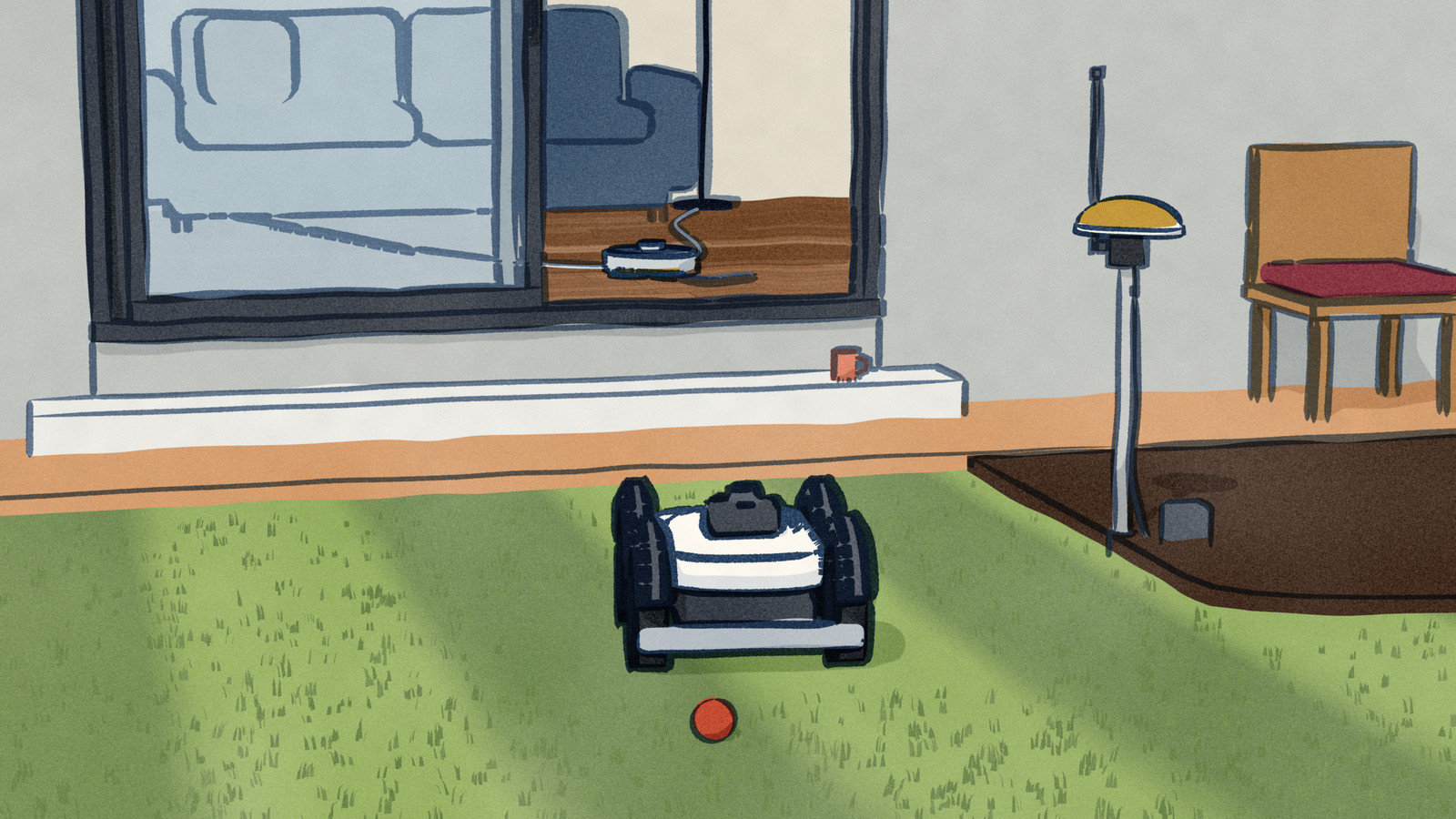
Wire-free mowers from Mammotion and Segway Navimow reach a lawn’s far corners without a buried perimeter wire, and they manage it by solving position first. A base station in a fixed, known spot reads the same satellites the mower reads, works out how far off those readings are, and sends the correction back to the machine.
Figure
How much position error correction removes
- The wanderOn satellites alone the machine knows its position to about half a metre either way, wider than its own cutting width.
- Strips left standing2 strips of this plot were never cut. Each is a place where two passes drifted apart by more than the plan allowed for.
- Base stationA receiver fixed at a known point works out the satellite error and radios a correction to the mower.
- Passes abutCorrected to a few centimetres, narrower than the seam between two stripes, each pass lands beside the last and the plot is covered.
- Cutground the machine actually covered
- Missedleft standing where two passes drifted apart
The result is precision a lawn robot can steer by. Independent explainer coverage of the Segway and Mammotion systems puts it at two to three centimeters in good conditions, close enough to drive a clean edge. The local versions need no Wi-Fi, because the base station talks to the mower over its own radio link.
The yard stops being unknown ground. It becomes a surveyed coordinate space the machine can step back into on every run, after a single guided drive that traces the boundary and the no-go areas once.
That is why the lawn crosses the line the living room does not. A hands-on lab test of one all-wheel-drive wire-free model found its mapping “impressively fast and accurate,” watched it hold a 45-degree test bank in wet January conditions with “minimal slippage,” and saw it steer around a dog that walked into its path. The machine ran the plot as a job it owned.
The limits appear where the survey runs out. The same test found it stalled in channels only a little wider than its own body, and the correction signal itself drops under thick tree cover or against a tall wall. When it does, the mowers “pause and attempt to re-establish the connection” rather than guess.
A machine that owns its mapped domain is a Level III machine again the moment it leaves that domain, and the review noted that the app’s zone tools stayed “fiddly for first-time users.”
Why the largest class stays a rung below
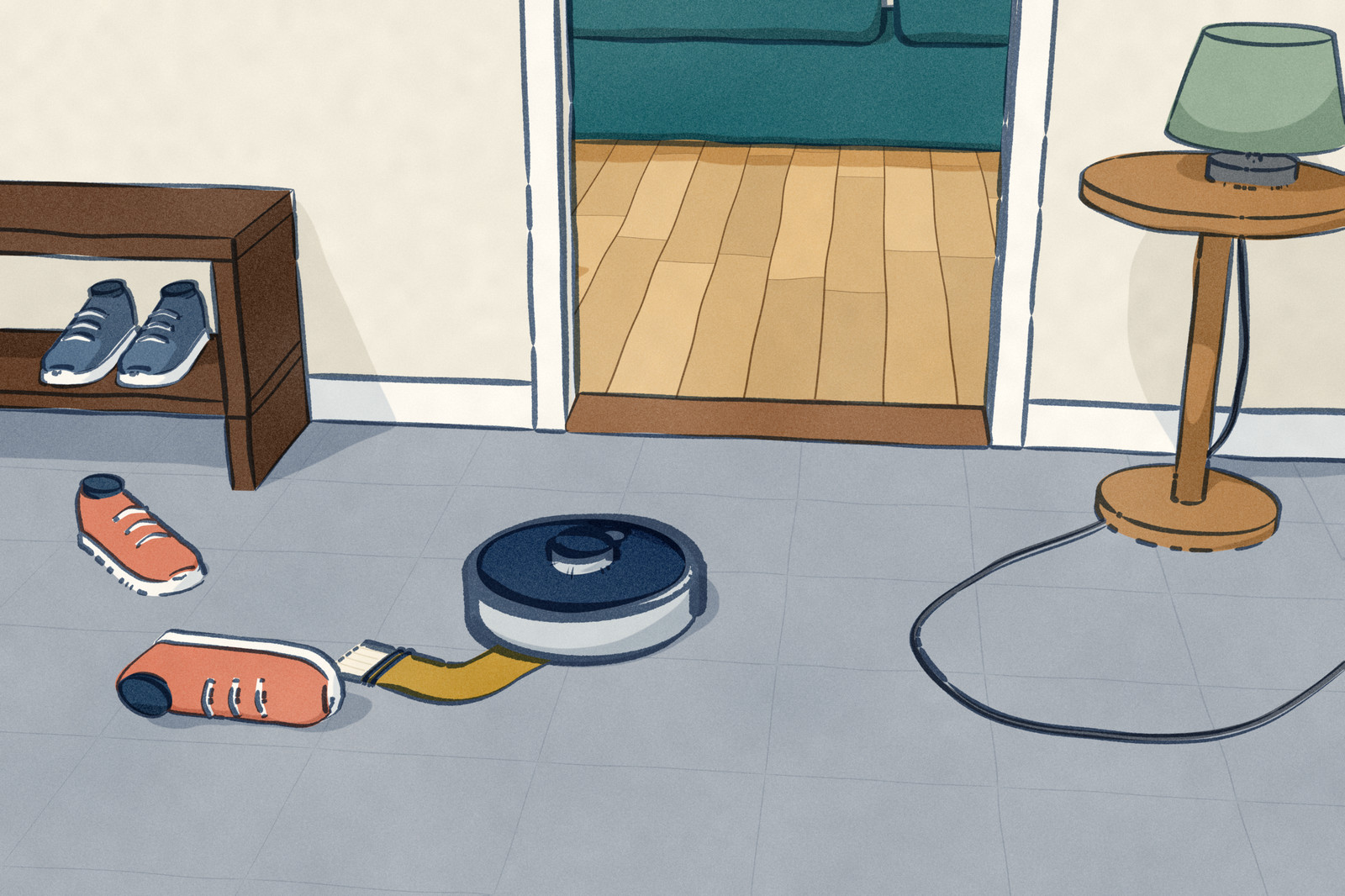
Robot vacuums are the biggest group on the list, 258 of the 614, and very few of them make the same climb. The reason is not that their makers try less; it is that nobody surveyed the living room. A floor changes every day, the obstacles on it are not a known set, and the machine meets each of them for the first time at runtime.
Term
SLAMSimultaneous Localization and Mapping: a vacuum builds its map from its own onboard sensors as it cleans, rather than starting from a survey made in advance. Nothing anchors that map to a fixed outside reference the way RTK does for a mower, so a room that changed overnight is relearned from scratch on the next run.A hands-on review of two dozen 2026 models shows exactly where the rung sits. One mid-priced vacuum was judged generally reliable, but the reviewers wrote that “heavy clutter or small cords can occasionally slow it down or require a quick manual intervention.”
A budget Roomba QO120 fared worse: it “could never consistently avoid any of our objects in our tests,” and instead “knocks into things with vigour, often knocking over our shoes and sucking up socks.”
The Roomba finishes most of the floor, which is the task it was built for, so it is autonomous in the narrow sense the third rung describes. Then it meets the cord, the sock, the threshold, and the run ends with a person walking over to it.
On a cluttered day that can happen several times before a single room is finished. The task is complete; the environment stays the owner’s problem.
The pattern holds up and down the price list. A cord on the floor stops a cheap robot and a thousand-dollar one in much the same way, because what defeats them is the room itself, never mapped and changing by the day, rather than a weak sensor. More suction and a sharper camera make a better Level III machine; neither builds the fourth rung.
The same testers put the trade in plain terms, and it is the trade the whole rung is built on.
If you don’t need your robot to be completely autonomous and don’t mind occasionally rescuing it from hangups, it’ll save you overall cleaning time long-term.
The machines that look most advanced sit lowest
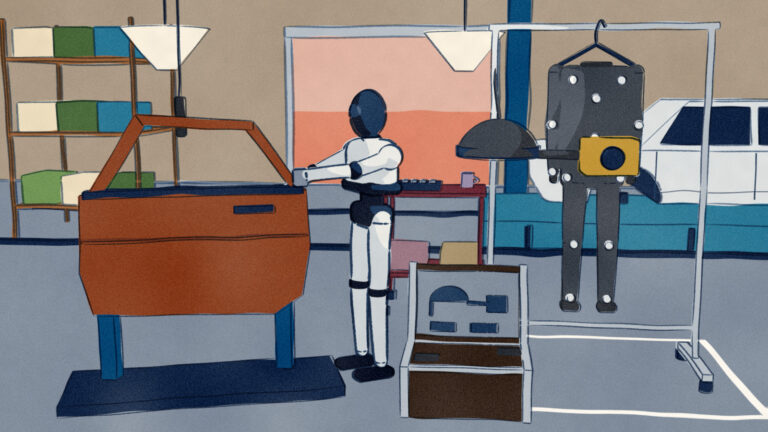
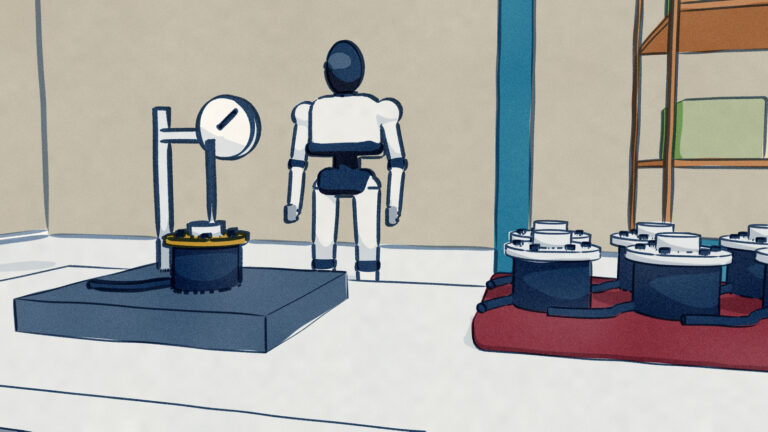
Now turn to the machines that get the magazine covers. Humanoids are 66 of the 614 and multi-task robots another 11, and as a group they aim at the least bounded job there is, open-ended chores, in the least bounded place there is, the whole house. On the ladder they land near the bottom of the populated rungs.
The reason keeps surfacing in their own demonstrations. A Tesla Optimus unit fell during a December 2025 event in Miami. It raised both hands to its face in a motion that looked like a person pulling off a VR headset, and the clip reopened a running question about how much of the robot is a remote operator.
Tesla has neither confirmed nor denied that the Miami demo was teleoperated, though Elon Musk has said separate footage of the robot running was “AI, not tele-operated.”
The habit is not only Western. In August 2026 the state-owned defense group NORINCO showed a full-size humanoid, Fuxi, driven by what it calls an “external avatar” system, described as China’s first homegrown teleoperation setup for humanoids of that size, roughly 90 kilograms. A person moves; the robot across the link copies the movement in real time.
Agility Robotics, which builds a warehouse humanoid, has said why the house comes last. Its chief executive has put a home-ready humanoid at ‘10-plus years,’ noting that a warehouse has fixed aisles and predictable workflows while a home is full of dogs, babies, visitors and objects left in unexpected places.
At least roads have some discipline to them. Most of the areas that humanoids will be operating in don’t.
This is where the ladder draws a hard line. A robot whose hardest work still routes through a person at a console cannot be placed above Level II here, however impressive its hardware, because the autonomy belongs to the operator.
Only 8 machines on the whole list sit at Level I, Manual Automation, the rung for a robot that is essentially driven. None sit at Level V. The top of the ladder is not a crowd the humanoids are joining soon.
Which turns the usual intuition about these machines inside out. On this ladder, the rung a consumer robot reaches is set by how tightly its task and its surroundings are drawn.
Cleverness has less to do with it than the shape of the room. A mower that owns a mapped lawn sits higher on the ladder than a humanoid that needs a hand, because the lawn was made knowable and the kitchen was not.
The same logic runs through the quieter classes on the list. A pool is a finite basin and a window is a single pane, environments a maker can bound before the machine ever runs.
What lifts the lawn is at work there too: a space made knowable in advance is a space a robot can be left alone with. The open house is the one setting nobody has yet managed to make that promise about.
Where a consumer robot has climbed to the fourth rung, it is almost always working a space that was measured before it was ever switched on. The lawn was turned into a map. The living room never was.