Skip to content
Saved
Specialty Robots

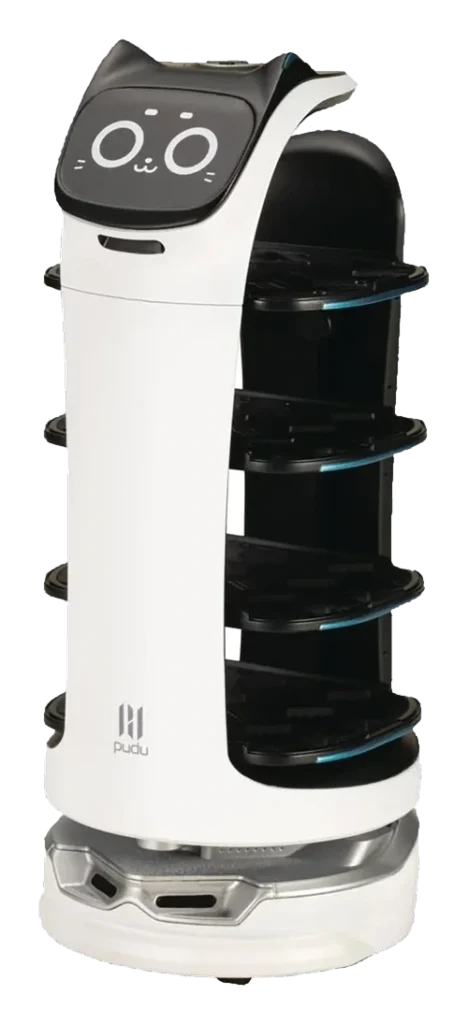
Pudu BellaBot

Pudu Robotics

The highest-volume commercial delivery robot in active deployment globally. Task completion is narrow and repeated; the value case depends entirely on labor cost offset in high-volume venues.
Level III
Conditional Autonomy
3 sources reviewed ·
Reassessed
Jun 12
View history
Robovations Score
Capable · 64 of 100
Rescored 2026-06-12
Autonomy68 / 100

30% weight

Reliability72 / 100

25% weight

Maintenance56 / 100

15% weight

Value42 / 100

15% weight

Privacy70 / 100

15% weight

Will the Pudu BellaBot fit your application?

Pick what matches your setup. The fit updates as you go.

Primary use case
Where it operates
Operator skill
Power setup
How Pudu BellaBot holds up
Primary use case
Where it operates
Operator skill
Power setup
Specifications

The full spec sheet.

Manufacturer-published values.

Within the category, weight among the heaviest in the class and one of the longer runtimes in the class.

Positions are rank within the 24 specialty robots in the Robovations database.

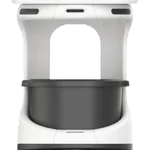
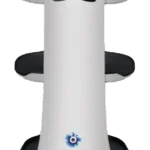
30 in24 inTOP52 in24 inSIDEDimensional drawing
Pudu Robotics BellaBot · 110 lbs
This robot’s rank in categoryCategory median
Runtime480min30660 min
Charge time120min90360 min
Noise68dB5575 dB
Weight110lbs0.092,646 lbs
Battery720Wh · Li-ion
Wi-FiSupported
Mapping & navigation

LiDAR SLAM + monocular camera obstacle detection; gyroscope-stabilized odometry

Official referencesProduct page
Lifecycle

The record since launch.

3 tracked events since launch
Ownership & reliability

How it holds up after the purchase.

Owner reports · manufacturer documentation

Fleet-wide uptime is solid in venues with active maintenance; navigation failures spike when daily sensor cleaning is skipped.

Operator reports from 50,000+ deployed units show <8% unplanned downtime in well-maintained venues. Navigation lockups increase 300% in facilities with neglected sensor cleaning; this is the primary failure cause, not hardware.

Owner effort~8 hrshands-on time per month
Consumables$600per year, replaceable parts
Reliability trendStableowner-reported arc to date
What goes wrong, and who fixes it
Failure pointLikelihoodResolution
LiDAR sensor contaminationNavigation diverges from map; robot circles and fails to reach delivery zones.CommonOwner fixDaily lens cleaning with microfiber; 2 min per shift. Neglect forces re-mapping cycle (4–8 hours).
Wheel tread wearReduced traction on polished floors; slipping on turns.OccasionalOwner fixWheel replacement every 6–12 months (~$150 per set, 30 min labor).
Tray latch failureTray ejects mid-delivery; contents spill.OccasionalOwner fixLatch hinge replacement; ~$50 part, 15 min labor. Frequent in high-volume venues (1–2 replacements per year).
Monocular vision desynchronizationDepth estimation fails; obstacle avoidance misses low objects.RareOwner fixFirmware update or camera module replacement; factory return required (~$400 + 1 week downtime).
Maintenance cadence
Daily365×a year

LiDAR dome and front camera lens wipe-down with microfiber cloth.

Weekly52×a year

Deep sensor clean with isopropyl alcohol; tray sanitization (removable trays, standard dishwasher-safe).

Monthly12×a year

Battery health check; wheel bearing and motor inspection; firmware update push (auto-downloaded).

Seasonallya year

Thermal sensor recalibration; wheel tread replacement if worn.

As neededVariesno fixed cadence

Tray hinge repair (~$50 per hinge); monocular camera replacement (~$300–$500 if impact-damaged).

Safety flags
CautionTray pinch point when loading/unloadingStaff must use two-hand grip to remove trays; single-hand pinch can cause finger injury. Training mandatory at installation.
NoteCollision risk in high-traffic areasBellaBot stops when humans approach (proximity sensor), but stop distance is ~18 inches; risk of contact in crowded venues during peak service.
NoteOperational constraint: wet floorsWet or oily kitchen floors degrade wheel traction; robot may slip. Spill cleanup must precede automatic delivery runs.
Common questions

What buyers actually ask.

4 answered
Operation
How many deliveries can BellaBot complete in a typical 8-hour restaurant shift?
Manufacturer specs cite 300–400 kilometer total distance per charge cycle. Average delivery is 20–40 meters round-trip; real-world venues report 50–100 successful deliveries per 8-hour shift depending on floor complexity and operator intervention frequency.
Operation
What happens if BellaBot gets stuck behind chairs or stranded by a blocked passage?
The robot sends a mobile alert to staff. Operator intervention is required to manually reposition or restart navigation. Stuck episodes average 2–5 times per shift in busy venues with dynamic seating.
Operation
How often do the LiDAR and vision sensors need cleaning?
Daily wipe-down of sensors is recommended by Pudu; weekly deep clean (isopropyl alcohol on optics) prevents performance drift. Neglected cleaning causes navigation lockups within 1–2 weeks.
Operation
Can BellaBot handle stairs or access upper floors in multi-story restaurants?
No. BellaBot is elevator-dependent for multi-floor deployment. Autonomous stair climbing is not supported; operator manual carry is required.

Cite & embed

Reference the Pudu BellaBot classification.

Embed the Autonomy Ladder™ mark or copy the citation. The mark links back to this assessment and updates if the classification changes.

Citation
Where to next

Three ways to keep going.

For shoppers

Stack against a peer.

Open the compare builder pre-loaded with the Pudu BellaBot and Trifo Lucy — side-by-side score, autonomy, fit profile, and trade-offs.

3 peers ready to stack right now.
For browsers

See every Level III.

Every robot we’ve classified at conditional autonomy — sorted by readiness, score, and price. Filter by category, manufacturer, or release date.

Browse the database

Updated weekly with new entries and reclassifications.