
Approaches compared
Roller-mop vs spinning-pad robot vacuums: better clean or just more maintenance?
Roller and track mops are rinsed with fresh water while the robot is still mopping. Spinning pads go back to the dock to be washed. This page sets one lab's stain results beside what each design asks of you.
This page checks
- How it mopsRoller, track or spinning pads
- When it is washedDuring the run or at the dock
- The stain testOne lab, one test, all four
- UpkeepRugs, mop parts and water
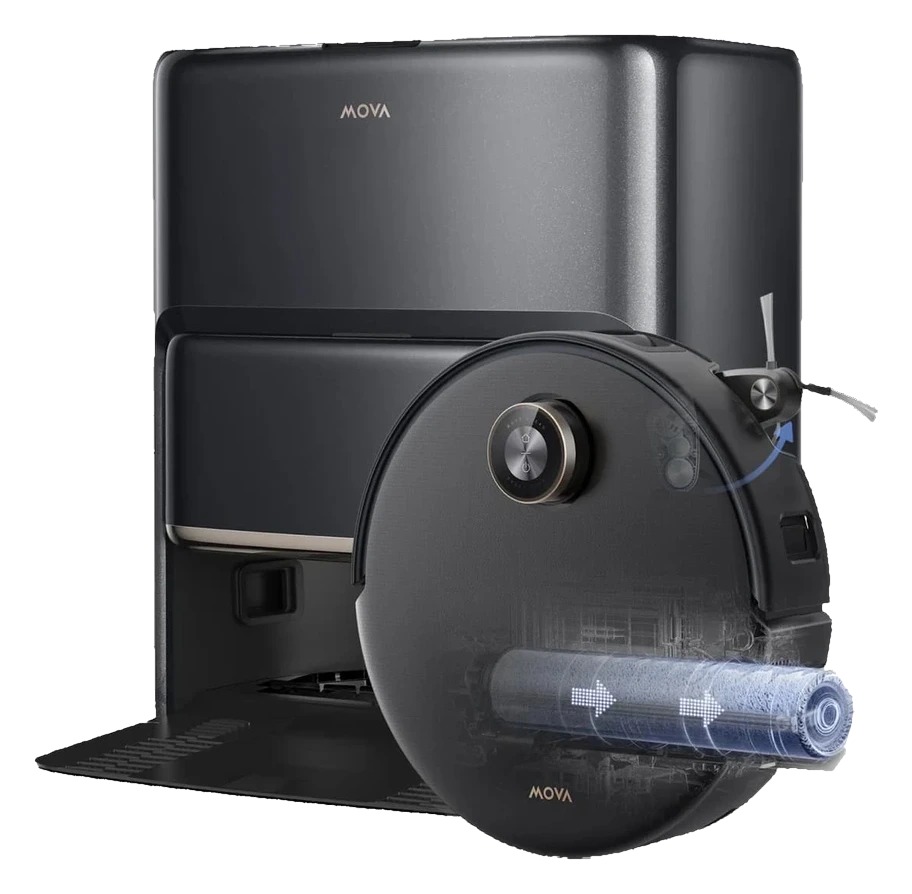
MOVA
Where to buy
Early owner reports surface mop-pad clog and dock mineral-deposit patterns
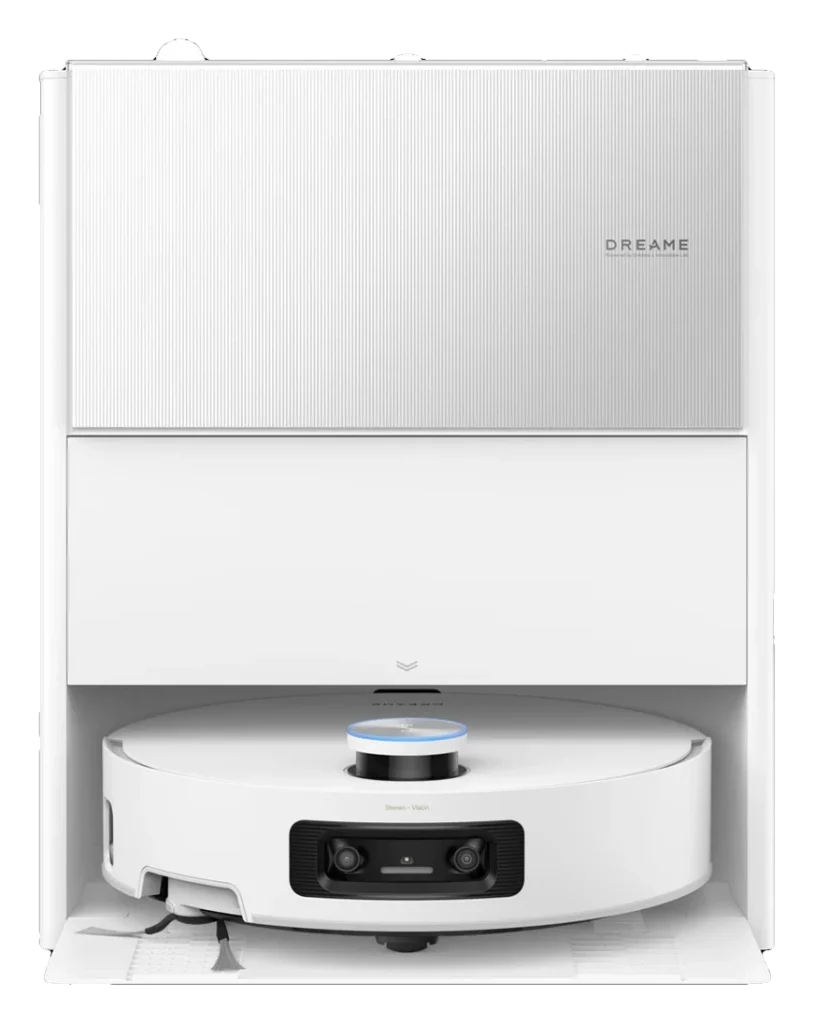
Dreame
Where to buy
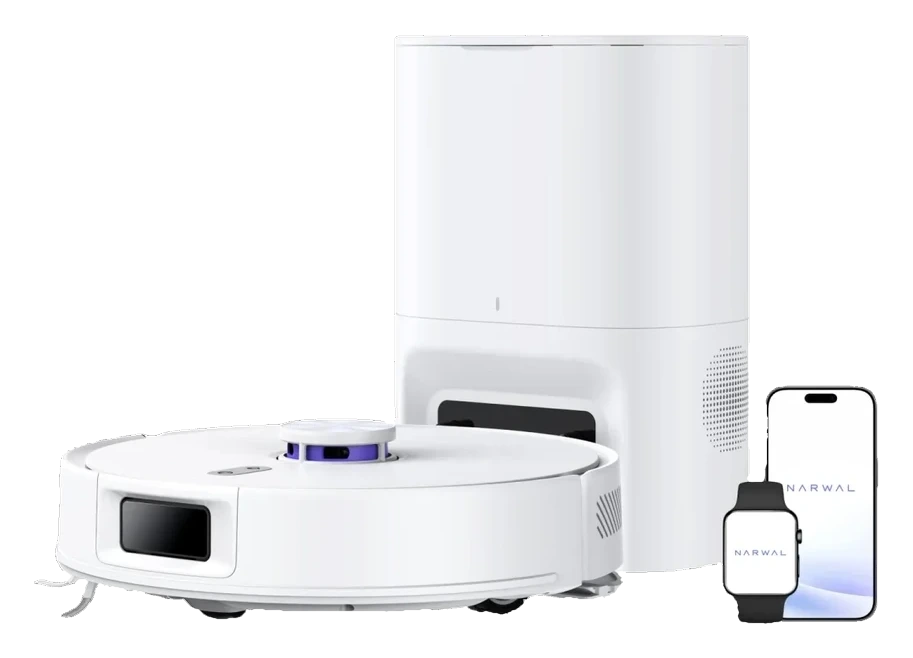
Narwal
Where to buy
Narwal launches White color variant of the Flow 2 flagship vacuum
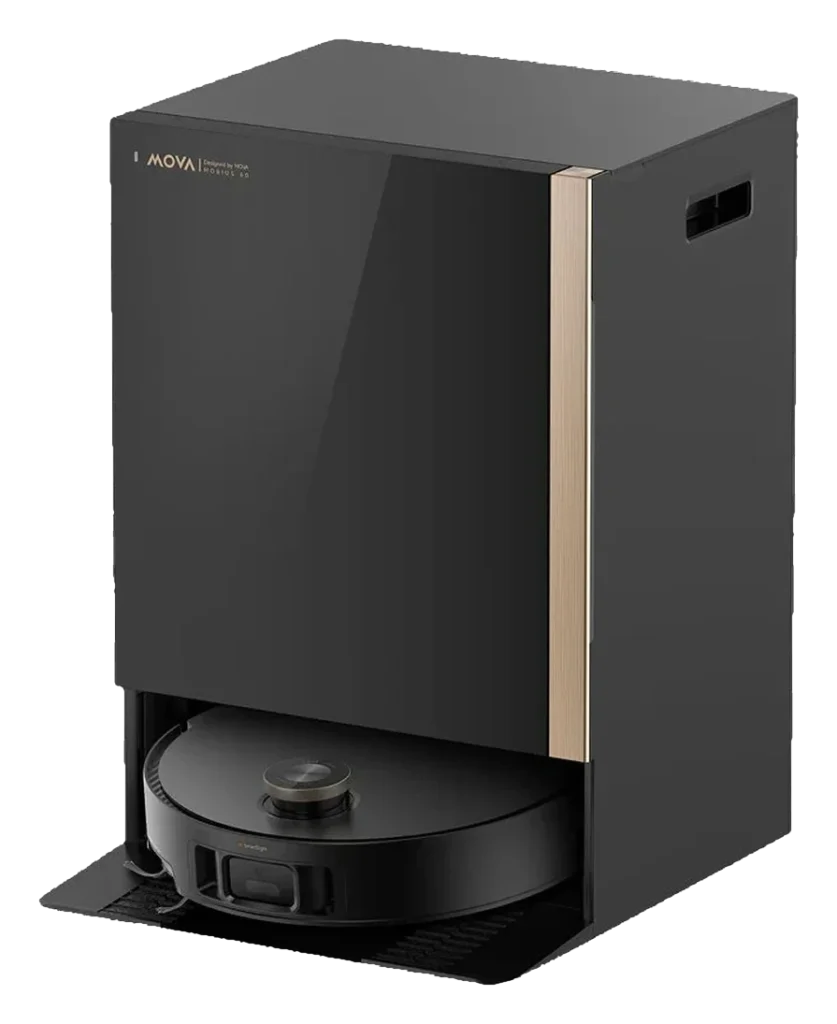
MOVA
Where to buy
Unveiled at CES 2026 with MopSwap interchangeable pad system
Full specifications18 figures on record · 17 differ
Some links earn Robovations a commission. Nothing on this page is ranked by it.
 Z60 Ultra Roller Complete
 Aqua10 Ultra Roller
 Flow 2
 Mobius 60
Clean against upkeep
What each mop design delivers, and what it asks
In one lab's dried-on stain test the two rollers scored highest: 148 for the Z60 and 136 for the Aqua10, against averages near 110. The Mobius 60's spinning pads scored 98 and the Flow 2's track 67.5. Upkeep is close on all four: a new mop every 1 to 3 months and a used-water tank to empty.
Roller
Pressed down at 4,100 Pa. A second fluffing roller works the fibers as it mops.
MOVA product pageRoller10.24 in long
Pressed down at 9 to 11 N. It counter-rotates to keep the fibers fluffed.
Dreame product pageTrack10.5 in wide
A flattened belt mop pressed down at 12 N.
Narwal Flow 2 page2 padsspinning
260 RPM at 12 N. The dock swaps between three pad types, chosen by room.
MOVA product pageTwelve nozzles spray fresh water while a scraper pulls the dirty water off in real time.
MOVA product pageTwelve nozzles and a scraper clean the roller as it goes. Its 100 mL clean tank lasts about 20 to 48 minutes per refill.
Dreame product page and FAQSixteen nozzles spray 140°F water and a scraper wipes the track. On large jobs it also returns to the dock to wash.
Narwal Flow 2 page and manualIt returns to the dock to wash its pads on the interval set in the app, then carries on.
MOVA manual148points
Lab average at the time: 110.
Independent lab, Nov 2025136points
Lab average at the time: 110. It used about half the water the Z60 did.
Independent lab, Nov 202567.5points
Lab average: 108. A tester saw better results at home after a later firmware update.
Independent lab, Jun 202698points
Lab average: 112. It used less water than average. Its ThermoHold pads did about 15% better.
Independent lab, Jan 20260.55in
0.55 in (14 mm). A shield also lowers to keep the carpet dry.
MOVA specifications0.55in
A guard also closes over the roller when carpet is detected.
Dreame product page0.40in
Lifts when its sensors detect carpet.
Narwal Flow 2 page0.41in
0.41 in (10.5 mm). The pads are removable, so it can vacuum carpet with them off.
MOVA specifications$22.90per roller
Every 1 to 3 months, per the manual.
MOVA US store and manual$26.99per roller
Every 1 to 3 months.
Dreame US store$29.99per track
Every 1 to 3 months. Out of stock at Narwal US on 2 Oct 2026.
Narwal US store and FAQ$15.90 to $19.90per pair
Every 1 to 3 months. It works with three pairs, one of each pad type.
MOVA US store and manual4 / 3.5L clean / used
The manual says to empty and rinse the used tank after each use. No plumbing kit in MOVA's US store.
MOVA specifications and manual4 / 3.5L clean / used
No plumbing kit found in Dreame's US store. Its own FAQ gives the clean tank as 4.5 L.
Dreame product page and US storeTanks on the standard dock. Narwal also sells it with an auto refill and drainage system.
Narwal US store5.5 / 4L clean / used
The manual says to empty the used tank after each use. No plumbing kit in MOVA's US store.
MOVA specifications and manualSame on all four: the dock washes the mop with hot water and dries it after the run, and none of the four has a paid plan.
Your home
How each one fits a home like yours
Set the conditions that describe your home. Each robot answers from its own Fit Check; nothing is scored until you choose.
Fit check
Describe your home
Pick what applies. Each robot answers from its own record.
Everything else
Where they land among 255 robot vacuums
Only the measures on which these four differ. The bar is the whole category; the block is the typical middle half; the tick is the median.
Sources
Where every figure comes from
- Z60 Ultra Roller Complete · us.mova.tech product page and store (2 Oct 2026); mova.tech specifications; MOVA user manual (model RLZ83CE-1); Vacuum Wars review (Nov 2025)
- Aqua10 Ultra Roller · dreametech.com product page, specifications, FAQ and US store (2 Oct 2026); Vacuum Wars Z60 review comparing both (Nov 2025)
- Flow 2 · us.narwal.com Flow 2 page, product page, FAQ and store (2 Oct 2026); Narwal Flow 2 user manual (YJCC036); Vacuum Wars review (Jun 2026)
- Mobius 60 · us.mova.tech product page and store (2 Oct 2026); mova.tech specifications; MOVA Mobius 60 user manual (RLV83LE); Vacuum Wars review (Jan 2026)
Maker figures were read on 2 Oct 2026 from each maker's US product page, store and manual. Stain scores come from one independent lab that ran the same dried-on stain test on all four. Each score is shown beside that lab's average at the time.
Questions
What readers ask
Is the MOVA Mobius 60 the same robot as the Z60 Ultra Roller Complete?
No. The Z60 mops with a roller that is rinsed as it moves. The Mobius 60 mops with two spinning pads that are washed at the dock, and its dock swaps between three pad types.
Do any of these work without a water line to the dock?
All four run from tanks in the dock. Narwal also sells the Flow 2 with an auto refill and drainage system. No plumbing kit for the other three was found in Dreame’s or MOVA’s US stores on 2 Oct 2026.
Do spinning pads cost more battery?
One independent lab found the Mobius 60 used a lot of battery washing its pads, because it spins them during the wash and returns to the dock several times a run, depending on settings.
Common questions