
Grillbot
A timer and three spinning brushes. Level I Manual Automation describes the cleaning model: one mechanical motion bounded by a preset time window, with no measurement of how dirty the grate is. A heat sensor stops the motors and alarms above the rated 250°F, which protects the machine and the user but does not change how it cleans. Grate scrubbing is automated. The judgment of when the grate is clean remains with the owner.
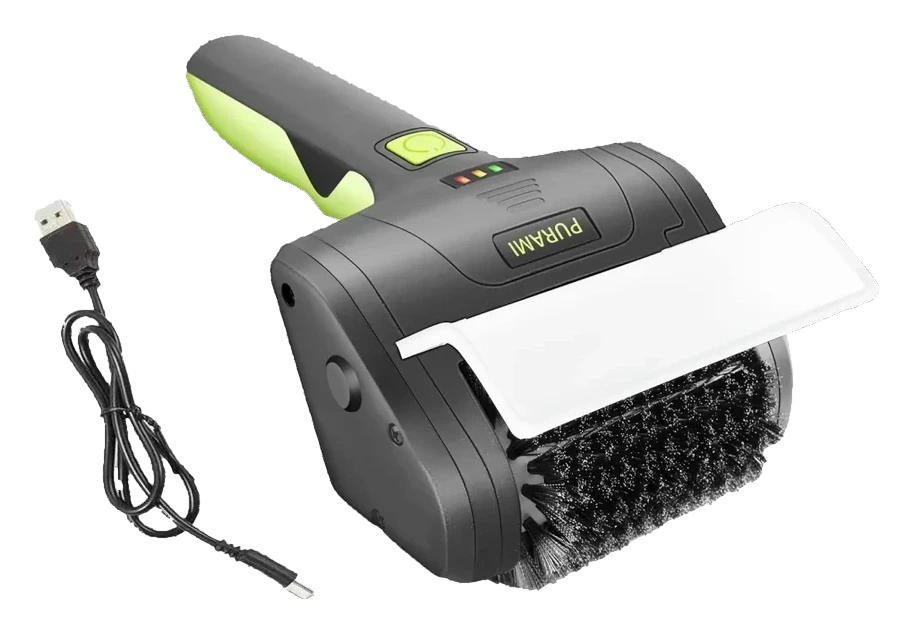
Will the Grillbot fit your application?
Describe your use case using the controls. Each choice reads the spec sheet for you, flagging where the Grillbot is built for your space and where it isn’t.
A classification of fit for the conditions you set, not a recommendation. Verdicts describe engineering design intent, not test results.
Living with it.
Decade-old design with predictable battery and brush wear; no software or firmware to update.
→ Stableowner-reported arc
NiMH battery loses capacity starting in 12-24 months with regular use. Brush-head wear accelerates on charcoal grates. Mechanical simplicity eliminates software-related failures.
Rinse unit and brush heads to remove residue; allow to dry before storage.
Inspect drive wheels and brush motor housing for debris or grease accumulation.
Replace brush heads when wires are flattened, splayed or missing. Grillbot publishes no cycle interval, so wear is judged by looking at the heads. Brass for standard gas; stainless for heavy buildup.
Store the lithium pack partially charged in a cool, dry place and top it up occasionally over the off-season. Do not deep-discharge it before storage.
Replace the battery when it no longer completes a cycle; parts availability depends on manufacturer stock.
$129 to buy, then about $60 a year for the replaceable parts below. Over three years that is roughly $180 past the sticker price. Excludes electricity and any repairs.
- Brush
- BatteryWhere to buy Battery
Replacement cadence from the maintenance schedule; prices shown where the source documents them. Part links may earn a commission and do not influence the classification.
-
CautionNo temperature sensing on grateUnit operates on hot grate; owner must enforce safe cooling temperature
-
CautionSpinning wire brush bristle hazardWorn bristles separate and contaminate food; inspect before use
-
Unsupervised operation off-grate riskUnit can travel to grill edge; confirm lid open and unit confined before start
The full spec sheet.
Priced below the category median, with every figure charted against the category below.
- FootprintThe width, depth and height of the robot itself, without its dock.
- 8.27 in dia · 3.94 in tall
- WeightThe robot alone, without its dock, as the maker states it.
- 2.73 lbs
- BatteryStored energy in watt-hours; a larger pack runs longer, not harder.
- 10.4 Wh · Li-ion
Mechanical bounce-pattern only; no sensors or onboard positioning.
Position shows where the figure sits across the tracked category, not a quality judgment.
How the assessment has moved.
Every announcement, release and reassessment behind the current classification.
-
Aug 2026 · AssessmentRobovations Score rescored under v4.2: 60 → 53
-
Jul 2026 · AssessmentRobovations Score recorded at 60 of 100
-
Jan 2016 · ReleaseDebuts nylon brush option and global sales milestone at CES 2016
-
Jan 2014 · ReleaseGrill-cleaning robot debuts at CES 2014 as first of its kind
What people actually ask.
OperationDoes the Grillbot have any sensors for temperature or dirt detection?
OwnershipHow long before brush heads need replacement?
OperationHow does the battery hold up over multiple years?
OperationIs it safe to use on a warm or hot grill?
CompatibilityDoes the Grillbot require Wi-Fi, an app, or an account?
OperationHow does it change direction if it has no navigation sensors?
OperationWhy Autonomy Level I if it is marketed as a robot?
 I
I
Yukai Engineering Qoobo
 I
I
Ropet KAMOMO
 I
I
Moflin
 I
I
SwitchBot Bot
Where it's sold
We may earn commission from qualifying purchases. This does not influence classification.
We are no longer finding a current new-stock listing for this robot. Remaining offers may be used, refurbished, or third-party — confirm the condition and price on the retailer’s page before buying.
Reference the Grillbot classification.
Embed the Autonomy Ladder™ mark or copy the citation. The mark is served from this record, so a reassessment updates it on your page automatically.
Get the embed code and citation
Scale proportionally only, up to 2× (536px wide)(224px wide). No recolouring, cropping, rotating, or re-typesetting.
Robovations. "Grillbot: Autonomy Level I (Manual Automation)." Autonomy Ladder™, assessed August 2026. https://robovations.com/robots/grillbot/
- Link it. The mark must point at this record. An unlinked mark is not authorised.
- Hot-link it. Never download, self-host, or re-upload the image. A saved copy stops updating, and a mark that has stopped updating is a claim we no longer stand behind.
- A classification, not an endorsement. It may not appear beside language implying Robovations recommends, rates, or approves the product.