Review: Worx Landroid M 20V
Evaluating: Worx Landroid M 20V

 Autonomy grade based on our classification methodology.
Structured review — not a purchase recommendation.
The Worx Landroid M 20V provides effective automated mowing for lawns up to 1/4 acre, with user-friendly app control and advanced navigation features. It excels in maintaining lawn appearance but may face challenges in complex layouts or with connectivity. Regular maintenance and occasional manual assistance are necessary to address these limitations. Key strength: Effective automated mowing for lawns up to 1/4 acre. Key concern: May struggle with complex yard layouts and obstacles. Scored 73/100, tracked at Autonomy Level 2 (Assisted Autonomy) by Robovations.
Review Summary
Based on published evidence and our classification methodology.
- Effective automated mowing for lawns up to 1/4 acre
- App control with Bluetooth and Wi-Fi connectivity
- Advanced navigation through narrow passages with AIA technology
- Compatible with Worx Power Share battery system
- May struggle with complex yard layouts and obstacles
- Connectivity issues can affect app control and scheduling
- Requires boundary wire installation and maintenance
- Occasional manual intervention needed for optimal performance
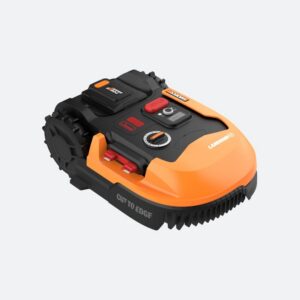
The Worx Landroid M 20V is designed to automate lawn maintenance for areas up to 1/4 acre. Equipped with a 20V 4.0Ah battery, it integrates with the Worx Power Share platform, allowing battery compatibility across various Worx tools. The mower features a cutting width of 8 inches and offers adjustable cutting heights ranging from 1.5 to 3.5 inches. Its patented AIA (Artificial Intelligence Algorithm) technology enables navigation through narrow passages, and the floating blade disc adapts to uneven terrain to prevent getting stuck. Users can control and schedule mowing sessions via the Landroid app, which connects through Bluetooth and Wi-Fi.
In our evaluation, the Landroid M 20V demonstrates proficiency in maintaining lawn appearance through regular mowing cycles. The offset blade design allows for cutting close to edges, reducing the need for additional trimming. However, owner reports indicate that the mower may struggle with complex yard layouts, particularly those with multiple obstacles or intricate boundaries. Some users have experienced issues with the mower getting stuck or failing to cover the entire lawn, necessitating manual intervention. Connectivity problems with the app and Wi-Fi have also been noted, affecting remote control and scheduling capabilities.
This robotic mower is well-suited for homeowners with relatively simple, flat lawns who desire an automated mowing solution. It effectively handles routine mowing tasks and integrates seamlessly with the Worx ecosystem. Prospective buyers with more complex yard layouts or those requiring consistent remote connectivity should be aware of potential limitations and may need to provide occasional manual assistance.
Autonomy Ladder™ Classification
Assigned using the Autonomy Ladder based on observed performance.
Assisted AutonomyJustification
The Landroid M 20V operates autonomously within defined boundaries and can be scheduled via the app. However, it may require periodic human intervention for issues like getting stuck or connectivity problems, placing it at Level 3 (Conditional Autonomy).
Observed Limitations
- Cannot handle complex yard layouts without manual intervention
- May struggle with slopes or uneven terrain
- Requires boundary wire installation and maintenance
- Connectivity issues can impede remote control and scheduling
Human Readiness Criteria
How ready this robot is for everyday home use — based on reliability, safety, and ease of ownership.
Ready Now
Proven autonomous performance, reliable, and available for purchase.
Our Assessment
The Worx Landroid M 20V is currently available and offers a reliable solution for automated lawn maintenance in suitable environments. While it performs well in simple, flat lawns, users with complex yard layouts or connectivity concerns should be prepared for potential manual interventions. Regular maintenance is essential to ensure consistent performance and longevity.
Ideal For
- Homeowners with simple, flat lawns up to 1/4 acre seeking automation
- Users already invested in the Worx Power Share ecosystem
- Individuals comfortable with initial setup and periodic maintenance
- Those looking to reduce time spent on routine lawn mowing
Not Recommended For
- Owners of complex yards with multiple obstacles or intricate boundaries
- Users with steep or uneven terrain exceeding the mower’s capabilities
- Individuals expecting completely hands-off operation without occasional manual intervention
- Those without reliable Wi-Fi coverage in the mowing area
Best For
- Maintaining consistently short grass through frequent, automated mowing
- Reducing the need for manual lawn mowing in straightforward yard layouts
- Integrating with other Worx 20V tools for battery sharing
Robovations Score
An overall reliability and capability score based on our published methodology. Not a recommendation.
Score Breakdown
-
Autonomy (30%)65
-
Reliability (25%)70
-
Maintenance (15%)75
-
Value (15%)80
-
Privacy (15%)85
Reliability & Maintenance
Long-term stability and the effort required to maintain it.
Reliability Over Time
Long-term owner reports suggest that the Landroid M 20V maintains consistent performance with regular maintenance. However, issues such as boundary wire breaks and connectivity problems can arise, requiring user attention. The battery life remains stable over time, but blade wear necessitates periodic replacement to ensure optimal cutting performance.
Maintenance Burden
| Every Run |
|
| Weekly |
|
| Monthly |
|
| Seasonally |
|
| Yearly |
|
| As Needed |
|
Failure Modes & Recovery
Where the robot struggles — and how it recovers.
- Stuck on obstacles: The mower may become stuck on uneven terrain or objects left on the lawn, requiring manual intervention
- Boundary wire issues: Breaks or disconnections in the boundary wire can cause the mower to malfunction or stop operating
- Connectivity problems: Wi-Fi or Bluetooth connectivity issues can impede app control and scheduling
- Incomplete coverage: Complex yard layouts may result in the mower missing certain areas, necessitating manual trimming
- Battery depletion: If the mower cannot return to the charging station due to obstacles, it may run out of battery and stop operating
- Obstacle detection: The mower attempts to navigate around obstacles but may require manual assistance if unable to proceed
- Boundary wire errors: Alerts the user via the app if there is a boundary wire issue, prompting inspection and repair
- Low battery return: Automatically returns to the charging station when the battery is low, provided the path is clear
- Rain detection: Returns to the charging station during rain to protect the mower and lawn
Safety & Misuse Risk
Safety observations and potential misuse risks identified during testing.
- Ensure boundary wires are properly installed to prevent the mower from entering restricted areas
- Keep the mowing area clear of toys, tools, and other objects to prevent damage or injury
- Supervise the mower during initial runs to identify potential hazards or areas where it may get stuck
- Regularly inspect blades for wear and replace as needed to maintain safe operation
- Improper boundary wire setup may lead to the mower entering unintended areas
- Leaving small objects on the lawn can result in damage to both the mower and the objects
- Operating the mower on steep slopes beyond its capability can cause it to tip over or get stuck
- Neglecting regular maintenance may lead to decreased performance or safety hazards
Sidebar
Reviewed Product
Evidence Chain
All content connected to this record.
- Worx Landroid M 20V Feb 22, 2026