Review: Mammotion Yuka 2000
Evaluating: Mammotion Yuka 2000

 Autonomy grade based on our classification methodology.
Structured review — not a purchase recommendation.
The Mammotion Yuka 2000 provides efficient, perimeter wire-free lawn maintenance with AI-assisted mapping and optional leaf collection. Manual cutting height adjustments and potential setup challenges may require user intervention. Regular maintenance is essential for sustained performance. Key strength: Perimeter wire-free operation simplifies setup and lawn mapping. Key concern: Manual cutting height adjustment may be inconvenient for some users. Scored 79/100, tracked at Autonomy Level 3 (Conditional Autonomy) by Robovations.
Review Summary
Based on published evidence and our classification methodology.
- Perimeter wire-free operation simplifies setup and lawn mapping
- Optional sweeper kit enhances functionality by collecting leaves and debris
- AI-assisted mapping and obstacle avoidance improve navigation efficiency
- Manual cutting height adjustment may be inconvenient for some users
- Initial setup and mapping can be challenging, requiring user intervention
- Regular maintenance, including blade replacement and cleaning, is necessary to maintain performance
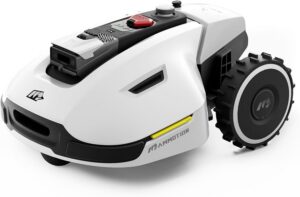
The Mammotion Yuka 2000 is designed to automate lawn maintenance for areas up to 0.5 acres, eliminating the need for perimeter wires through its UltraSense AI Vision system. This technology enables automatic lawn mapping and precise obstacle avoidance, streamlining the mowing process. Additionally, the optional sweeper kit allows the Yuka 2000 to collect leaves and debris, further enhancing its utility.
In our evaluation, the Yuka 2000 demonstrated efficient navigation and consistent mowing patterns, thanks to its intelligent route planning and dual floating cutting discs. The AI-assisted mapping effectively identified lawn boundaries and obstacles, reducing manual intervention. However, the cutting height adjustment is manual, requiring users to set it via a rotary wheel, which may be inconvenient for those preferring automated settings. Some users have reported challenges during the initial setup, particularly with app connectivity and mapping accuracy, indicating a learning curve for optimal operation.
Overall, the Yuka 2000 is well-suited for homeowners with medium-sized lawns who are comfortable with technology and seek to automate their lawn care routine. Prospective buyers should be prepared for manual cutting height adjustments and potential setup complexities. Regular maintenance, such as blade replacement and cleaning, is necessary to ensure optimal performance.
Autonomy Ladder™ Classification
Assigned using the Autonomy Ladder based on observed performance.
Conditional AutonomyJustification
The Yuka 2000 autonomously maps the lawn, navigates obstacles, and performs scheduled mowing tasks. However, it requires manual cutting height adjustments and periodic maintenance, indicating Level 3 autonomy.
Observed Limitations
- Manual cutting height adjustment
- Initial setup and mapping require user intervention
- Regular maintenance tasks such as blade replacement and cleaning
Human Readiness Criteria
How ready this robot is for everyday home use — based on reliability, safety, and ease of ownership.
Ready Now
Proven autonomous performance, reliable, and available for purchase.
Our Assessment
The Yuka 2000 is currently available and offers a range of features suitable for automating lawn maintenance. While it requires manual cutting height adjustments and regular maintenance, its AI-assisted mapping and obstacle avoidance provide efficient operation for medium-sized lawns. Users should be prepared for potential setup challenges and ongoing upkeep to ensure optimal performance.
Ideal For
- Homeowners with medium-sized lawns up to 0.5 acres
- Individuals comfortable with technology and app-based controls
- Users seeking automation in lawn mowing and leaf collection
- Those willing to perform regular maintenance tasks
Not Recommended For
- Individuals with large lawns exceeding 0.5 acres
- Users preferring fully automated systems without manual adjustments
- Those unwilling to engage in regular maintenance
- Homeowners with complex lawn layouts that may complicate mapping
Best For
- Automating lawn mowing and leaf collection for medium-sized lawns
- Users seeking perimeter wire-free operation
- Homeowners desiring app-controlled scheduling and monitoring
Robovations Score
An overall reliability and capability score based on our published methodology. Not a recommendation.
Score Breakdown
-
Autonomy (30%)85
-
Reliability (25%)80
-
Maintenance (15%)70
-
Value (15%)75
-
Privacy (15%)80
Reliability & Maintenance
Long-term stability and the effort required to maintain it.
Reliability Over Time
Long-term user reports indicate consistent performance with regular maintenance. However, some users have experienced challenges during initial setup and mapping, which may affect reliability if not properly addressed.
Maintenance Burden
| Every Run |
|
| Weekly |
|
| Monthly |
|
| Seasonally |
|
| Yearly |
|
Failure Modes & Recovery
Where the robot struggles — and how it recovers.
- Setup Challenges: Users have reported difficulties during initial setup, particularly with app connectivity and accurate mapping.
- Manual Adjustments: The need for manual cutting height adjustments may be inconvenient for users expecting fully automated operation.
- Maintenance Requirements: Regular blade replacements and cleaning are necessary to maintain optimal performance.
- Obstacle Detection: The AI Vision system identifies and navigates around obstacles, resuming the planned mowing path afterward.
- Boundary Adherence: Operates within virtual boundaries to prevent mowing outside designated areas.
- Weather Adaptation: Designed to operate in various weather conditions, though performance may vary in extreme situations.
Safety & Misuse Risk
Safety observations and potential misuse risks identified during testing.
- Equipped with AI Vision for obstacle detection to avoid collisions
- Automatic shutdown upon lifting to prevent blade exposure
- Operates within virtual boundaries to prevent unintended areas from being mowed
- Weather-resistant design allows operation in various conditions
- Improper setup may lead to inaccurate mapping and mowing outside desired areas
- Failure to perform regular maintenance can result in decreased performance or damage
- Manual cutting height adjustments, if set incorrectly, may scalp the lawn or leave it too long
Sidebar
Reviewed Product
Evidence Chain
All content connected to this record.
- Mammotion Yuka 2000 Feb 22, 2026