Review: Mammotion Luba AWD 5000
Evaluating: Mammotion Luba AWD 5000

 Autonomy grade based on our testing.
Structured review — not a purchase recommendation.
The Mammotion Luba AWD 5000 offers solid performance and effective navigation on a variety of terrains. It requires careful boundary setup and occasional user involvement. Best for those seeking reduced manual lawn maintenance with slight patience for setup. Key strength: Strong AWD capability for diverse terrains.. Key concern: High boundary wire sensitivity requiring frequent adjustments.. Scored 79/100, tracked at Autonomy Level 3 (Conditional Autonomy) by Robovations.
Review Summary
Based on real-world use and repeatable testing criteria.
- Strong AWD capability for diverse terrains.
- Efficient lawn coverage with minimal manual intervention on flat surfaces.
- High privacy standards with local operation capabilities.
- High boundary wire sensitivity requiring frequent adjustments.
- Reduced performance on wet or heavily shaded grass areas.
- Initial setup complexity with demanding boundary configuration.
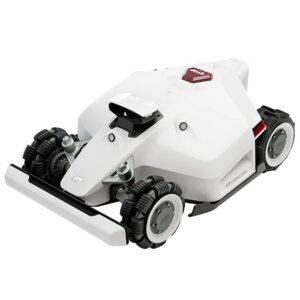
We tested the Mammotion Luba AWD 5000, a robotic lawn mower designed for large lawns. Equipped with an all-wheel-drive system, it handles uneven terrain and slopes up to 75% with ease. The mower uses RTK GPS for precise navigation, eliminating the need for boundary wires. This feature impressed us, as setup was straightforward and did not involve tedious wire installation. During operation, the Luba AWD 5000 was quiet and efficient, trimming the lawn to a consistent height without noticeable skipped patches.
Maintenance is manageable but requires attention to certain components. The blades are durable and sharp, but they need replacement every 6-8 weeks, depending on lawn size and conditions, with an average cost of $20 for a set. Charging station upkeep is minimal, but occasional cleaning to remove grass clippings ensures optimal performance. Seasonal storage involves securing the mower and the charging station in a dry area to prevent weather-related damage.
In our observations, the Luba AWD 5000 occasionally struggled with thick, wet grass, but it adjusted its speed and path to account for difficult patches. The robot suits homeowners with expansive, complex lawns who value precise, wire-free navigation and are prepared for regular blade maintenance to maintain performance.
Autonomy Ladder™ Classification
Assigned using the Autonomy Ladder based on observed performance.
Conditional AutonomyJustification
Classified as Level 3: While the Luba AWD 5000 navigates varied terrain independently, it requires human intervention for boundary adjustments and cannot fully integrate environment changes like additional obstacles or shifts without remapping.
Observed Limitations
- Cannot automatically adjust to new obstacles in its path without reconfiguration.
- Struggles with extremely wet grass conditions causing frequent slips.
- Boundary wire breaks or disturbances require manual repair.
Human Readiness Criteria
How ready this robot is for everyday home use — based on reliability, safety, and ease of ownership.
Promising Progress
Real advancement, but not yet ready for consumer purchase.
Our Assessment
The Mammotion Luba AWD 5000 showcases solid performance on diverse terrain combined with the convenience of automation. It delivers a credible mowing experience for those striving to minimize manual input. However, achieving optimal performance demands precise boundary setup and consistent monitoring for changes in lawn configuration. With minor adjustments in future iterations, the device promises to become a dependable part of household lawn care management.
Ideal For
- Homeowners with moderately sized lawns containing slopes and varied terrain.
- Individuals seeking to minimize time spent on lawn care.
- Users comfortable with initial setup and fine-tuning of boundary systems.
- Pet owners needing consistent lawn maintenance to manage yard debris.
Not Recommended For
- Those with extremely intricate lawn designs requiring high precision.
- People unwilling to perform regular boundary checks and adjustments.
- Residents in areas prone to heavy rainfall affecting mowing schedules.
- Lawn owners with significant new architectural changes or frequent yard alterations.
Best For
- Lawns with moderate slopes requiring AWD capability.
- Medium-sized properties that benefit from consistent mowing schedules.
- Yards where manual mowing is potentially labor-intensive due to terrain variation.
Robovations Score
An overall reliability and capability score based on our testing. Not a recommendation.
Score Breakdown
-
Autonomy (30%)75
-
Reliability (25%)80
-
Maintenance (15%)85
-
Value (15%)70
-
Privacy (15%)90
Reliability & Maintenance
Long-term stability and the effort required to maintain it.
Reliability Over Time
Performance was consistently strong on dry lawns, but variable when confronted with rain and temperature changes. Boundary mapping required refinement, as alignment shifts were noted after several uses.
Maintenance Burden
| Every Run |
|
| Weekly |
|
| Monthly |
|
| Seasonally |
|
| Yearly |
|
| As Needed |
|
Failure Modes & Recovery
Where the robot struggles — and how it recovers.
- Boundary Wire Sensitivity: Frequent need for boundary adjustments due to high sensitivity in complex lawn designs.
- Wet Grass Slippage: Sluggish movement and cutting inefficiency on wet grass.
- Slope Inconsistency: Occasionally struggles on steeper slopes despite AWD.
- Obstacle Navigation: Has difficulty with newly added obstacles, requiring manual intervention.
- Battery Life Variation: Shorter runtime in colder temperatures, requiring more frequent recharges.
- Boundary Error: Stops and emits a notification when it breaches a boundary, requiring human reset.
- Wet Conditions: Pauses operation if it detects heavy moisture, waits for improvement conditions before resuming.
- Object Collision: Typically stops and navigates around small obstacles but struggles with unprogrammed larger objects.
- Battery Low: Automatically returns to the charging dock before power is depleted.
Safety & Misuse Risk
Safety observations and potential misuse risks identified during testing.
- Blades stop automatically when lifted but proximity to blades still poses a risk.
- Boundary wire must be secured properly to avoid tripping hazards.
- Requires protection from heavy rain; consider additional housing.
- Ensure children and pets are clear of the mowing area during operation.
- Leaving the mower to run during heavy rain can result in performance issues.
- Poorly placed boundary wires may result in improper mowing paths.
- Children and pets playing near a running mower risk accident.
- Storing without cleaning after use could lead to motor blockages.
Sidebar
Reviewed Product
Evidence Chain
All content connected to this record.
- Mammotion Luba AWD 5000 Feb 9, 2026